

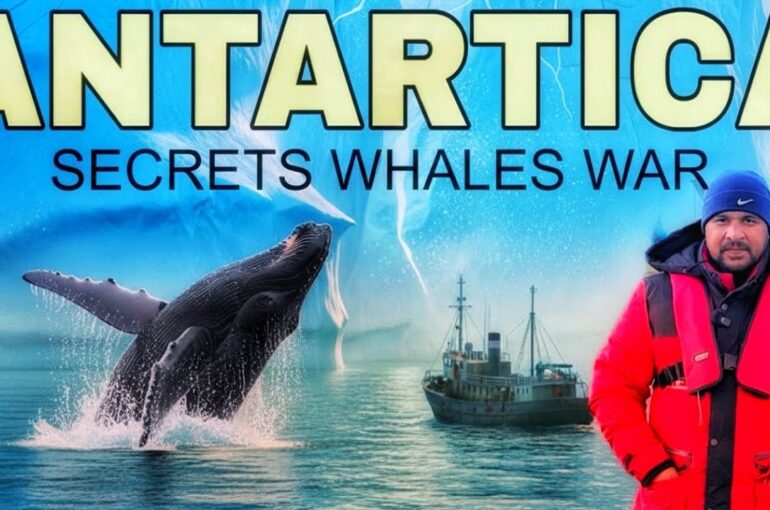
Antarctica’s Secrets: Whales War || Great Survival Story || Pole To Pole Ep.6
Graveyard of Free Spirits… and here comes the baby seal.
I always say in my life that if there is a leader, it should be like them.
Whales were hunted to the point of death.
This is the southernmost church in the world.
Now humans no longer control this place. Nature and animals have taken it back.
This place has also been cleaned thoroughly so that no seed sticks to it and travels further.
Hello friends, welcome once again to my new video.
We have now reached South Georgia.
In the last video, you saw that we had already entered South Georgia. South Georgia Island is a small island that is known as the Gateway to Antarctica.
Now our Zodiac boat will take us down to land. But before that, there will be extremely strict checking here—especially for biosecurity reasons. Not a single grain, seed, or even a tiny sand particle is allowed to go down to the island.
Because of this, there are scientists and officials here whose job is to check us properly. Anyone can be randomly checked. Before that, the cruise staff will clean everything thoroughly, and only then will we be allowed to proceed.
Before heading down, I want to tell you that in this video we are going to hear two historical stories. This place is deeply historical—dangerous, and you could even say soaked in blood.
Two names come up in this story:
- Whaling
- The Boss of Antarctica – Sir Shackleton
Sir Shackleton had a dream of seeing Antarctica, crossing it, and living that dream. It was extremely dangerous, and his grave is here.
Before starting the story, let me take you along with my vlog to the cleaning area, and then we’ll board the Zodiac to move forward.
What you see ahead is the research centre, and you can call this the capital of this land. This is the main settlement here.
Everyone has been cleaned and cleared. Now look—each and every item is checked carefully. Every single thing is inspected.
There is light snowfall happening.
Alright, we are now ready to leave. The Zodiac is waiting for us.
Once again, the shoes have been cleaned. Now we stand in line and wait.
Let me tell you something interesting—the South Georgia visa fee.
Even though I already have a UK visa, I still had to pay ₹25,000 to enter South Georgia.
Only 3,000 people per year are allowed to visit this island.
The fee per person is 200 British Pounds, and British currency is used here.
It is an e-visa, applied online. You have to enter:
- Your vessel number
- Cruise details
- Travel dates
Only 25–30 people live here, and they are seasonal residents. There is no airport here. The nearest place is the Falkland Islands, about 1,400 km away.
Around 75% of South Georgia is covered with glaciers, and only 25% is land. Ships cannot dock easily, which is why air travel is impossible. The only way to reach here is by ship.
To protect biodiversity, the UK government limits visitors and charges high fees. Only long Antarctic cruises (around 22 days) are allowed to stop here. Short cruises are not permitted.
Every person is assigned a number. Entry and exit are recorded so that no one is left behind.
Government officers from South Georgia have boarded our ship. They inspected everything to ensure nothing harmful to biodiversity was present.
I have never seen such strict biosecurity—not even in New Zealand or Australia. Shoes were checked four times. Gloves, tripods, bags—everything was cleaned so no seed could travel further.
Now we put on gloves and move ahead.
Old abandoned ships are standing here—remnants from the whaling era. Over time, these ships will rust and merge back into the ocean.
Welcome to the only town of South Georgia – Grytviken.
“Gryt” means pot, and “Viken” means bay. The name was given by Norwegians because whale oil was processed and stored here in large pots.
These emergency bags are kept here in case of accidents. A doctor is always present with us for emergencies.
During the whaling era, around 100 whaling stations existed across the island.
The ground where I am standing once had blood flowing through it—literally. Between 1900 and 1960, around 175,000 to 200,000 whales were killed here. Seals and other animals were killed in uncountable numbers.
But nature has reclaimed this land. Humans no longer control it. Animals rule again.
In front of me is a large museum, and behind it is the whaling station.
Two British ships are standing here. They were built in the early 1900s and used during World War I for patrol duties in the North Sea. Later, they were sold to Norwegian owners and used for whaling until 1964.
In 1965, a treaty was signed that stopped whaling. Since then, these ships have remained abandoned.
Now we will explore every part of this historic place.
Slowly, we move towards them. First, let me show you something—at some places, even today, you can still see red stains, despite the snow outside. Look here. These are whale teeth. These are heads, these are vertebrae. These are original. We are not allowed to touch anything here. Touching is strictly prohibited, because everything here is soaked in blood.
Now let us go back. They have created a museum here. What they have done is this—two to three thousand people visit this place, they collect money from them, and with that money they have built this museum. Elephant seals were also killed here. Elephant seals were hunted because they weigh up to 4,000 kilograms and produce a large amount of oil, which was used extensively.
Look at this—this is the central mast of a ship. And these were cutters. These were used to cut whales. Incredible. Huge machines were installed, and the whales were cut using them.
Now let me show you something else. At first glance, this looks like a cannon, but it is not a cannon. A Norwegian man discovered this tool. What they used to do was attach a sharp projectile at the front and fire it into the whale to kill it. Once the whale was dead, hooks were attached, and the whale was dragged back to the ship. That was the process of whaling. After that, the whale was pulled up and oil was extracted from it.
Even today, you can still smell the oil here. Reaching this place is difficult, but listening to its history is even more disturbing. The first person who discovered this place was a Norwegian sailor. He was the one who started the first whaling station here.
Now you might ask—why did they choose to kill whales here? There was a very big reason. The waters around Antarctica are extremely pure. The ice here is original and untouched. These waters contain a large amount of minerals and nutrients needed by marine life. Because of this, animals here grew larger, healthier, and their population increased rapidly. That is why there were so many whales and seals here. People chose this place so they could extract oil and other resources and take them away.
Friends, in the 16th and 17th centuries, oil was not easily available. Some Europeans discovered that oil could be extracted from fish, and that this oil burned for a long time. They began using it to light their homes. In the 18th and 19th centuries, Europeans developed a hunger—for money and fame. They wanted to explore the world, loot resources, establish themselves, and earn maximum wealth. That is why they spread across the globe. They were not travelling for discovery alone, but largely for profit.
Now we have reached the museum. Let me show it to you.
“What are you doing, Sachin bhai?”
“Sending postcards.”
“How much does it cost?”
“One pound per card.”
The post office is just behind this place.
At the top, you can see Albatrosses. Look how large they were—around 3.5 metres long, not even fitting into the frame.
This is Sir Ernest Henry Shackleton—the Boss of Antarctica. He taught leadership and how to live life. This was his route: he left London, came here, then went to the Cape of Good Hope, then to South Georgia, then to Rio, then Cape Verde, and finally back to London. He came here three to four times. He passed away on South Georgia Island. His last ship was the Quest, which arrived in 1917. The Endurance was the ship that got trapped and broke apart, leaving them stranded.
All the dogs were kept on the upper deck. Horses and dogs stayed above. This was the emergency boat they travelled in. After the ship broke, this became part of their journey. This is his funeral banner. A London newspaper headline read: “Boss leaves his ship for the last time.”
Here, it says “Please touch.” Normally, it says “Do not touch.” The seal skin is incredibly soft. Inside, there is a souvenir shop where you can buy items. There is also a post office from where you can send postcards. The mail goes to the UK during the season and then to your country.
Now we are behind, near the Maritime Gallery. This was used for signalling. These were their original clothes—imagine how strong they must have been. They had to wear full animal skins.
Compare today’s emergency boats with these older ones. Earlier, people sat inside with supplies, and the boat was covered to prevent snow from entering. Today’s lifeboats are completely different.
Now let me explain how whaling was done. They travelled all the way from Europe to this remote corner of the world. First, they searched for whales using sound instruments, as whales have specific sound frequencies. In the beginning, they used spears—20, 50, even 100 times—but whales would not die because they were as large as ships. Then they developed a gun called a harpoon gun. They targeted a specific angle to kill the whale instantly. Hooks were attached, and the whale was dragged behind the boat and lifted onto the ship.
Whaling was never an easy task. The whale was cleaned and cut here. Blood was collected, parts were separated, crushed, and rolled inside using rollers. These were called flensing wheels, and the workers were called flensers. The oil was then boiled in furnaces and prepared.
Gradually, whaling stations grew larger. Eventually, there were nearly 100 whaling stations across South Georgia Island, but this was the main one.
Now I am walking through the snow. This place is abandoned now. Nature has reclaimed it. Animals have returned. After seeing human cruelty, you realise humans can go to any extreme.
They used whale oil even to run machines—no petrol or diesel. Around 30 whales were processed daily. One whale alone could fill a 200-yard plot of land. Massive tanks were built to store oil. Whale oil was used for soap, lubrication, lamps, and fuel. Baleen was used to make brushes. Meat was sent to Europe and Japan. Bones were used to make fertilisers.
Now I have reached the church. The bells are ringing. Snowfall has increased. This is the church of Grytviken, built in 1913. The first whaling station was built in 1904. This is a Norwegian church and the southernmost church in the world. Weddings, funerals, cinema, and all cultural activities took place here.
Inside, everything is wooden. Heating was done using whale oil. This is where Shackleton’s body was kept. In 1922, when he passed away, nearly 100 sailors attended his funeral.
There is also a football ground here. Sailors from Europe played football. Wherever humans go, they try to find happiness. Sorrows are everywhere, but we must find joy in small moments.
You can still see wildlife here. Seals roam freely. Once they were hunted; now they are kings again.
There is a working post office here. Letters are dispatched daily. There is also a small shop selling South Georgia chocolates, stamps, and postcards. Unfortunately, we forgot our wallets on the cruise, so we couldn’t buy anything.
This was the accommodation area—400 people lived here in summer and around 90 in winter for maintenance. Winds here can reach speeds of 150 km/h.
Look at this bird—it hasn’t moved because it has laid eggs. Its partner has arrived. The temperature is around zero, yet rivers of meltwater flow into the sea.
Now we are heading towards the grave of a leader I deeply admire—someone who defined leadership.
This is a government vehicle—Toyota Hilux. Nature will soon reclaim everything here.
An elephant seal is resting here—around 2,000 kilograms in weight and nearly 15 feet long. It can run at 40 km/h.
As we walk, let me tell you a story from 150 years ago. In Ireland, a boy was born. At 16, he told his family he would not follow the expected path. He joined the Merchant Navy at just 16 years old. His mission—Antarctica. At that age, I was in 11th class. I had only heard of Antarctica. He joined Captain Scott and began his journey.
From the island, he reaches London. From London, a ship departs. While working as a helper on that ship, he reaches South Georgia—where I am right now. From here, a mission begins: to find the southernmost point of Antarctica, the final point, what we can call the 90-degree point.
Captain Scott, the 16-year-old boy, and one more companion—all three of them together manage to reach up to 82°. Right now, South Georgia, where we are standing, lies at only 56°. Travelling from 56° to 82° in those days was almost impossible. The weather was extremely harsh. Still, through sheer determination, they reached 82°. But the captain decided they must turn back because winter was approaching.
They returned, but inside that young boy’s heart remained a deep longing. He wanted to see the Southern Point. He wanted to see the last point of Antarctica. He wanted to reach the zero point of Antarctica.
After coming back, he worked for some time, arranged resources from different places, and then set out again. This was his second attempt. This time, he reached up to 88°. He was only about 150–170 kilometres away. Winter was about to begin. Keeping his team’s safety in mind—because he was not travelling alone—he turned back again and returned to his country.
Then came the main attempt. He named the mission Endurance. He selected 27 people, took dogs along, and arranged a large ship. Raising 3,000 pounds at that time was equivalent to several million pounds today. With 27 chosen men, he set out again.
This time, his goal was different. Someone had already reached the South Pole, so he decided to do something unique. His plan was to walk across Antarctica—from one end to the other—on foot. With this vision, he left South Georgia with his full team on a new mission.
But as they say, no one knows what will happen where and when. As soon as they reached near the Antarctic Peninsula, their ship got trapped in a storm, became stuck in ice, and eventually broke apart. He then moved his entire team and the dogs onto an iceberg.
What Sir Shackleton did next is something almost no one else has ever done. From Elephant Island, he travelled 1,400 kilometres to South Georgia in a small boat with just two companions—and saved his entire team. The entire rescue process took nearly two years. After rescuing everyone, he returned to the UK.
But even then, a longing remained inside him—to complete the mission he had started. To fulfil that dream, he once again travelled from England to South Georgia. But as soon as he arrived here, tragedy struck. He suffered a heart attack and passed away.
So finally, I have reached the cemetery. You can call it a graveyard or cemetery—64 people have been buried here so far. The grave of Sir Ernest Shackleton is at the back of the cemetery. He was buried here on 6 March 1922.
There is a tradition here. Every sailor or visitor who comes pays respect by raising a toast at his grave. Our ship’s crew is performing a small ceremony. The ship’s captain pours alcohol as an offering. Red wine is being poured today. These are our crew members, raising the toast. Alcohol is being served to everyone, and they will cheer and drink.
As for us, we will simply fold our hands and offer our respects. We don’t have the courage to toast. They even gave us a cup—but with juice. This is the exact place where he was buried on 6 March 1922. He was born on 15 February 1874, and he passed away on 5 March 1922.
Being an explorer is not the biggest achievement. His greatest quality was his leadership. True leadership is not found in everyone—you have to put yourself on the line. And he did exactly that. For 14 days, he travelled 1,400 kilometres through storms in a tiny boat meant for only three people.
From Elephant Island to South Georgia—this journey itself feels impossible. Even today, with our large ship, reaching Elephant Island will be extremely difficult. And he managed it with just three men. During those 14 days, they only saw sunlight for two or three days, and it was because of those brief moments of sunlight that they could navigate. Without sunlight, finding direction in the ocean is almost impossible.
We salute such a great soul. He was incredibly dedicated and fiercely determined. He wanted to come here again for a new adventure. Even though he developed heart problems earlier in Brazil, he still insisted on coming to South Georgia. Sadly, within three or four days of arriving, he suffered a heart attack and passed away.
In this video, we tried to show many things. I will share Sir Shackleton’s full story in detail again later.
Now I am back on the cruise. My camera stopped working earlier. I have two phones—both shut down completely. The batteries drained 100% within two hours because of the extreme cold. iPhones drain very quickly in such temperatures.
After lunch, we will again disembark from the ship. The best thing about this cruise is that they keep allowing us to step onto land again and again to explore. Even in such cold conditions, I am truly enjoying this journey.
Our dog, Dhanno, is resting in the lower section—we won’t wake her. There is a barbecue being prepared today. It’s not useful for us, but the smell is drifting through the air.
Now we say goodbye to this place. This area ahead is a research centre, and entry is not allowed. Our boat will now leave this bay and move to another one, where we will disembark again and explore.
Let’s go inside once more and eat something. Everything else is fine, except Indian food isn’t available, which causes some difficulty.
As soon as the ship started moving, the weather suddenly worsened. Large waves appeared out of nowhere. A barbecue is going on here. This is Sanjay bhai.
“How are you?”
“All good.”
I request them to keep something for vegetarians too. Lunch was said to be vegetarian, but I doubt it today as well. Even last night, there was no vegetarian option. We eat to survive, not live to eat. Non-vegetarians are enjoying themselves here, but vegetarians do face some trouble. Both Khan and I are vegetarian.
The buffet today is full of meat. After lunch, our boat moved to another bay—Stromness. There is another whaling station here. We are being dropped off again.
The weather is rough, clouds everywhere. Our boat is setting out again. Behind us is the whaling station—the second largest one. This entire bay once had hundreds of whales within just one kilometre. That is why they built the whaling station here. So much blood was spilled that the water literally turned red.
There are around four major whaling stations in this area. This one was built in 1906. Entry inside may not be allowed, but I will explain its story.
The cruise keeps letting us explore again and again—it makes the experience enjoyable.
Welcome to Stenness. The last return will be at quarter past six.
Once again, we are surrounded by beautiful views. Large seals are resting here. Usually, one dominant male stays with many females and pups. Most of the seals I have seen here are elephant seals.
Look—this one has woken up. They inflate their trunk and make sounds. This one is around ten feet long. It moved, scratched itself, and lay down again. Its oily skin repels water easily.
Behind me is the whaling station. Even today, blood stains are visible. These appear more clearly in summer, when the ice melts.
Everything here has been abandoned since 1965. In the next 20–30 years, all of this will likely dissolve into the sea. Seals now rest inside these old structures. We are not allowed to go further due to security restrictions.
Chemical residues are still present inside, and wildlife may also be there. That is why entry is prohibited.
Small rivers flow here during summer—proof that the season has changed. I wanted to visit the king penguin colony nearby, but it’s not allowed.
King penguins are deep divers—they can dive up to 300 metres. They can survive temperatures of -20 to -30°C due to their thick fur.
A baby seal is here. I must keep my distance so it doesn’t get scared. Touching is strictly prohibited. If rules are broken, authorities take action.
We didn’t see much here due to worsening weather, so we returned. The day was hectic, food was limited, the weather harsh—but look at these surroundings. Absolutely breathtaking.