

How People Survive in Antarctica! Real Life Stories | Ep. 9
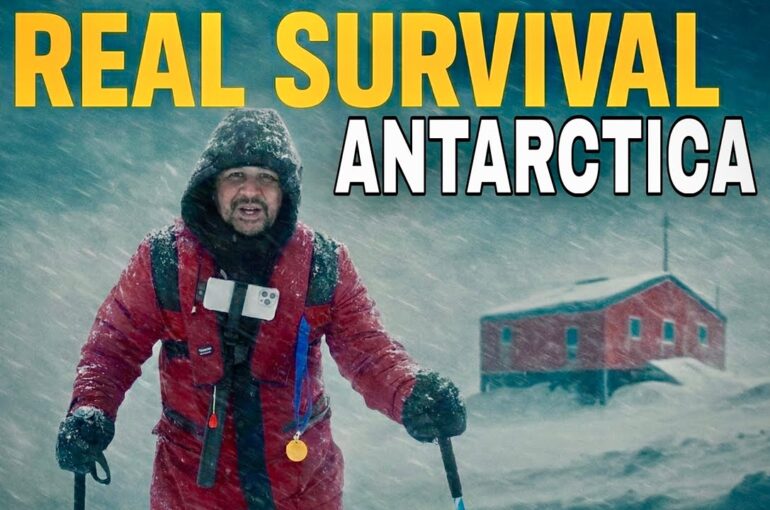
We have finally set foot on the mainland of Antarctica.
This experience is something you probably cannot buy even with crores of rupees.
Welcome to Antarctica.
Brother, it is so cold today that even the sea has frozen. Half of the ice has broken off and gone into the sea, and the rest is still a massive mountain of ice. The staff raise their hands and clearly say that every passenger is responsible for their own belongings.
Look at how clean and neat the water is here. You can see right through it — it is absolutely crystal clear. Walking on this much ice is very difficult. In front of the penguins, there is a glacier — a very beautiful glacier. The glacier has cracked, so waves can come at any time. That’s why they are quickly evacuating us.
A bay has formed. If that bay gets blocked, we won’t be able to leave. Otherwise, if the gate closes, you could be stuck here for an entire year.
So finally today, we have set out to enter the mainland of Antarctica. We will be among the few people who have ever stepped on Antarctica’s mainland. Over the last 100–200 years, only around 400,000 to 500,000 people on Earth have set foot here — and we are among them.
I feel extremely fortunate to have the opportunity to come to such a place. If you read stories from 2,000 years ago, there is no mention of a place called Antarctica. People only imagined that beyond the ice, there was something unknown.
But about a little over 100 years ago, when a Norwegian man reached the South Pole and planted his flag — around 1911 — everything changed. After that, there was a rush: “I want to go, I want to go.” People started exploring.
At that time, it was mainly British rule, and the British explorers were adventurous, but they say discipline and knowledge matter. That Norwegian explorer went with discipline and reached the South Pole before the British. Amazing, isn’t it? The full story is available on YouTube, but first, enjoy the reality — what you are actually seeing.
What you see is far more powerful than what you hear. It feels like the entire ocean is merging into the ice. Half of it has already broken off into the sea, and the rest is still a massive mountain — a 200,000-year-old mountain.
Look at our people — they have already gone there. From a distance, they look like ants sitting on a sweet. Tiny red and yellow dots. Landing is very difficult here because there are steep vertical mountains close by, so they are only allowing us to land on the ice.
“Welcome, guys. This landing… step on the continent… we have about 40 minutes and then we must head back because there is ice closing in at the entrance of the bay. If we stay too long, it could be a problem. So the idea is to get out in about 40 minutes and then leave, otherwise we may be stuck here all day.”
So finally, we have placed our feet on land. We have stepped onto the mainland of Antarctica. From here, you can see that there is only a 500-metre gap forming the bay. If it blocks, we won’t be able to leave. That’s why they are telling us — go quickly, take photos, enjoy for half an hour, and then return. Otherwise, if the gate closes, you might have to wait here for a year.
Welcome to Antarctica.
This is the Antarctic flag — a land that belongs to no one. A land free from nuclear activity. A land covered in ice. A land that is dry, covered by an ice sheet around 2 kilometres thick. A land where there is no rainfall at all.
Welcome to such a land. The feeling is different — impossible to explain. Sometimes you don’t even know what to say. It just feels good.
The ice you see here is extremely deep. On average, Antarctica is covered by about 2,000 metres of ice, and in some places, it goes up to 4,000 metres. Inside these ice layers, 800,000-year-old air is trapped. Scientists study the environment by analysing this ancient air.
In many places, you’ll notice that when I step on the snow, it turns blue. Why does it turn blue? Because the air escapes from the ice, and then sunlight reflection makes it appear blue.
We have now reached higher ground. There is a constant fear of slipping here, so you have to walk very carefully.
Look — the zodiac driver has changed the route near the glacier because the ice has moved closer due to the wind. That’s why they were in such a hurry to get us out. These ice crystals keep gathering, and glaciers are breaking.
Whenever a glacier breaks, I always mention global warming. You can sometimes see a mist rising — that means a glacier has collapsed. Its wave can push the ice even closer. That’s why they evacuate us quickly.
Look at that massive iceberg nearby. Only 15% of it is visible above the water — 85% remains underwater. That’s why they warn us — you are responsible for your own safety. If someone falls and gets injured, evacuation from here is extremely expensive and very difficult.
A lot of ice has entered the bay now. The zodiac has to carefully manoeuvre around it. Ice can be sharp, and it can puncture the zodiac. These boats are filled with air — they look small on top but are huge underneath.
Now look — they are navigating between two icebergs. Both are breaking from the top. If a large chunk breaks suddenly, it creates a wave, and that can cause serious problems.
The deep blue colour below could mean it is 40–50 metres deep, but no one really knows. Ice keeps melting from the top and flowing out from below. Even the seawater temperature here is below zero. Wind has carved patterns into the ice — incredible.
This experience truly cannot be bought, even with crores of rupees. Only a few hundred thousand people on Earth have ever experienced this.
Look — the zodiac is creating its own path. A wave just came — that means a glacier broke somewhere. If a big chunk comes floating here, it could cause trouble. From a distance, it looks small, but beneath the ice, there is another 2–2.5 km of ice inside the mountains.
The highest peak here, Mount Vinson, is nearly 4,000 metres high and is part of the Seven Summits. Many people travel there using special flights.
Water keeps flowing underneath so it doesn’t freeze completely — otherwise, it would become impossible to move.
Now the ship has started moving. They are pushing ice blocks aside. Our ship is slightly ice-breaking capable, but it was still important to leave quickly.
We have exited the area now. There are many whales here — you may not see them clearly on camera, but we can see them with our eyes. You’ll just see water being blown into the air. There — look — that’s one! We have had whale sightings from close range.
So friends, we are ready again. It is still snowing, but we are going for another landing. The good thing is that this second landing is also on the mainland of Antarctica — which is very rare and difficult.
Our cruise has positioned itself perfectly. The scene right now is absolutely incredible. We will land at Neko Harbour, which is a harbour on Antarctica’s mainland.
Do you know how Neko Harbour got its name? In 1911, a Norwegian whaling ship named Neko used to stop here repeatedly. Because of that ship, the place came to be known as Neko Harbour.
There are Gentoo penguins here, and behind them is a stunning glacier. This is our second landing on Antarctica’s mainland. Our group has already gone ahead — we are the last ones.
Let me show you the beautiful views. This is the island where we are going, and all those black dots you see are penguins. And look at this glacier — it is dangerous. If this glacier collapses, it can create massive waves and shake the entire boat.
If it breaks from there and the Zodiac is here, there’s a chance the Zodiac could also flip over. Today we’ll go right up to the top, all the way to this area, and we’ll do proper hiking here. After many days, we’re finally going to have a good hike, and I’ll show everything to you as well.
So, we’re getting late as usual, and now we’re preparing to head out. We can’t go from the main deck; we have to go from the side. It’s snowing right now, so we need to walk very carefully. On this side, the engine makes a lot of noise.
Look, we’ve reached the geodesic area. You’ve already seen this in earlier videos, and everything here is completely frozen.
“How are you, Captain? All well?”
“Yes, brother.”
It’s so cold today that even the sea has frozen. Absolutely frozen. Wherever they find a small opening, they pull the Zodiac out through it. The current temperature is –4°C, but it feels like –20°C. Today, we’re literally stuck in ice.
Brother, you’re looking great on camera today. Honestly, it feels good. And look here—slowly, all the ice is drifting this way.
It’s amazing, but you probably can’t see much. Everything is foggy all around. Sometimes the boat hits ice, and when it does, you hear a sharp cracking sound. Listen—there it is.
Look at how clean and clear this water is. We’re very close to a glacier. You can see the seabed clearly, even though it’s 10–12 feet deep.
And we’ve arrived—just two minutes today. Look at these massive icebergs here.
Welcome to the Antarctic continent, guys.
This is going to be easy. Follow the instructions. Do not leave the path.
They told us not to leave the marked route because these icebergs have cracks inside them. Look here.
Now I’ll show you a piece of pure iceberg ice, holding it in my hand. It’s crystal clear—like stone. This is fresh ice. You can see right through it. If there was sunlight, it would sparkle. This piece could be thousands or even hundreds of thousands of years old. Icebergs take nearly 200,000 years to form.
Think about it—humans live about 100 years, and we still wander around acting proud.
We can’t stand here for long. Why? If an iceberg breaks and falls into the water, the wave it creates would sweep us away instantly. That’s why we must be very careful. Also, there are cracks everywhere between the glaciers. We must follow only the route they show us.
This route is called the “Penguin Highway.” The team did reconnaissance first and placed flags to mark safe areas. This is the first ship of the season, so all future ships will follow the same route.
We have to stop now—penguins are crossing. We can’t move until they pass. Because this is an expedition cruise, we’re allowed a bit more freedom. On normal cruises, you’re not allowed this close.
Look at them—they’ve made their own paths up the slope.
Okay, I’m going now.
They’ve gone back. Now we can move. One penguin just made a sound—it’s like its mum or boss called it.
Walking in this snow is really hard. Snow particles are hitting my face hard. This isn’t rain—it’s pure snow. I’m covering my face while talking.
Everyone is going uphill. I’ve removed my sunglasses because snow particles stuck to them and blocked my view. Even without sunlight, the reflection is intense. I wonder how people who came here 100–150 years ago survived—many must have damaged their eyesight.
We came all this way for this view. The clouds have completely covered the area. Now we’ll go down the opposite side and I’ll show you Neko Beach. Usually, you see the sea in front of a beach, but here, you see a glacier directly in front—thousands of metres wide.
We’ve reached the top, and now we’re going down to see a seal. Look at the fog—it’s like North India in December. Sometimes it takes hours to travel just one kilometre in this fog.
The glaciers are completely covered, but they’re so huge—standing 50–60 metres tall. If one of these collapses, no one here would survive. Luckily, there’s no sunlight and it’s very cold, so the chances are low.
I was thinking—today it’s 2025, and we have cruise ships with every facility. But in the 1900s, when Norwegians first came here, how did they survive? Walking 500–700 kilometres into pure ice, no food, no people, only storms. That took real courage.
Humans can do anything with dedication and consistency. Dedication to keep going, and consistency to take one step every day. If you stop once, both dedication and consistency disappear. Make this a rule of life.
Look at this—another penguin colony. Now we’re going downhill. The fog has cleared, and you can see the glacier clearly. From up close, it feels completely different.
If this glacier breaks and falls, the water would rise up to here. That’s why we’re told to stay together. And look—a seal is sleeping peacefully on an ice block. What a life.
Everything here is frozen. We walked through rocks like a stone road. I’ve seen many penguin species, but Gentoo penguins are the most aggressive. They fight properly and make a lot of noise—and yes, they poop everywhere, so the smell is strong.
I’ve been on this tour for 17 days now, with five more days to go. It’s so quiet here—pin-drop silence. Sometimes you hear the ship, or the sound of a glacier cracking. That sound is unforgettable.
If we can’t even save this place, what can we save? I request you all—please protect the environment. These views may not exist for future generations. If humans don’t protect nature, nature will protect itself—by taking revenge.
I was curious—what do penguins eat? They eat krill, tiny fish about 5–7 cm long. Even blue whales eat 3–4 tonnes of krill in one meal. Krill is the largest biomass on Earth. A treaty bans excessive fishing, but some countries are still allowed limited catches because krill is rich in Omega-3. But its population is declining—that’s dangerous for whales and the ecosystem.
I feel calm here. I want to sit here all day. I’m walking last—only three or four people behind me. Now we’re heading back to the Zodiac.
Tell me how you liked the video. I’m also uploading short clips from the Pole-to-Pole journey on Instagram and Facebook—now officially from Antarctica to Alaska.
Look how the Zodiac has to twist and turn because the sea is frozen. Emergency kits and medical equipment are ready. The water is so clear—you can see stones even at 10 feet depth.
The engine jolted—we hit ice. We have to be careful with the camera; if it slips, the footage is gone. Ice forms again within minutes at –34°C.
Someone joked about Mumbai’s vada pav—I haven’t eaten properly for 20 days!
There are about 52 penguins here. One of the boat engines had a problem—the rolling caused an oil leak. Now they’ll lift it and fix it.