

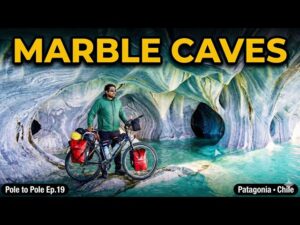
Marble Caves Chile | Patagonia’s Unreal Blue Caves (Pole to Pole Ep.19)

Fly fish come here. Now we are going to enter the biggest cave. A little while ago, this water was looking green. Inside this, I have onions and flatbread (roti). We said goodbye to the camping site.
This is the most beautiful road in the world. Bicycles, motorbikes and pedestrians are not allowed ahead. The road is closed.
Good morning. Salaam, Namaste, Sat Sri Akal, Ram Ram to everyone.
At this moment, we are in Chile, which is my 132nd country. Last night, as I showed you in the previous video, we camped somewhere on the way. We woke up a bit late this morning. I will fill up water first.
This is the camping site where we stayed. We had to pay 7,000 pesos per person (around ₹700) just to pitch the tent, and honestly, the place was not very good. For bathing, they heated a bucket of water for us.
The people here are locals. Two brothers live here. After their parents passed away, they separated, and one of the brothers started this camping site. They live here and do small jobs. They also said that you need permission to run a camping site.
Today, we will ride to Cochrane, which is 50–60 km from here. There is a lot of climbing on the way. I made coffee in their house because the camping kitchen was not working, so they allowed me to use their place.
Mili will soon come after preparing her bicycle.
Let me tell you one thing – I have never seen such a beautiful road anywhere. The mountain views here are extraordinary. If only this road were paved, it would be perfect. Otherwise, the gravel makes it very difficult. Hands start hurting because of the constant shaking – big stones everywhere. Look at this – everything is covered in dust. And this was on a Sunday, when traffic was less. Today will probably be worse.
See that tree? It is so tall. The brother here showed me its root – look how far it spreads. I am standing almost 30 feet away from it, and that is about its height. He keeps chickens, ducks and turkeys, and has a dog tied there.
The best thing is that only two people live here, and both are happy. Their children have moved out, and they live peacefully. It was nice talking to them.
We have left the camping site. The area is quite large, but look at this road – it is so rough. We still have 500 km to go. The river is flowing alongside us.
We climbed from about 100 metres to 400 metres in elevation. There is still about 100 metres more to climb. It was a continuous 6 km ascent, and the wind is strong.
We met these people earlier on the ferry. I stopped to talk to them. “How are you? All well?” He is a good photographer. (laughs)
What incredible views! This climb is tough. We are getting dehydrated – need to drink water. We have covered around 25–30 km so far. Out of that, we had to walk 6–7 km because of the bad road.
We had nothing much left to eat, so I did a desi jugaad. We toasted the roti, cut some onion, and added a little chutney. As they say in Haryana, sometimes you just eat onion and roti when needed. So today, that is our meal. We have not been able to visit a proper supermarket since before the ferry a few days ago.
Inside this, there is onion and roti. That is fine.
Mili is eating her avocado and bread. Her face has turned red. I told her, “Your face is totally red now.” She says maybe it is sunburn or tiredness.
Look at the condition of the road. The bicycle is covered in dust. My phone is also dusty. Our target is Cochrane, a town ahead. There is a hostel for about $30 (around ₹3,000), and I think we can find a camping site for around ₹800. So we will probably camp again.
For the next 10 km, we finally got a proper flat road. I feel like saluting it. The wind is also in our favour, so we should reach in about an hour.
See this sign – it shows snowfall level. Snow can reach up to one metre here. All these rivers look so beautiful. I flew the drone here to see the view.
This is why I say this is the most beautiful road in the world. What stunning views! And this lake – I feel it can even compete with Dal Lake in Srinagar. It is so beautiful, nestled in the mountains.
All day they made us ride on rough roads, but inside the town, look how nice the road is.
We have reached our place. The camping site is 1 km inside. Let’s go there.
I have reached the camping site. There are 12 cyclists here and a couple of vehicles. This route is truly a paradise for cyclists. The camping site is full but very beautiful. The whole town is lovely.
I am setting up my tent. I have chillies, tomatoes and pumpkin. I am making roti and cooking onion and pumpkin sabzi with tadka. It has been 3–4 days since I had proper roti. Today I feel like eating well. After cooking, I will take a bath – I have not bathed yet.
Good morning once again. We have woken up. Some cyclists have already left; some are still here. A few will stay for a couple more days. Around 12–13 cyclists are still here.
Today I will leave from here. I will stop somewhere between 50 and 100 km because the road is very bad. Gravel starts again after 5–6 km. The Argentine girl, Mili, took a lift from here and left. It is not an easy task to cycle on such rough roads. Everyone here is tired. Some have been resting for three days because riding on gravel makes your hands hurt badly, even for experienced cyclists.
This is how my tent normally looks. I keep one bag inside with some belongings. This is my sleeping bag, my mattress and my pillow. That is everything inside the tent. Right now, everything is scattered, but I will pack up in 15 minutes and leave.
Everything is ready. I packed the tent. I flew the drone because when I arrived yesterday, I found this town very beautiful. Let me show you how it looks from above.
The town is small but very beautiful.
Now I will show you the lower views, fill up water and leave. It is already 10:00 am, and I have to cover 60 km. Gravel roads are very tiring. On a proper road, even climbs feel enjoyable.
For the first 5 km, we will get a good road, so let’s ride that first.
In this area, supermarkets look like this – small local shops. I bought some supplies and had to buy a water bottle because I forgot to fill my water earlier.
Now we will move ahead. And look at this – such a beautiful town. It looked beautiful from above, and it is beautiful from below as well.
It looks beautiful from below as well. Look over there – it says Cochrane, that’s the name of the town. I really felt like staying here, but I am thinking of reaching Santiago by 26 January. There is still one month left, but the distance is long – around 2,000 km. I will try my best to reach.
There is also a small museum here – Museo de Cochrane. Today I am wearing half sleeves. It is still cold, but not too much. After many days, the sun has come out nicely, so I thought I should get some Vitamin D.
The town is beautiful. There are roses planted everywhere, and they are fully in bloom in this season. It looks lovely. The climb here is very steep. Climbing with Dhanno (my bicycle) becomes difficult. Anyway, let’s say goodbye to this beautiful town, nestled in the lap of the mountains. The plantation and flowering here are amazing. Nature has gifted this place beautifully.
I have ridden 4 km now, and I am riding along the river. There is only 1–2 km of this good road left. After that, again the same rough gravel road starts – bumpy and shaky. Here they have made a very beautiful stretch of road, but why don’t they build the whole thing like this?
As soon as the city ends, the road ends. Again, the shaking begins. The middle of the road has layers formed by vehicles, like small ridges. The cycle keeps bouncing on them. Many vehicles pass by, and when they do, they raise so much dust that your clean face turns completely black.
What is there to fear? Only 200–250 km of gravel left. After that, the road will improve.
You saw the climb, right? I had to wear my jacket again because it was cold and windy. When you sweat and then stop, it feels even colder.
There was a sign saying bicycles, bikes and pedestrians are not allowed – road closed. So I asked a driver if he could carry me and my cycle for the next 20 km. I took a lift. In total, I took a lift for about 40 km because the road condition was very bad.
It is now 9:30 pm. I have reached and unloaded my luggage. I booked a room here on Airbnb. All hostels were full. Each hostel was charging $40–50 because Christmas has just passed and New Year is coming. Everything is expensive here right now.
Two bikers are also staying here. I booked this hotel for two days. Tomorrow morning, I will visit some caves nearby.
This is the front of our Airbnb. It is almost full. It is a small village. It is already 9:30 pm, and the sun has not fully set yet.
I am fed up with this rough road. Tomorrow I will also rest because the road has been very tiring. Around 150 km of gravel is still left. Once the gravel finishes, things will be easier. My hands are hurting badly. After 200 km from here, there will be a bigger city.
I kept my luggage in the room and went out to buy something to eat. Now I will eat and sleep. I do not have the energy to record more today, so we will continue tomorrow morning.
Normally, something that costs ₹1 costs ₹2–2.5 here. Everything is expensive.
Good morning, friends. It is the next day. It is 6:00 am. Sunrise happens around 4:30–5:00 am here. I am going to see some caves. I booked a boat tour. The boatman called me at 7:00 am instead of 9:00 am because of strong winds.
I am in a town called Puerto Tranquilo (I will write the name below). There is a lake here that is one of the largest shared between Chile and Argentina. On the Argentine side, it is called Lake Buenos Aires, and on the Chilean side it has another name.
Inside this lake, there are marble caves formed over thousands of years by the cutting action of water. We have already covered about 240 km from Tortel. Chile Chico, which is 164 km from here, is near the Argentina border. This lake stretches up to Chile Chico on the Chilean side and then continues into Argentina.
There is also a glacier 50 km from here which many people visit.
We have reached the boat point. They gave me a life jacket, raincoat and waterproof trousers. Today the wind is strong. I paid around ₹3,000 for this tour. Better to wear the cap – no fashion here, just safety.
After many days, I am sitting in a boat again. I have to protect my mic from water because I have already damaged one before.
The guide welcomed us to one of the largest lakes in Chile, called General Carrera Lake. He gave many instructions – do not move too much.
We rode for about 20 minutes through strong waves before reaching an island. He explained that there used to be a small mining town of around 100 people nearby. After mining stopped, the town was abandoned. There used to be a hospital and school there, but now nobody lives there.
Look at these marble tunnels. It took around 6,000 years for water to carve these shapes. You can see how powerful water is. The caves go about 10 metres inside. The colour of the water keeps changing. Sometimes it looks blue, sometimes green. That is why this place is famous.
The marble itself is around 300 million years old – even older than dinosaurs. Earlier, this place was under the sea, and marine fossils can still be found here.
The water level changes between winter and summer by up to 3 metres. In winter, the water level is low; in summer, when glaciers melt, the water rises.
You can even drink this water – it is crystal clear.
This lake is 500 metres deep in some places. Half of it lies in Chile and half in Argentina. On the Argentine side, it is called Lake Buenos Aires.
The boat took us inside the largest cave. It was dark and deep. Water was dripping from above. The waves were strong, rising up to 3 metres at times. It was an adventurous ride.
There are fly fish here that jump and feed on the minerals in the marble rocks. You can see marks where they have eaten. Turtles also come here.
Some rock formations look like animals – like a dog or even a crocodile. There are tunnels inside the caves, and even bats live here.
The most famous marble formation is one where you can kayak through it. Many people come here for kayaking.
But these formations are fragile. One day, they may collapse – maybe in 100 years, 50 years, 5 years, or even tomorrow. Nobody knows.
The wind became very strong, so we returned quickly. Normally, they do not operate in such conditions.
This was my boat tour. From here, we have about 200 km of gravel road left. After that, the road will improve. I flew the drone to show you the surrounding views.
So friends, this was the boat tour video. I will end the video here. We say goodbye to Puerto Tranquilo. From here, there will not be many good places to stop for the next 200 km, so I may upload the next video after two or three days.
There are still 900 km left on the Carretera Austral. After that, we will reach the highway.
Until then, stay happy, stay busy, stay joyful, stay healthy.
Jai Hind. Jai Bharat.