

Mini India in Fiji: 12,000 km from Home, Yet So Familiar
Good morning! Salaam, Namaste, Sat Sri Akal, and Ram-Ram ji.
Right now, I’m in Vanuatu, in its capital Port Vila. Today, we’re leaving for a new country, which is often called a “Mini India.” We’re headed to Fiji, which is about a 2-hour flight from here.
Our flight is around 2:30 PM today. We were staying at the Pacific Paradise Motel, and there’s a church right across the road. It’s a school day today — you can see the kids going to school. The schools are on a different level here.
This road outside is a main city road, and I’ve always seen traffic on it — it’s never empty. The vibe of this country reminds me a bit of some African nations — somewhat developed, somewhat underdeveloped.
We’re now heading towards the airport, which is about 5-6 kilometers from here. Here’s a look at the local transport.
I stopped by a supermarket on the way and found a lot of Australian chocolates and fruits. It’s quite a big supermarket. I picked up some peanuts and a Coke — Coke came free with a scheme.
The main road is where everything is located — Parliament, beaches, etc. The weather’s great today, but when it rains, it gets messy. It rained all day yesterday, and my plans were ruined.
Now we’re about 2 km from the airport.
There it is — the international airport. Customs is ready; the airport is pretty decent. The departure gate is open. Our flight is in about 2.5 hours, but we arrived early.
Did you know? In India, we have the highest post office, but here, they have the deepest one — underwater, 3 meters below sea level, and it’s still functional.
This country is part of Melanesia, one of the three divisions of the Pacific Islands. The population here is only about 300,000, and most of them live in Port Vila. Out of 83 islands, only 15-16 are populated.
Now I’ll pack up my stuff — usually takes me 30 minutes. Here’s how I pack my bike and bag to keep everything safe. I’ve handed over my bike at the counter, but they’ve kept my passport.
I didn’t have a return ticket from Fiji, because I hadn’t booked one yet. I’m still waiting for visas from the next few countries. Let’s see what happens — I’ll show them a dummy ticket for now to exit the country.
Immigration is cleared now, and here’s the waiting area — it’s not that big. There are a few duty-free shops around.
[Music] Thank you, thank you so much! Welcome to Fiji!
This is the 127th country of my world cycling tour, and we’ve just landed in Fiji’s Nadi Airport. Immigration was smooth. I met another fellow YouTuber here.
Fiji has visa-free or visa-on-arrival access. I got a 15-day eSIM with 175 GB of 4G data for $35. Another traveler got 225 GB for a month.
It took less than 30 seconds to activate the SIM. My luggage is packed, and now I can skip paying those expensive $50 taxi fares.
I found a hostel-style room for ₹1500. It’s basic — just a fan, no AC — but decent. I parked the bike outside.
I met up with AK bhai — another traveler. We ended up having lunch, not breakfast, since we woke up late.
He told me he’s been watching my videos since the North Korea series. He found them inspiring. We talked about how over time, the spark for video-making sometimes fades, but newer creators bring great energy and attention to detail — something we can all learn from.
Right now, I’m in Nadi (or Nandi). The spelling is N-A-D-I, but pronunciation varies.
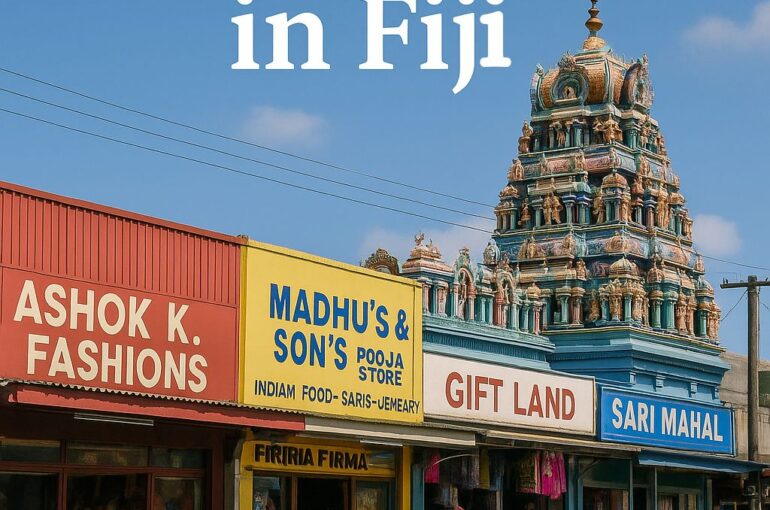
Fiji feels like Mini India. I’ve been eating Indian food nonstop for the past 3 days — it’s available everywhere!
Brief History of Indians in Fiji:
During British rule, the British took Indian farmers, especially from UP and Bihar, to various colonies for sugarcane farming. They brought about 60,000 Indians here under 5-year agreements, called “girmits”. Many Tamils and Andhraites came too. Later, some Punjabis also arrived.
The first ship arrived in 1879, and people decided to settle permanently. They couldn’t pronounce “agreement,” so it became “girmit.” Now they even celebrate Girmit Day to honor their ancestors.
I visited a South Indian-style Hindu temple, where the first idol you see is of Lord Ganesha. They also have a hall, a trust-run restaurant, and bilva trees (used in Shiva worship) are planted all over Fiji.
I met Pradeep Yadav, whose great-grandfather came to Fiji in 1898. Through an old letter and Facebook, their family recently reconnected with relatives in India after 50 years. Amazing story!
Temples are everywhere in Indo-Fijian areas. You’ll know it’s a Hindu house if you see a Hanuman flag out front.
I passed by LIC signs, Bank of Baroda, Indian jewelry shops, dhaba-style restaurants, and even a cinema showing YRF’s “War 2”. You won’t feel like you’re outside India.
There’s a Muslim League Mosque too. Indo-Fijians were once 70% Hindu, 16% Muslim, and the rest Christians. Many roads are named in Hindi.
A Muslim college is right next to a mosque — a rare sight elsewhere but common here. The national sport of Fiji is rugby, thanks to the big-built islanders who are very athletic. But people also love football.
In Indo-Fijian homes, there are always small temples, cows, tractors, and sugarcane fields.
Fiji has 333 islands, of which about 100 are inhabited. Most of the population lives on just two main islands. And yes, it lies near the international date line.
I visited an Indian restaurant — Shri Krishna Restaurant — and had a thali with 3 curries, rice, chapati, papad, etc. The restaurant has been running for 11 years.
We talked about cassava, a local root vegetable I first had in Africa.
Political History of Fiji:
In 1987, there was a military coup because Indo-Fijians were gaining political influence. At the time, they made up 57% of the population. Fijians feared Indians would take over. So many Indo-Fijians migrated to Australia, New Zealand, Canada, the U.S.
Now they are only 37% of the population. The coups continued — even when Mahendra Pal Chaudhry, an Indo-Fijian, became PM, he was overthrown.
Locals feel that if the earlier multi-party governments had stayed, Fiji could have become like Singapore.
Now, Chinese influence is growing. Chinese migrants are arriving in large numbers.
Despite internal politics, the Indo-Fijians run many major businesses, especially Gujaratis. Many repatriate money to India.
Despite religious and linguistic diversity, Indo-Fijians have built a unified Hindi dialect that everyone understands — a big achievement.
Final Thoughts:
The weather here is amazing after the rain. Many people own dogs as pets. And in Indo-Fijian areas, you’ll find a temple in every lane.
I’m now by the beachside in Nadi — beautiful beaches, lots of locals and tourists. The vibe is peaceful and joyful.