

CAMPING at International BORDER in ARGENTINA | Pole to Pole Ep.14
Welcome to the 32nd country from the bottom of my heart.
They refused me a room, so I came to the immigration area. I have set up my bed here. There are security issues, so I cannot film much. I made a big mistake. The situation became difficult. It felt like snow particles hitting my face. In four days, I have travelled more than 400 km.
Rio Grande is famous — or rather notorious — for its strong winds. You might see police officers standing behind me. All of them gave me a salute at once. There are temples in Argentina. Sometimes you even have to pedal hard while going downhill because of the wind. There are at least 50 Brazilian vehicles here. In two hours, I managed only 15 km. If the wind is so strong from the front, how can you move forward? It has shaken my budget for the next year. I do not know what to do.
Good morning. Salaam, Namaste, Sat Sri Akal, Ram Ram Ji.
Right now, I am in Rio Grande. It is a town about 220 km from Ushuaia. Last night I stayed here, as you saw in the previous video. The room cost me $35. The system was simple — they give you a code, you open a box, take the key, unlock the door and enter. It cost me around ₹3000. The good thing was that I washed all my clothes.
It is now 9:30 in the morning. I should have left much earlier. I made a big mistake because from 5:00 am to around 8 or 9 am, there was no wind. Now that it is 9:30, the wind has started again. Anyway, let us go into the city. I will tell you some history and then head towards the next city and the border.
It is 10:00 am now. Everything is packed. Thank you so much to the hosts. They even have a small puppy and a room upstairs. People here are very kind and helpful. Last night I said I wanted to wash clothes, and they even brought detergent for me. Some people are truly wonderful.
This is Rio Grande. We often hear the word “Rio”. It means river. “Grande” means big. So Rio Grande means “Big River”. The city is named after this large river. The Rio Grande River is famous for its trout and fishing. People come from far away to fish here. The river is not very long — maybe 100–200 km — but it carries a lot of water because of glacier melt and heavy rainfall in this region.
Today the wind will be against me. Rio Grande is well known for very strong winds — sometimes 100 to 150 km per hour. It can even become dangerous. Most of the winds come from the Patagonia region. About 90% come from the west, and 10% from the South Atlantic side.
This island where we are — including Ushuaia — is separated by sea further ahead. Rio Grande is the largest city on this island, even bigger than Ushuaia. You could say it is the biggest city at one of the southernmost points in the world.
After riding 80 km from here, I will temporarily enter a new country — Chile. We may or may not cross the border today. Let us see.
This city is also historically important because ferries to the Falkland Islands leave from here. The Falklands are about 500–600 km from here. Argentina calls them “Malvinas” and still claims them. There is a war memorial here showing artillery, a fighter jet and monuments for around 700 soldiers who lost their lives. At least they honour their martyrs. There is also a children’s playground and many national flags. Argentinians display their national flag proudly.
There is a beautiful cycling route here. Every city in Argentina has a nice welcome board — it gives a special feeling when you enter.
I tried flying my drone near the airport, but it showed a no-flying zone. So I packed it away.
I bought some croissants from a bakery because today I will not cook. The wind is too strong. Sometimes it becomes so windy that you cannot even sit — you have to eat while standing.
Outside the city, the wind becomes stronger. I saw a special hostel only for bikers, built in memory of a man who travelled from Argentina to Alaska between 1960 and 1963. That must have been extremely difficult at that time. Even cyclists and backpackers are allowed to stay there.
Something surprising happened. At a police checkpoint, around 20 officers were standing there, and all of them saluted me together. I was shocked. I had even hidden my camera, but they saluted me anyway. I wish I had recorded that moment.
After riding about 15–20 km, it became very cold. I had to change my clothes and jacket. I could see mountains on one side and a Christian shrine on the other.
About 30 km ahead of Rio Grande, there is a big industrial zone. This area is known for oil and gas extraction. I saw many oil pumps working.
I have about 30 km left to the border. I plan to stop near a petrol station before the border. The place is called San Sebastián. There is a lot of movement here — trucks, SUVs and vehicles related to the oil industry.
Rain has not left me alone for three days. It keeps coming and going. Sometimes sunshine appears, and at the same time, rain falls. I even saw a rainbow behind me.
The wind speed reached around 35 miles per hour (50–55 km per hour). Even while going downhill, I had to pedal hard. After just 80 km, my legs were completely exhausted.
I reached near the border but decided not to cross because of strong winds. I checked a hostel, but they refused me a room. I asked if I could sleep outside; they said no. So I came to the immigration office and requested permission to stay in their waiting area.
They allowed me to stay inside the staff waiting area. There is a heater and a gas stove. I set up my bed there. My bicycle is outside, which worries me, but since it is an immigration area, it should be safe.
I made coffee and cooked rice and lentils (khichdi) for dinner. After that, I will have tea and go to sleep. I am extremely tired. The wind makes your muscles fill up with pain.
Tomorrow, I will try to reach a Chilean town about 130 km away. Before that, there is a ferry crossing. According to the weather app, there will be no wind until 10 or 11 am, but later it may reach 40–50 miles per hour.
Because of security reasons, I cannot film much here.
For now, I will drink my coffee, eat my food and rest.
Good morning, friends. I have woken up.
It is 8:00 in the morning. I woke up at 6:00 am, but traffic had already started gathering here. The border remains closed from 10:00 pm until 8:00 am, so you cannot cross at night. As soon as it opened at 8:00, I packed all my luggage and got everything ready. Immigration has just started a few minutes ago.
I slept right beside the immigration office. One immigration building is here, and about 50 metres ahead is the crossing point. Let us see how the immigration process goes. I will explain the full story later. I am slightly tense because this is the first time I feel nervous while clearing immigration.
It has been raining since 5:00 am. But I have to leave anyway. In a couple of hours, strong winds will start, so I need to get moving before that.
Security check is done. Now I have to park my cycle ahead and complete immigration. They will put the exit stamp.
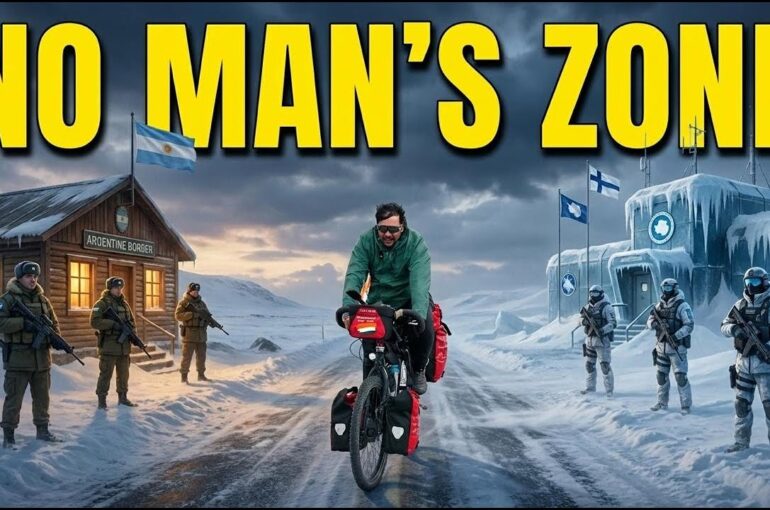
You can see behind me — this is the Argentina border immigration. Now I will ride 13 km through the so-called “no man’s zone”. It is still raining, but I have no option. I must move.
At exit immigration, I was a bit worried. I had originally entered Argentina with a visa. Later, India became visa-free for Argentina, but my visa had already expired. I had overstayed by a few days. So I was afraid they might stop me. But nothing happened. They did not ask anything. They stamped my passport and gave me a small slip, which I may need to show at the Chilean border.
Now I will ride about 13 km on this empty road. Because of the rain, I cannot even clearly see the road condition. But I just have to keep going.
Regarding Chile, as per what I have read, if you have a valid US visa, you do not need a separate Chile visa. Let us see what happens.
This area is not exactly “no man’s land”, but both countries have placed their customs and immigration offices a few kilometres apart.
Early in the morning, I saw a biker gang coming from the opposite side. Many people travel here on bikes — just like people explore Ladakh in India, here they explore the Patagonia region. You will find bikers from all over South America, the USA and Europe. In Chile, you can even hire or buy a bike and travel across South America. Otherwise, from many countries, you cannot easily take your own bike across borders in this region.
There are many foxes here. You can see them standing near the road. They are slightly small in size. I even recorded a close-up video.
A large group of vehicles passed by — at least 50 cars from Brazil.
Now, friends, we are officially leaving Argentina. After about 10–12 km from immigration, we reached the Chilean border area. There is no official fence or big marking — just open plains. We are in the Patagonia region, one of the most beautiful regions in the world.
I will keep telling you more about Patagonia gradually.
Now we are heading towards Chilean immigration. I do not know how it will go because I do not have a separate Chile visa. I was told that if you have a US visa, you do not need one. Let us see.
There are so many sheep here — it feels like paradise for sheep. I have never seen so many in my life.
People are crazy about doing the Argentina-to-Alaska or Ushuaia-to-Alaska route. I keep meeting travellers — some coming from Alaska by car, some by bike, some by cycle. Cyclists are also passionate about completing this route.
There is just a line on the ground marking the border — it almost looks like a farm boundary line.
So friends, welcome to Chile — my 132nd country. Thank you for the love you are giving me on this Pole-to-Pole journey. Please keep supporting.
Chile is said to be one of the most beautiful countries in the world — almost like paradise. I am feeling emotional and excited inside. But first, I have to clear immigration.
Immigration is about 1 km ahead. Let us go.
All the formalities are done now. Customs, immigration and biosecurity checks are complete. This is the official Chile border area.
About 500 metres ahead of the border, I saw a hostel — you could call it a hotel or restaurant as well. I will stop here to eat something.
Let me tell you what happened at immigration. The officer asked me how many days I planned to stay. My bicycle was officially registered, and they gave me proper documents for it. They also removed my rice and lentils during the biosecurity check.
That was the process.
Now let me eat something and then continue the journey.
I had some almonds with me — they took those out as well. Basically, they removed everything. Any item with seeds is not allowed. You have to make an online declaration for all food items. After I declared everything, they allowed me to enter. They did not charge me any fee. The whole process took around 15–20 minutes, even though there was quite a crowd. In the morning, it is usually busy. Later it becomes easier.
Now I am going inside to eat something. Welcome to Chile!
I ordered rice with soya.
“Rice with soya.”
“Thank you so much.”
I asked, “What do you call this in Chilean?”
They said, “Spanish.”
“Pino? Pino de soya?”
“Yes, pino de soya.”
“Okay, muchas gracias.”
I also took a coffee. This dish is made of soya beans and rice. So let’s eat.
After eating there, I started riding again. I have done only 15 km, and the wind is so strong that I can hardly move. My legs are completely exhausted. The wind speed is around 40–45 km per hour. I do not know what to do. The place I need to reach is almost 100 km away. Whether I reach today or tomorrow, I do not know. There is absolutely nothing on the way for the next 100 km.
Maybe if the wind becomes steady, I can manage. But in this strong headwind, riding feels almost impossible. In 2 hours, I managed only 15 km. I have been riding continuously for 2 hours. After 20–21 km, I am completely drained. I do not have the strength to continue.
When such strong wind hits you from the front, how can you ride? Even my flag is about to break. I am removing it for now and will put it back later.
What should I do? I will wait for some time. When the wind slows down, I will ride again. Even if I have to ride at night, I will ride at night. Let us wait and watch. It is 2:00 pm now.
So friends, it is now 11:00 at night. I have reached a place called Porvenir. From here, Punta Arenas is very close. A ferry will take me there.
I reached here at 11:00 pm. I am almost going mad. I can barely speak. It is extremely cold. My face has turned completely red after facing strong winds the entire day. I will rest a little now.
Last night I stayed at a local brother’s house. He gave me a room at 11:00 pm. I had been stuck 20 km before this place because the wind was blowing at around 60–70 km per hour. I simply could not ride. A car stopped, and that kind man gave me a lift for 20 km and brought me here. You cannot imagine my condition at that time. My face is completely burnt from the wind.
I have seen strong winds in Iceland, but Patagonia’s winds are even more dangerous.
Now I will catch the ferry and head to the main city where I plan to stay for a few days.
So friends, we have reached Punta Arenas. Behind me is the ferry terminal. It took about one hour and fifteen minutes to cross. I could not record video on the ferry because there were army personnel travelling with us, and I did not want to disturb anyone’s privacy. So I started filming again after reaching here.
I have not yet recovered from last night’s struggle. My nose is irritated and sore because of the cold wind. My condition is still not great.
Welcome to this beautiful city. Let me show you around.
There are many basketball courts here. They have even made a red cycling path — like rolling out a red carpet for my cycle! It feels like Chile is welcoming me.
The city looks majestic. It is located beautifully between the sea and the mountains. What an amazing view!
I have booked a small Airbnb-type room. All hostels were full, and honestly, I did not have the energy to search more. So I booked a private room for today. I will probably stay here for 2–3 days.
Before settling in, I will meet an Indian brother here named Mahesh. He works here. I need some cash because I have not withdrawn money yet.
This time I arranged my SIM card in a smart way. There is a company called Holafly. They charge me 6 dollars per month, and I can use the SIM across South America with 4G. I purchased it the day I returned from Antarctica.
In a new country, two things are most important — SIM and cash. The SIM is sorted. For cash, I will exchange USD because withdrawing from ATMs here is very expensive due to high surcharges. It is better to carry USD and exchange locally for a better rate.
Financially, things have been tough because my Antarctica trip completely disturbed my budget for the next one year. But what can we do? The journey must continue. We will manage somehow.
Look at these beautiful sea views. They have even built a skating area near the coast.
Now I will go, take a bath and sleep. I did not sleep properly last night. Sometimes when you are over-exhausted, you cannot sleep. That is what happened to me. I kept turning the whole night. I reached around midnight, but still no sleep.
After travelling more than 400 km in 4 days — facing rain, snowfall and heavy winds — I finally reached Punta Arenas.
This accommodation costs me 35 dollars per day. I am waiting outside for someone to come and let me in.
So let me end today’s video here.
Stay happy. Stay busy. Stay positive. Stay healthy.
Jai Hind. Jai Bharat.