

World’s Biggest Iceberg A-23A || Delhi + Mumbai Se Bhi Bada. Pole to Pole Ep.5
The ship was moving violently, pitching and rolling continuously. At one point, it felt like it was standing upright in the middle of the waves. Parents had to pull their children back for safety. Even in the most remote country, in the most isolated place, can there still be history? Absolutely.
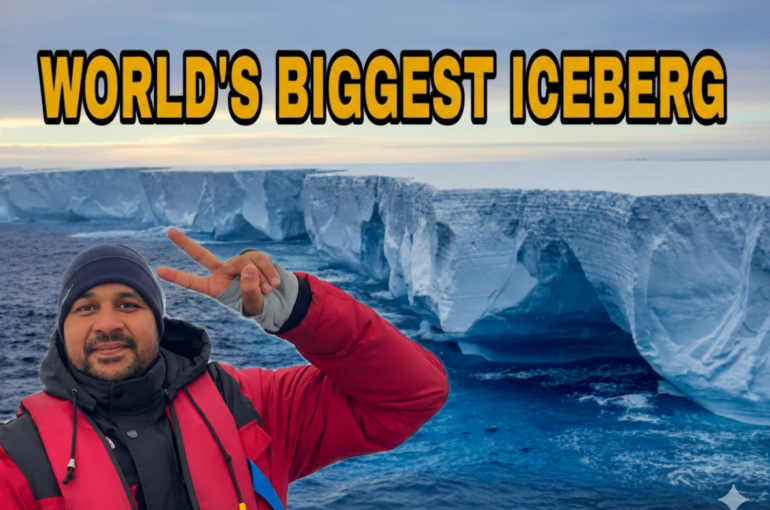
Friends, it’s 5:00 in the morning right now. Yesterday, we were told that early this morning we would pass through something truly extraordinary. And here it is. Behind me, you can see what looks like a moving city made entirely of ice.
Why am I calling it a city? Because this iceberg is so massive that if you combine Delhi, Noida, Faridabad, and Gurugram, it would still not match its size. This iceberg covers an area of about 4,000 square kilometres—almost twice the size of London. It is one of the largest icebergs in the world.
Its name is A23a. The letter “A” stands for Antarctica. “23” refers to the district or region where it was identified, and the final “A” means it was the first major iceberg to break away from that area. This is the first time such a huge iceberg has broken off there.
Right now, we are around 25 to 30 kilometres away from it, yet it still feels like we are passing through a gigantic frozen landscape. The sun had not risen earlier, so visibility was poor. By the time it became clearer, the iceberg had already moved a little farther away.
Just looking at its height is astonishing. About 70 to 80 metres of it rises above sea level, while nearly 300 metres lie beneath the water. That means its total thickness is around 300 to 400 metres—taller than the Statue of Liberty in New York.
When it first broke away, it immediately got stuck, almost like something trapped in mud. It became attached to the ocean floor and stayed there without moving. This iceberg broke off in 1996 and then remained stuck in the same place for 37 years, completely motionless, almost in deep meditation.
Then, in 2023, it finally began to move. Once it started drifting, it got caught in an ocean vortex and kept rotating at its own angle for six to eight months. One day, it suddenly escaped that vortex and drifted further ahead. Now, it has reached very close to South Georgia.
Because of its proximity to South Georgia, this iceberg may change the natural routes of birds and marine animals such as whales, dolphins, sea lions, and seals. Initially, this could cause some disruption. However, in the long term, it may also bring benefits.
Why? Because this ice contains minerals, iron, and nutrients that have been trapped for thousands—perhaps even millions—of years. As the ice melts, these nutrients will enter the ocean and help marine life flourish. So while there may be short-term challenges, the long-term impact could be positive.
Icebergs breaking apart is a natural process. However, the reason this iceberg began moving is linked to environmental damage. Over the past two decades, temperatures in this region have risen. The upper 70 metres of the iceberg melted, making it more buoyant. As it lifted higher, it was no longer stuck and began drifting. If temperatures had not increased, it would likely have remained grounded there.
One more fascinating fact: when this iceberg first broke away, the Soviet Union still existed. Until around 1986, the Soviets had a research laboratory on this ice shelf. When the iceberg broke off, it carried the entire laboratory with it. The researchers contacted Moscow, and ships were sent to rescue the team. All personnel were evacuated by helicopter, and later, Russia established a new research station. India, too, has a major research centre in Antarctica.
Greetings to everyone—Namaskar, Salam, Sat Sri Akal, Ram Ram. Let’s begin today’s video.
This morning, I woke up and immediately rushed to start filming. It was extremely cold, and in the hurry, I wasn’t even fully dressed properly. I was afraid that A23a might pass out of sight. For the past two days, we have been travelling through open ocean. We left the Falkland Islands and are heading towards South Georgia Island.
The journey is about 1,500 kilometres long. We have been sailing for nearly 60 hours. After these 60 hours, we are finally getting our first glimpse of South Georgia Island.
Right in front of us is South Georgia Island. Let me show you—it’s an incredibly beautiful sight. The island is vast and wide, with large icebergs scattered throughout the waters.
South Georgia Island is a British territory located very close to Antarctica. I had to obtain an e-visa to visit, which cost me ₹25,000. When we disembark, the ship’s crew will handle customs and immigration clearance, after which we will be allowed to enter.
It’s still not confirmed whether we will be allowed to go ashore today, as everything depends on the weather. Over the past two days, conditions on the ship were extremely rough. The ship was rolling and pitching heavily. Many people fell sick and started vomiting. It was quite chaotic.
Thankfully, I didn’t feel nauseous, but for one night, I had to sleep in the guest lounge or bar area. My cabin is on an upper deck, where the movement is felt much more strongly. So, I decided it was safer to sleep downstairs.
Today, however, when I woke up early in the morning, everything felt much better.
This 1,500-kilometre journey was completed at a speed of 15 to 20 kilometres per hour, pushing through massive waves. Some waves were as high as four metres. At times, the ship was completely sealed to prevent water from entering.
Before anything else, I want to show you the sight I’ve been eagerly waiting for. Today’s video is going to be special. Stay till the end—you’ll enjoy it.
Look at these views. Huge icebergs scattered all around. One is right here. Many icebergs have recently broken off from A23a and are drifting through this area. Somewhere ahead lies South Georgia.
This region is part of South Georgia’s waters. We are expected to enter South Georgia within the next three to four hours.
It’s now 12:00 noon. After two days, we finally managed to take a proper bath. For the past 60 hours, bathing was not allowed due to heavy ship movement. There was a risk of slipping and getting injured, so the crew strictly instructed us to use the bathrooms only when absolutely necessary.
Now, the lunch bell has rung.
The entire system here is very different from what we were used to back home. It’s almost like a hostel routine. Breakfast is at 7:00 a.m., lunch at 12:00 noon, and dinner at 7:00 p.m. This fixed schedule is followed strictly. The food portions are also small and balanced so that it’s easy to digest. It’s not like at home where we eat four or six rotis in one go. Here, everything is served in measured portions—little by little.
This is the bell you can see here. It rings at regular intervals. It rings at 6:00 a.m., then again at 7:00 a.m., and also for other instructions. All important announcements are made through this bell. You’ll also find all ship-related information written everywhere—emergency exits, safety instructions, what to do and where to go in case of any situation.
Now we’re heading for lunch. Today, we didn’t even get our room cleaned. We just stayed inside. You can see how everything is tied and secured, with support rods placed in between so that people can hold on while walking.
“Hi, how are you?”
“Thank you so much.”
This is our restaurant where we’ll have lunch. So, we’re getting ready for lunch.
“All well?”
“All well. What about you?”
“I’m doing well.”
“So what’s special for today?”
“We have sirloin steak, but we also have a special programme today. And after dinner, there will be a talent show.”
Everyone is having their lunch. We have a favourite spot where we usually sit. Our friend Sachin bhai sits here, so we come and sit right next to him.
“Namaste, Sachin bhai.”
“Namaste. How are you?”
“Very well.”
He is from Slovenia. His name is Chilan. So yes, this is our favourite corner—we’ve been sitting here for the last five days.
The starter has arrived—onion soup with a bit of cheese. Normally, there’s garlic toast and butter served alongside, which you can also use with the starter. After that comes the main course, followed by desserts.
Today’s main meal includes rice, which they’ve served after many days. There’s a sandwich and a burger as well—a soya burger, made from lentils. That’s our lunch for today. We’ll finish lunch and then I’ll show you something new.
After lunch, as I was coming upstairs, we were told to stop for a while. The view was unbelievably beautiful—something I can’t even describe. The ship is still moving slowly. Once it stops completely, I’ll show you some amazing footage.
The ship is now taking a full turn. Then the anchor chain will be dropped, and the hooks will be secured. In front of us is a glacier. Let me show you how beautiful it is. All of this ice has melted and flowed down from the top. Everything you see above is glacier ice.
Our cruise ship is now completely stable. It’s not moving at all. After three days of constant rolling and pitching, we’ll finally get the chance to step on land again.
Let me tell you a little about South Georgia. This island is about 170 to 180 kilometres long. Its size keeps changing because sometimes the ice stretches further out, increasing the width, and sometimes it recedes. The total area of South Georgia is around 3,700 square kilometres.
It’s an incredibly beautiful place. We won’t talk about its history today—that will be covered in the next video. The history of this island is fascinating. It’s known as the gateway to Antarctica, and its history goes back nearly 200 years. You wouldn’t believe how much history exists in such a remote and isolated place.
When it comes to wildlife, there are two types—land wildlife and marine wildlife. This place is a paradise for marine life. You’ll find some of the highest concentrations of marine animals in the world here.
I’ll show you the most beautiful penguin species—the King Penguin. There are also many types of seals here, including fur seals, sea lions, and elephant seals. Elephant seals can weigh up to four tonnes—sometimes even heavier than elephants. And as for whales, this region is a complete paradise for them.
Our ship has now dropped anchor, and we are ready to disembark. I’ve never been this excited during the entire journey. It’s been seven days since the trip started, and we spent nearly five of those days at sea. Today is only the third day we’ll be stepping on land. For the next three to four days, I’ll be staying in this paradise.
Our ship will stop at multiple locations along the 170-kilometre stretch of the island. Some places are rich in history, some in geography, and others in wildlife. I’ll show you everything, so stay with me till the end.
The highest mountain here is Mount Paget, with a height of around 2,935 metres. It rises almost 3,000 metres straight up from sea level. There are four or five other major mountains as well.
The place where we’ve landed is also historically very important. I’ll talk about that in detail in the next video. From here, one extraordinary man—often called the “Boss of Antarctica”—crossed these mountains on foot, from one side to the other, and that too during winter. We’ll discuss his incredible story in the next episode.
Right in front of us is the sea, with tall mountains on both sides. Between these mountains lies a bay, and our cruise ship is anchored safely within it.
Now you can see the Zodiac boats being lowered. One has already been deployed. It will now be test-driven. These boats run on fuel, and the crew checks everything carefully—fuel levels, air pressure, and any possible punctures. If the pressure is low, they immediately pump in more air.
You can see the hook being attached, and the Zodiac is being lowered into the water. Normally, they lower four boats at a time, but today they might deploy more because they need to transport everyone. I can already see a large colony of King Penguins over there—I’ll tell you more about them shortly.
Safety is never compromised here. The captain himself is overseeing everything and helping personally to make sure nothing goes wrong. One of the boats seems to have low air pressure, so they’re filling it up now. You can see the air pipe and how they’re checking the pressure carefully.
We’re currently at around 55° latitude. Beyond 60°, Antarctica officially begins. According to international treaties, all land south of 60° latitude falls under Antarctica.
This entire island is covered by glaciers—around 70 to 75 percent of it. In some places, the island is just 2 kilometres wide, while in others it stretches to nearly 30 kilometres. Its shape zigzags, and if you look at it on a map, it almost looks like wilted leaves on a branch.
I’m really enjoying this place.
We’ve finally come ashore after three days. The routine has started again—clean your boots, disembark, and move on. Our cruise ship is anchored very close this time. We’ve landed safely, and we were greeted immediately.
A seal seemed to welcome us and motioned for us to follow it towards its colony. Of course, we decided not to go into its colony and instead headed towards the larger colonies.
This is a temporary landing site. I’ll show you the main landing area tomorrow. We were instructed to stay at least 5 to 10 metres away from seals because they can move very fast.
Here you can see a mother seal with her five pups. She’s shouting at us, clearly protective. Look at her stance—she’s standing right in front of her babies, blocking us and watching closely to make sure there’s no danger. A mother is a mother, after all.
I’ll show you elephant seals and sea lions shortly. These special boots were given to us because we’re walking on snow.
Here’s an elephant seal resting. And these are Gentoo Penguins—smaller in size but very mischievous. They sometimes try to come close to humans, though penguins are generally quite timid and their heart rate increases very quickly when stressed.
Now let’s move forward. The main attraction here is the King Penguins. This place is truly a paradise for them. Fresh snowfall has covered the area, and you can see so many King Penguins sitting together.
These are King Penguins—the royalty of South Georgia. They are the most famous and royal species here. In some places, their colonies are so dense that you can’t even step forward.
Their average height is around 90 to 100 centimetres (about 2.5 feet), and they usually weigh between 12 and 15 kilograms. They live in large colonies, often with 150 to 200 penguins in each group. You’ll almost always see them in pairs—they usually have only one partner for life.
The total population of King Penguins here is around 700,000 pairs—that’s nearly 1.4 million penguins.
Look at this, mate—so many groups are coming out of the sea together. The ones at the back are different, and the group in front is different. The King penguins are the biggest. The Gentoo penguins are the smallest. And the ones I showed you last time, the ones that bend while walking, are slightly bigger than these.
They keep their eggs between their feet and keep them warm like that. Let me tell you one more amazing thing about King penguins. They are very deep divers. They can go as deep as 300 metres into the ocean—300 metres! That’s incredible. And in winter, they can survive temperatures of minus 20 to minus 30 degrees Celsius. They have thick fur, so the cold doesn’t bother them at all.
And here comes a baby seal. Look at this—what you see in front of you is an elephant seal. Its mouth looks like an elephant’s trunk. Oops, it just did its business there—looks like it’s really hungry. A male elephant seal weighs between 3,000 and 4,000 kilos. The female can weigh around 700, 800, even up to 900 kilos. This one is a male.
In terms of size, they can be 9 to 12 or even 13 feet long sometimes. You can say it’s almost the size of a bus. It’s dangerous too, and it can run very fast. Its trunk is just like an elephant’s. It stores air in it and then makes a very loud sound—that’s why it’s called an elephant seal. Look closely, you can see its trunk right there in the middle.
And these two fellows are sitting in the middle, picking a fight with them. Because of us, their path got blocked. That was really fun to watch. And over there, on the far side, you can see a glacier. There’s a big glacier behind it too. What an amazing place. Ice chunks are breaking and floating around.
Now look—penguins are coming out from inside. See that? Penguins are walking around right near our zodiac boats. Look, they’ve come out of the water. The whole group has come out together. They go deep into the ocean—100, 200, even 300 metres. Slowly, they keep coming out and going back in.
So, this was the penguin colony and the elephant seal sighting. We’ll be staying on South Georgia Island for another four days. After that, we’ll head towards Antarctica.
Now we’re heading back. Most of the zodiac boats have already left, only a few people are left. Slowly, everyone is going back. Come on, time to head home. People are getting into the zodiac boats and leaving. This one has put it in reverse gear—yes, they even have reverse gear!
We’ve reached back safely. But now there’s a queue to wash our boots. Tomorrow we’ll enter the mainland of South Georgia, and they are very strict there. They don’t allow anything dirty. So right now, they’re washing everyone’s boots with a pressure pump. Look at that—everyone’s boots are cleaned like this.
I’ve got my tripod with me; that has to be cleaned too. After that, it goes into chemicals. Then another officer checks whether any food particles are left. He even checks with a screwdriver. Oh man, he completely soaked everything—but he cleaned it properly, fair play to him.
There are security issues here. We haven’t officially landed in South Georgia yet. We came back like good boys. Overall, it was very entertaining. They’ve taken out all our equipment, and now everything will be checked to make sure there are no seeds inside. Before entering South Georgia, everything must be inspected. Anything we take ashore has to be cleaned thoroughly.
Machines will come, and officers will inspect everything. The whole day is gone. We had a nice dinner—some fruit and good food. Sachin bhai and the others were sitting and chatting. A little while ago, we were playing cards. Now it’s 10 pm.
So, we’ll end today’s video here. Until then—stay happy, stay busy, stay cheerful, stay healthy. Jai Hind, Jai Bharat. Jai Maharashtra. Jai Kerala. Jai Kerala. Jai Assam. Jai Bengal. Jai Kerala.😄