

World’s Most Remote Island
World’s Most Remote Island
All the kids are walking barefoot. Look at this. Sinking is certain here. The British once conducted a nuclear bomb test here. And after that, I took a direct flight to Fiji, from Fiji I went to Sydney, and from Sydney I came to India. Namaskar, Salam, Sat Sri Akal, Ram-Ram ji to everyone. Right now, I am in Nadi, a big city where the main airport of Fiji is located. Fiji is our 128th country. In the last video, you saw that we had gone to Samoa. From there, we came back to Nadi. I reached here this morning, and now I am leaving for my next country, which is Kiribati.
 I am going to a small island of Kiribati called Kiritimati. It’s a totally different world—very remote and separate from the main Kiribati country. Only one flight goes there per week. So, I’ll go today and return tomorrow evening on the same flight. That flight goes onwards to the USA, but it stops there, so tomorrow I’ll come back in it. I’ve packed my stuff, kept one bag, and taken my bicycle. Now we are heading towards the airport.
Coming to Nadi feels like coming home to me. There are temples on every corner. This temple construction has been going on for many days. Earlier, I had spent around 10–15 days in Fiji. Now, about 2 km from here, there is an Indian restaurant. I’ll go there, eat food, and then head to the airport. Let me find a taxi. There are two kinds of taxis—fixed price and meter taxis. It’s better to take a meter taxi. A fixed-price taxi will ask $20 from here to the airport, while a meter taxi will take you for $10. I’ve been waiting for a long time, but no taxi has come. So, I’m thinking I’ll walk around 1.5 km on foot since I still have time. Might as well use it to explore.
Now I’ve reached the International Departures. I’ve roamed this airport so many times that it feels like home. We will now take Fiji Airlines flight number 822 to Honolulu. It goes to the USA, so we’ll go in this flight and return in the same.
You’ll now see the very first sunrise of the day. This is the runway. This is the city, this is the country—everything is here. Look, the plane is ready. We filled out the declaration and health forms. People are filling out their forms and then heading inside with passports.
Now we’ve come outside the airport. See these cars? These are hotel cars. The board says Welcome to Kiritimati. I’ll sit in this one and move forward. It will cost me $45 one way and $45 for return. I’ve kept my luggage inside, and I’ll take my bicycle out there. Then I’ll ride and later return in the same vehicle.
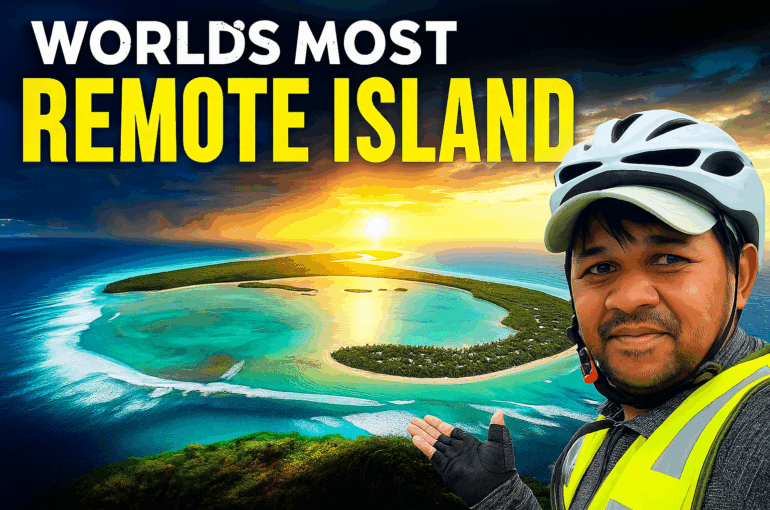
So, welcome to the 129th country of Bicycle Baba’s World Tour—Kiribati! And specifically, we are on Kiritimati Island. This is a very remote island. We came here in a vehicle from the resort. The name of this town is London. On this island, there are four villages—London, Banana, Poland, and Paris. The total population is about 4,000–5,000.
Some countries in the world will drown in the next 40–50 years due to climate change—this is one of them. The entire country is only 1–2 meters above sea level. Not just this island—all islands here are the same.
We first saw a church where villagers gather on Sundays. Women also ride bikes here. I saw 3–4 small primary schools on the way. Education is being given attention. Around 3,000–5,000 people live here, but many shift abroad. Ahead is a small market—Pujas Kiribati Limited, looks like owned by an Indian. I asked, and yes, it’s owned by an Indian.
Most goods here are imported in containers because bringing things by air is too difficult. There are hardly 3–4 shops in the whole island. Mostly Chinese bikes are used here. Children go to school barefoot; hardly any wear slippers.
There is a council here called Kiritimati Urban Council, established in 2004 with help from the External Affairs Ministry.
This island is also called a “Fishing Paradise.” Early morning fish markets open. The island is very clean—no trash, very tidy. The Kiribati flag has the sunrise symbol because the world’s first sunrise happens here. This is also the first place in the world to celebrate New Year.
Kiritimati is also called Christmas Island. Captain Cook discovered it on December 24, 1777—hence the name. Kiribati has no own currency; they use Australian dollars.
The main economy runs on coconuts and fishing. Coconut is used in food, building houses, water, and many other ways.
This country was under British rule until 1979. During World War II, battles took place in Tarawa, the capital. After the war, the British tested nuclear and hydrogen bombs here. Because of this, the island was abandoned for many years. Only later did people settle here again.
Kiribati is the only country in the world spread across all four hemispheres—north, south, east, west. The equator passes right through it. It’s also the first to see sunrise and New Year.
Electricity is limited—mostly generators. Population of Kiribati overall is around 120,000, spread across 21 inhabited islands (out of 33 total). Tarawa, the capital, is thousands of km away from here and houses 40–45% of the people.
Life here is simple—based on fishing, coconuts, and community. Japanese and Australian aid projects are visible everywhere—funding hospitals, vehicles, etc.
The island is very low-lying. Even a 1–2 meter rise in sea level will drown it completely. To protect it, they are planting mangroves to prevent erosion. But still, in 40–50 years, this place may vanish under the ocean.
I stayed here unexpectedly for 15 days because my return flights were canceled—first due to delays, then due to tsunami warnings. It cost me about $50 per day at the hotel. I also suffered terrible tooth pain for 10 days there. After finally managing to leave, I took a direct flight to Fiji, then Sydney, then India. In India, I had two wisdom teeth removed and one root canal done.
Now, I’m ready for my next journey. Stay tuned for the next video—it’s a surprise! If you enjoy the videos, keep sharing them.
Jai Hind, Jai Bharat.