

Exploring Australia’s Wilderness by Caravan: A Journey Through Heat, Hills & Highways
Exploring Australia’s Wilderness by Caravan: A Journey Through Heat, Hills & Highways
Namaskar, Salaam, Sat Sri Akal. Ram-Ram Ji to everyone.
Today, we are setting off from here. In the last video, you saw that we reached Adelaide River at night, where we met quite a few Gujarati brothers. After meeting them, we slept there itself.
Today, we will be travelling from Adelaide River towards Keswick, passing through Townsville. The journey will be around 2,000–3,000 km. But before we start, let me give you a quick tour of this vehicle.
Have a look — I’ve kept my cycle down here. I slept right here last night. The top opens up like this. Let me first show you the kitchen. Here’s the fridge where you can store food. These are all the utensils. You open it like this, and here is the gas stove, frying pan, and all the other utensils. There are also extra gas cylinders provided.
They’ve given two to three cooking pots, a kettle, and even a toaster. Now let’s go inside. There are two extra spare tyres at the back and two 20-litre jerry cans, which can be used in case the fuel runs out. There is water stored here, and on the other side, there’s a water tank. The fuel tank is also there. Even if this vehicle goes a bit into the water, there’s no issue.
Some extra items are stored here. Inside this section is all the shower equipment. There is also extra power storage here. If you connect the power from here, all the lights inside will turn on. Although, the lights are already working since there’s a solar panel on top. You can even take a shower here — shower equipment like pipes are also available. So, everything is included.
Now moving inside — this is a 10-litre emergency water bag that I’ve kept here in case of fire. Let me open this up — inside there are two extra gas canisters (butane gas which I use). You can store extra items here as well. There is space to sit, and even one person can sleep here. Three people can easily travel in this vehicle.
Here’s the bedding — two towels are provided, along with bed sheets, two pillows, and a blanket. Switches are installed so you can charge your phone and other devices right here. There’s space to keep your belongings. Even here you’ll find additional switches. You can sit and open the window for fresh air.
I’ll have to rush now, though. I’ve already wasted two days. I only have four days left, and I need to cover 3,000 km — around 700–800 km per day. It’s a long journey. I intentionally wasted yesterday, and the day before, my flight was delayed. If I had managed to cover 500–600 km yesterday, it would’ve been easier for me now. I could’ve travelled more comfortably. Anyway, let’s start the journey.
They’ve also made a nice footrest here. I’ll pack up this stuff and put it inside. From a distance, the vehicle looks really cute. Let me show you one more thing — some of my stuff is kept here. This vehicle has already run 100,000 km.
There’s a rear-view camera fitted here, not just a mirror. One important feature I’ve shown earlier in the Australia series — look at this: they’ve provided a GPS system. You can use this GPS in case of an emergency. If you’re stuck somewhere with no signal, you can send an emergency signal or even call using the GPS, because there are many places in Australia where there’s no mobile network. So this is very useful.
There are two extra tyres attached at the back. If you want to sit outside, you can pull out the awning, which provides shade, and you can sit comfortably under it.
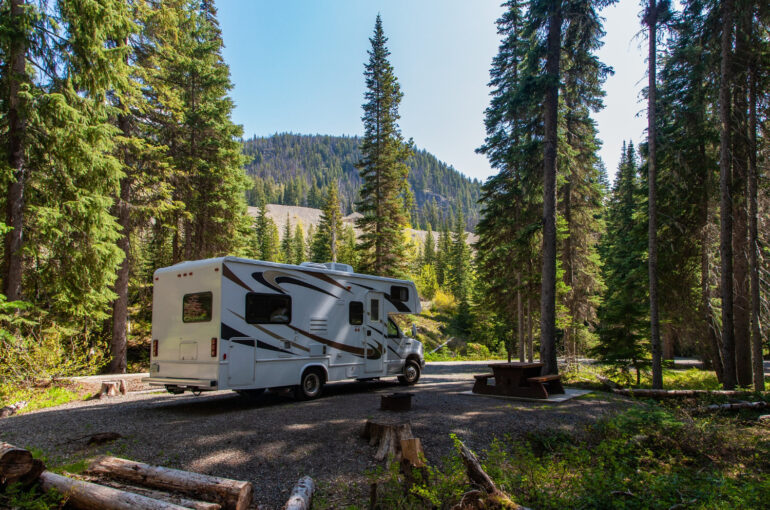
So, this is my full caravan which will be my companion for the next 5 days. This is Adelaide River, which is just about 100–110 km before Darwin. So I decided to stop here.
Now look, Darwin is ahead. We’ll reach there in about 2 hours. Right now, we’re here and heading towards Katherine. Although this route goes to Alice Springs, we’ll take a turn from here. So from this path, we’ll continue towards the next destination. Some people arrived early in the morning and set up their stalls to sell old books. There’s a stall over there too. We’ll grab a coffee and then leave. These are some old photographs showing how huge crocodiles can get—look, a 200-foot-long crocodile!
This is the Adelaide River Railway Heritage. The railway line came here in 1888. This is how they used to build things back then. Here are some old train carriages. It’s 8:00 AM, so I’m heading out.
I bought a pie and filled up fuel worth $8, which is around ₹5000 in diesel. Now I’m in Katherine—a small town with a majority Aboriginal population. I’ve filled up the tank and am heading out. I also met a brother who came to see me. Mostly, I’m seeing local Aboriginal people here. Let’s see where Woolworths is and head in that direction. This town gave me the same feeling I got during my drive from Perth to Adelaide.
Now we’re at the Tourist Information Centre. We’ll have a brief chat with the people here and learn about tours—some are even available by helicopter. This board shows what all can be done in Darwin and maps out the area. We’re heading towards Cairns. We’ll take this route and reach by tonight. We’re currently somewhere around here on the map—Darwin is back there, and we’ve reached Katherine. From here, we’ll take a turn at Townsville and then head towards Cairns. For the next few days, we’ll be in this region. We’ve got about 2,500 km to drive in three days. You can buy souvenirs here or even take part in crocodile activities. This region is full of crocodiles, and they’ve laid out all the key spots clearly.
Controlled fires are set along the road to keep it clear and to spot animals from a distance. I’ve driven 150 km so far. Just 2-3 km ahead is a national park called Bitter Springs. Let’s go check it out.
To reach Bitter Springs, you’ll need to walk about 200 metres. There are clear instructions—only enter the water in designated areas, or else crocodiles might attack. That’s why everything here is well-fenced and secured. Just look at how crystal clear the water is—you can see the bottom! People are bathing here, but only in the allowed zones. The water is naturally warm—it’s a hot spring. We’re back on the highway now. There’s a nice park here, a caravan park too, and a BP petrol pump where we’ll stop for coffee before moving ahead.
There’s a small shop at the pump—like a mini-supermarket. You’ll find everything from sleeping bags to traditional Aboriginal T-shirts and artwork. They also have a musical instrument used by the Aboriginal people.
I’ve already driven 400 km today and will do another 400–500 km. At 100 km/h, I just cruise comfortably. There’s nothing on the road, which can make you sleepy. I stopped to have a kulfi (ice cream) and saw this caravan parked here—it has basic seating inside, not much else. But we won’t stop here. Another 300 km to go, and we’ll open the engine and check the wiring.
I slept in the caravan. It was around 9 PM when I reached. Yesterday, I drove nearly 800 km. Today will also require a long drive. I lost two days in Darwin due to issues. The roads are empty, just like in my earlier Australian travel series. Today again, I might drive 600–700 km, and in the next 2–3 days, I should reach Cairns.
Had a shower, all fresh now. Currently at Three Ways Roadhouse. From here, I’ll switch highways. Three days left and about 2000 km still to go. Since I’m passing through town areas, it’s taking more time. Darwin had a temperature of 28–30°C, but here it’s just 12°C—very chilly at night with strong winds. Moving slowly now.
Fuel efficiency isn’t great. I thought the vehicle would consume less, but it’s giving just 6–7 km per litre. So far, I’ve spent around $250 on diesel, and I estimate it’ll cost me $500–600 in total—that’s ₹30–40k. Still, I got to travel, so that’s a plus. Let’s go pay for the fuel now.
Check out the number plates displayed here—beautiful place. When plates fall off, people hang them here. This was the old number plate design. I filled up fuel for just $40–50 this time because I’ll soon enter another state. Darwin had diesel at $1.7 per litre, but here it’s $2.4. That’s almost ₹150 per litre compared to ₹100 in Darwin. Prices go crazy in desert areas.
From here, we’ll leave the main highway and switch to another one—about 500–600 km to Mount Isa, where we’ll stop. It’s about 650 km from here.
After 200 km, we reached a petrol station. The road is similar to before—just like the Nullarbor stretch. Ahead is a place called Cape Crawford. Filled diesel, did a bit of cleaning, and will now head on. The next fuel station is 250–300 km away. After that, we’ll exit the Northern Territory.
This petrol pump is known as the “bat petrol station.” The trees here are filled with bats—millions of them! Just like the Ivory Coast city I showed earlier, but these are much larger. There’s also an art gallery here, though photography is not allowed inside. They have some famous black cockatoos on display—native to Australia. All the trees are full of bats.
Hello and welcome to Queensland! This is our last territory in Australia for this trip. We’ve entered Queensland now, and it’s still 2000 km to go. Look at this amazing vehicle someone parked here.
Fuel consumption is terrible—one full tank lasted only 350 km, so it’s giving 5 km/litre. Now I’ve only filled half a tank since fuel is expensive here—$2.5 per litre. Hopefully, the next town will have cheaper rates. I need to cover 200 km, but I’m unsure if this will get me that far. The speed limit here is now 100, earlier it was 110–130. Over the next 190 km, you might encounter kangaroos or wild horses on the road—so drive carefully.
We’re heading towards Mount Isa—still 200 km to go. From there, we’ll continue to Townsville.
I’ve got paneer parathas that I’ll heat up and eat now. Got a bit late today. Just need to prep the van, and I’ll enjoy the meal. This was a long-time dream—to travel in a caravan. I wanted to experience it myself, and so far, it’s been great. It’s 8 AM. Behind me is a Chinese cemetery—historical and beautiful. The Chinese came here during the gold rush and made their own cemetery.
Lots of vehicles are parked here. We’ll leave from here now. They’ve given me so many keys—every door has a lock. Today will be our longest driving day. This is our fourth day on the road, and we plan to cover the entire 2500 km journey in these four days. The next two days we’ll explore Townsville and Cairns.
It’s 9 AM, and we’re heading out. We’ve covered 150 km this morning. Townsville is about 600–650 km away.
Another fuel stop. I filled fuel worth $120—this might be my fifth tank. Looks like I’ll need 7 tanks in total. Had coffee and filled diesel. Most of the staff here are from South India. Look at this beautiful lake—well-maintained, with play areas for children. But crocodiles are present, so safety precautions are posted. Time to say goodbye to Richmond. The roads ahead are open and clearly marked.
Before Queensland, in the Northern Territory, towns and fuel stations were 250–300 km apart. But here in Queensland, the population density is higher, so things are more frequent.
We reached Townsville last night. Today, we’ll head towards Cairns, stopping somewhere along the way. I didn’t do much last night as I arrived late. Washed up at a BP petrol station and now heading up a lookout point to show you a city view. This city seems bigger than Darwin.
We’ve reached the top of Castle Hill, from where you can see the entire city. That’s Magnetic Island in the distance. You can take a ferry there. There’s a zoo and a few other things, but currently, the ferry isn’t running, so we won’t go today. The city view is fantastic from here. That large area is a cemetery. There’s a stadium too—with a beautiful 400-metre running track.
Magnetic Island can be explored in a day trip if you have time. We don’t, so we’ll head back down and continue our journey. This video got a bit long, but I included the entire six-day trip in it. These six days were for me, not just for the video. I drove and travelled for my own experience, something I’d wanted to do for a long time.
This lookout point is 300 metres above sea level. I don’t think caravans are allowed here. I brought mine by mistake, so I better head down quickly.
As soon as you leave Townsville and reach the eastern coast of Australia, you see lush farmland. From Brisbane to Cairns, our people own thousands of hectares of land here. While driving off the highway, I noticed massive pineapple farms. These are all pineapples. Ahead, we’ll also see banana farms—our people do amazing farming here. If I find someone from our community, I’ll introduce them.
Saw a board and turned towards it—what a route! The vehicle had to cross waterlogged sections. It was fun. It’s currently the dry season in Australia, so everything looks a bit dry. Even though it’s winter, this part of Australia (Cairns and beyond) doesn’t get very cold—around 15–16°C at night. In summer, it gets extremely hot.
A river flows below with a waterfall. If it’s nearby, I’ll go, else I’ll return. I’m alone here. There’s a warning sign that the path is closed. You can only view the waterfall from here. CCTV is installed. The height of the waterfall is significant. I came quite far already. There are clear instructions everywhere for safety—especially when you’re travelling solo.
Huge rocks are scattered everywhere. I wonder where they came from. The stream flows between these massive rocks—beautiful and impressive. You can see the water flowing through them.
Honestly, the path to the waterfall was more enjoyable than the waterfall itself. Around 4–5 km through dense forest—what an experience! I should put on my seatbelt now. Before we move, just look at this stunning scenery.
What a thrilling route! Absolutely amazing to see.