

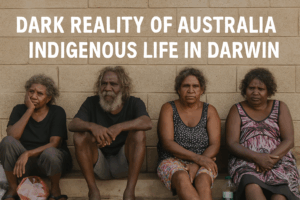
Dark Reality of Australia 🇦🇺 | Indigenous Life in Darwin

Hello, greetings, Sat Sri Akal, and Ram Ram Ji to everyone. Right now, we are in Darwin. In the last video, you saw that we had reached Darwin – one of the most remote areas of Australia. It’s a place tucked away in a corner, quite isolated.
I’m not talking about this town alone, but about the Northern Territory as a whole. The total population of the Northern Territory is around 400,000, and about 120,000 people live here in Darwin. In the previous video, you saw that I, along with Jason bhai, had taken a caravan, which I got for $7 for seven days. These are transfer caravans, which need to be moved from one place to another. From here, we’ll now head towards Cairns.
I’m still calling this caravan “Dhanush” because I’m reminded of my old one. Sitting in this caravan, I went to meet Ravi bhai. We had arrived here the night before yesterday, and yesterday I went to Jason bhai’s house. There, I enjoyed a glass of lassi, and after that, we spread out a charpai and slept. I’ll give you a full tour of this caravan in the next video.
Today’s video is going to be special about the Aboriginals here, so watch till the end – it’s going to be fun. I’ve just bowed my head in respect and am now on my way. It’s Sunday here, and pakoras are being made. Look, Raju paaji is frying some amazing hot pakoras.
“How are you all? Tell me more news.” These guys arrived from India just two or three days ago. After saying bye to everyone at the Gurudwara Sahib, we headed out, which took some extra time.
This is Airport Road. And this area here, called Karama, is known as one of the most dangerous in the city. While roaming around, I came here. This is my friend Ravi’s place – he’s from Panipat. Ravi has gone to work and told me to meet his friend, so here I am with him.
His name is Ankush, from Kaithal. We decided to explore Darwin city together since earlier I didn’t get a chance because most of my time was spent getting this vehicle. Ankush has been in Darwin for two years. Before that, he spent two months in Sydney. He came on a dependent visa, as his wife was on a student visa. Her studies finished just two days ago, and now they’re applying for a work permit and then PR.
We parked the car and came to the Rapid Creek Market – also called the Rapid Creek Business Village. Many Greek people live here, especially in Darwin, and I even noticed some Chinese signs. The Chinese influence is quite visible here, and the place is full of them. Sometimes, we even mistake Vietnamese people for Chinese.
Look at this – lemons are $4 per kilo, papaya is $6 per kilo (about ₹350 a kilo in India). You won’t find these vegetables in big supermarkets – these are sold mostly by the Chinese community here. There are also four different types of green chillies. Some people are buying large bottle gourds, others smaller ones.
There’s even produce I can’t recognise – maybe you can tell me in the comments. They’ve also packed ginger, garlic, and chilli in small bowls. I never thought I’d find beer here, but they’re selling something called “monkey apple,” which the older generation used to know.
I’ve seen many vegetables here that I’ve never come across before. This one looks like sweet potato but is actually something else. In the middle of the vegetable section, there’s even a salon – this market is truly multicultural. You’ll find halal shops, Buddhist stalls, and of course, plenty of Chinese vendors – though I think many of them are actually Vietnamese.
This market runs only on Saturdays and Sundays. One of the ladies here is Vietnamese – you can tell by what she’s making. My friend said everyone looks Chinese, but that’s because their facial features are similar. Even in India, people from Manipur are sometimes mistaken for Chinese, which is wrong – we should respect our own people.
Here’s some Chinese radish, sugarcane juice stalls, and more proof that many of these vendors are Vietnamese or maybe from the Philippines, where sugarcane juice is also popular.
After leaving the market, we met this gentleman, Mr Ravi. We parked the car at his place, and he will take us somewhere.
I asked, “Where will you take us?”
He replied, “To a friend’s house.”
I joked, “I don’t know him – is he your friend?”
He said it was for Robin, and then we drove towards the area.
This place is called Karama or Malama, where the majority of the ‘Baddus’ live. It’s considered one of the most dangerous areas in Darwin. The term ‘Baddus’ here refers to the locals, similar to the Bedouins in Arab countries, who are nomadic people. In Darwin, I’ve specifically heard this term used for the Aboriginal people. I never heard it anywhere else in Australia.
Here, you can see them standing around. Look, there’s a man swaying as he walks – clearly under the influence. He even has a phone, which suggests he might be selling something, probably drugs. After selling, he’ll move on.
If you notice, there’s a tracker strapped to his leg. This is so the police can track his location and movements. Many of the most serious criminals here are kept under such monitoring. They probably don’t keep them in jail for long, as they might not survive there.
Then someone says, “Hello, India!” followed by laughter and music.
I asked, “What’s your name?” and continued the small talk.
I asked him, “And you, what’s your name?”
He replied, “Father.”
I wondered how many people lived there – it seems they have quite a unique way of living.
“How many people live together here in one place?” I asked.
He showed me the homes, saying, “Look, these are the houses of the original people. How are you? Are you okay? Why don’t you come in the taxi right now? What are you playing? Are you winning or not?”
Then he pointed out the toilet – “This is their toilet.”
I asked to be taken to another spot to look around.
As we went, someone greeted us: “India!” and there was laughter and friendly chatter.
They asked my name, and one of them gave me a new name in their language – “Darpa Darpa”. I laughed and said, “Alright, so now my name is Darpa Darpa.”
He wanted $50 for naming me.
One man’s name was “Kudurko” in their language. Another said, “This house belongs to the Gunda family – my name is Gunda Gunda.”
They spoke about their traditions – how in the past they worshipped stones, big mountains, and certain animals. One of them explained, “Your new name, King Brown, is after a snake. That’s my totem.”
He said sadly, “My son has passed away. He was a young man in the army and died while fighting somewhere.”
They explained more about their culture – the “dreaming” stories.
One man said, “My dreaming is the white cockatoo and the emu.”
They also worship a big bird. I asked if they hunt it, and they said yes, along with the long-neck turtle. They hunt these in the jungle, kill them with sticks, cook them on a fire, and then eat them.
They reminded me again about my new name – Darpa Darpa.
We talked about money. They explained that on Sundays they often run out of money and have to wait until Monday night for the next payment. The money usually finishes within two days.
Each person gets two types of cards every two weeks – one cash card and one grocery card. The grocery card cannot be used for alcohol or cigarettes, only for buying food from supermarkets.
In a family of 30–40 people, only the head of the household receives the payment. Some houses have three or four heads, so each gets their share. For example, $400 on the basic card – only for food.
I noticed a sign outside one house saying “No Alcohol” – placed there by the police to protect the children inside. But they admitted alcohol still finds its way in.
Inside one house, there were around 20–25 children and adults. It was hard to tell whose child belonged to whom, as many people were under the influence.
They mentioned their community – “Ramingining” – which is a local Aboriginal settlement about 200–400 km inland, sometimes even 600–700 km away. When they come into town, they travel together in big groups, filling cars and staying for a week or 10 days before returning.
Their community is about 600–700 km inland. They only go back there once a month – for example, if someone passes away, they travel there for the rituals.
Interestingly, just as we call money “rupee”, they have their own term for “dollar” in their language. Some words even sound similar to ours.
I asked someone, “What’s your date of birth?” He replied, “I was born in 1974.” That makes him about 50–51 years old. His life, however, has been hard – much harder than most.
One fascinating thing about their language is that it has no written script. None of the Indigenous people here have a writing system. Their language has been passed down purely by word of mouth. They name things based on what they see, but there’s no written form. That, according to some, is a big reason why they haven’t developed as much in certain areas.
I asked about a sign I saw – “Humbug”. They told me it means “trouble” or “disturbance”. There are also rules like “No visitors after 6 pm” and “No alcohol” written outside some houses. These are meant to prevent fights, noise, or drunken arguments.
Legally, they can’t buy alcohol without showing ID. Some still manage to get it. I asked why some people are called “Baddoo” here, and they said it’s similar to the Arabic word “Bedouin” – used for desert nomads. In Arab countries, Bedouins often have a different passport and can move freely between countries like Saudi Arabia, UAE, and Oman. They live a distinct lifestyle, much like some Indigenous groups here.
When I visited one of their houses, I saw 25–30 people living together. I’ve never seen that many people inside one house before – even at big family weddings back home.
They also told me about fireworks. In Australia, fireworks are banned in most states, but in the Northern Territory there’s one special day – Territory Day – when locals are allowed to set them off. It’s a bit like Diwali for them, though they jokingly call it “Baddoo’s Diwali”.
Some areas are considered rough – Karama, Gray, Moulden, Nightcliff, and parts of Palmerston. In Palmerston, Indigenous people make up about 30–40% of the population.
I asked if there are fights. The older people generally don’t, but younger ones sometimes do – often after drinking – trying to act “tough” like they’ve seen in American culture. Many of these younger people are trying to be more modern, but the ones from remote areas are still very traditional and sometimes easily startled by city life.
I noticed some of them wearing ankle monitors with GPS trackers. There are quite a lot of criminal cases among them, though not usually violent crimes against strangers. Most issues are family disputes or domestic arguments, not robberies or murders. In the past, there were gang fights in Darwin, but now it’s mostly family-related problems.
Greetings from Darwin! This is one of the most remote corners of Australia, a place where modern life brushes shoulders with centuries-old traditions. When I first arrived here, I quickly realised that this wasn’t just another city – it was a gateway into a world I had never truly seen before.
The Indigenous community here is unlike anything I have experienced. Their home villages are deep inland, about 600–700 km away. Most only return once a month, often when there’s an important event, like a funeral ceremony. In their culture, such gatherings are essential, and the entire community comes together to honour the moment.
I was fascinated to learn that just as we call money “rupee”, they have their own unique term for “dollar” in their language. Some words even sounded similar to ours. One man told me he was born in 1974 – making him around 50 years old – but his face carried the weight of a life much harder than most of us could imagine.
Perhaps the most remarkable thing about their culture is that their language has no written script. Every word, every story, has been passed down by mouth for generations. They name things based on what they see, but there’s no alphabet or written form. Many believe this is one reason they’ve stayed so closely tied to their traditional ways.
While walking through their neighbourhoods, I saw signs outside houses – “No visitors after 6 pm” and “No alcohol”. These rules aren’t just for show; they help keep peace, prevent drunken fights, and ensure safety. Another word caught my attention – “Humbug” – which in their slang means “trouble” or “disturbance”.
Alcohol is strictly controlled here. You can’t buy it without showing ID, though some still find ways to get it. I also learned an interesting nickname – “Baddoo” – which sounds like the Arabic “Bedouin” used for desert nomads. Just like Bedouins in the Middle East, some Indigenous people here live a life deeply connected to the land, with their own customs and rhythms.
One of the most surprising moments was visiting an Indigenous home where 25–30 people were living together under one roof. It reminded me of big family gatherings back home – except this was their everyday life.
There’s also a unique celebration here called Territory Day, the only day in the Northern Territory when fireworks are allowed. For many locals, especially the Indigenous community, it’s like their own version of Diwali. They light up the sky, laugh, and celebrate – a rare burst of colour in an otherwise quiet place.
Of course, not every part of Darwin feels the same. Areas like Karama, Gray, Moulden, Nightcliff, and parts of Palmerston have a high Indigenous population – sometimes 30–40%. While older generations tend to be calm and peaceful, the younger ones sometimes get into trouble, often after drinking. Many are influenced by modern pop culture, but those from remote areas still carry the shy, traditional spirit of their ancestors.
I also noticed some wearing ankle monitors with GPS trackers – a sign of legal trouble. Most cases aren’t violent crimes against strangers; they’re family disputes or domestic issues. In the past, Darwin saw gang fights, but now such incidents are rare and mostly limited to family matters.
Walking away from these experiences, I felt a mix of emotions – curiosity, respect, and a deep realisation that Australia’s true story isn’t just in its cities or beaches. It’s here, in the heartbeat of the Northern Territory, where ancient traditions and modern life meet in a delicate balance.