
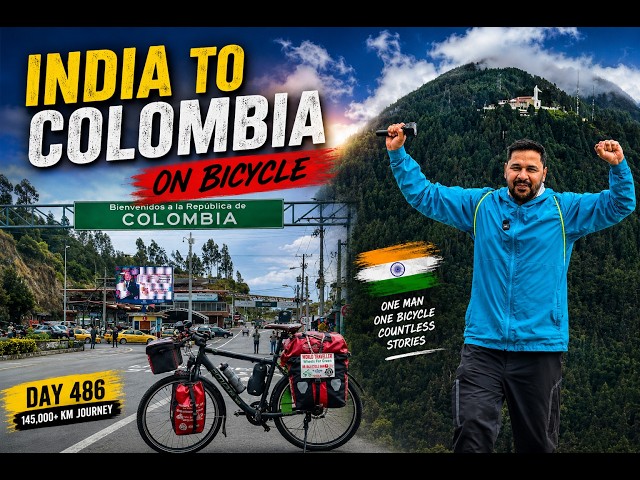
INDIA 🇮🇳 To COLOMBIA 🇨🇴 on Bicycle 🚴 Finally I Reached Colombia Ep.56
Welcome to Cycle Baba’s world journey across 136 countries. This journey is not without danger.
7 lakh…
“Yes, 23… cuatro… cinco…”
In this video, I’ll take you all the way to Bogotá, Colombia.
Hello, Namaskar, Salaam, Sat Sri Akal and Ram Ram to everyone!
Once again, welcome back to my channel. Right now, I’m in Tulcán, the last city of Ecuador, which is my 135th country. I arrived at this hotel last night and stayed here. It’s called Park Hotel.
Today, I’ll be crossing the international border. The border is only about 10 kilometres from here. I chose this hotel because it’s close to the Tulcán bus terminal.
There are serious safety concerns in this area. You’ll notice them yourself as we continue the journey. Dhanno (my bicycle) is ready to cross the border, so let’s get going. I’ll keep talking as we ride.
Oh wow! I just spotted the first car I ever owned in my life.
I’m now riding through the city. The roads here are constantly going uphill and downhill. I had expected northern Ecuador near Colombia to be fairly flat, but it’s been nothing but steep climbs and descents.
This is the city’s Plaza de Armas, with the church on one side and the public square in front. That’s what they call the Plaza de Armas. Here is the municipal office of Tulcán.
The security presence here is incredible. Even early in the morning, there are police officers everywhere. Here’s another park. The border is still about 6–7 kilometres away.
Look at this modern church. There’s also a sports complex here. From this point, you can hire transport directly to the border. All these vehicles are waiting to take passengers there.
Tulcán is quite a large city, and it even has an international airport. It’s roughly 150–200 kilometres from Quito.
Yesterday I arrived very late, so today I’m heading towards the border as early as possible. As you know, I never like crossing borders in the evening, especially dangerous ones like this.
You can really feel the tension here. Look around—even in the narrow streets, police officers are patrolling with firearms. They all have revolvers on their belts.
The first city in Colombia is said to be even more dangerous.
The markets haven’t opened yet. I left at around 8:00 a.m., so I should reach the border between 8:00 and 9:00 a.m. I want to cross into Colombia as quickly as possible and then decide my next move once I’m there.
I don’t know much about Colombia yet. There are significant safety concerns.
Someone has decorated their home beautifully. There are also plenty of private hospitals, pharmacies and orthopaedic clinics here.
Colombia recently had elections, and crime often increases during election periods. The elections ended the day before yesterday, so now it’s time for me to enter Colombia. Once I’m there, I’ll see how safe it really is and make decisions accordingly.
All the advice I’ve received has come from the Indian Embassy and other experienced travellers. Everyone has suggested that I take a bus instead of cycling.
The reason is that only one international border crossing between Ecuador and Colombia is currently open, and the area where I’m entering isn’t considered very safe.
As they say, “Once bitten, twice shy.” Since I was recently robbed, I’m naturally more cautious now. I think it’s wiser to cross this unsafe stretch by bus. Once I reach Bogotá, Colombia’s capital, I’ll reassess the situation.
In this video, I’ll take you all the way to Bogotá.
Here’s a petrol station. I’m stopping for a coffee. It costs $2.50.
Even leaving my bicycle outside while I go in for a coffee makes me nervous. I keep worrying that someone might steal it. People seem to stare at your belongings in a strange way here.
This is the first time I’ve genuinely felt that. Usually, people look at me with curiosity in a positive way, but here the attention feels different.
Anyway, that’s not my concern. I’ll enjoy my coffee and continue.
There’s a bakery here. I bought some bread and two enormous biscuits. The two biscuits cost $1. Honestly, I’ve never seen biscuits this big in my life.
I’ll pack them up and carry on.
Look over there—vehicles belonging to the United Nations are parked nearby, and several police vehicles are stationed here as well.
We’re now riding alongside a river, which eventually becomes the international border.
We’re getting very close now—only about 3–4 kilometres remain.
These people are coming from the border while we’re heading towards it. Entry isn’t allowed from this side, so we’ll use the designated route. It’s currently a one-way road, with traffic only moving towards the border crossing.
This is E35, the famous Pan-American Highway.
Here’s the village located right beside the border. Although it’s commonly known as the Tulcán Border Crossing.
We’ve finally reached the border.
Now it’s time to exchange currency. You can see the sign saying “Gracias Ecuador”, and ahead it says “Colombia”.
Immigration is just ahead, but before that, I thought I’d have one more coffee.
I bought a coffee from a local lady. After a little caffeine and some fresh energy, it’ll be time to enter another country.
I am feeling slightly nervous.
The main issue is the visa. Fortunately, if you already have a valid US visa, Colombia allows visa-free entry, but you still need to complete an online entry form.
I tried filling it in, but there was no option for land entry, so I couldn’t complete it. Let’s see what happens.
First, I’ll finish my coffee and recharge.
I had a terrible headache throughout the night. Yesterday, we got completely soaked in the rain. It started raining as soon as we left Quito. I cycled for a while, then accepted a lift to reach Tulcán.
There are also lots of dogs here. It reminds me of travelling through the mountains. In fact, we’re currently at an altitude of about 2,800 metres above sea level.
“Seven lakh…”
“Yes.”
“Okay.”
“Gracias.”
“No problem.”
“Twenty-three… four… five…”
The gentleman carefully counted all the money while exchanging it.
I’ve already exchanged currency for the next country—even before receiving my entry stamp.
I exchanged US$200, which should be enough to get me to the capital city. Once I reach Bogotá, I’ll decide what to do next. There are always plenty of options afterwards.
The exchange rate was very fair. According to Google, the official rate today was around 3,450 Colombian pesos per US dollar, and he gave me almost exactly the same rate.
I thought it was better to exchange money on the Ecuadorian side because exchange agents on the Colombian side usually offer worse rates.
In Colombia, the currency is the Colombian Peso.
Ecuador doesn’t have its own national currency—it officially uses the US Dollar.
Before coming here, one of my friends who works at TCS had helped me obtain US dollars.
As for my SIM card, I had a lot of trouble in Ecuador. None of the physical SIM cards worked properly in my phone, so I eventually bought an eSIM from an online provider.
It was a bit expensive, but for US$50, I received unlimited mobile data for one month.
Now the advantage is that my mobile data will also work in Colombia and Panama, so that’s why I chose this plan. It’ll cost me US$50 per month, but that’s fine.
Here was Ecuador’s immigration office. The Ecuadorian officials took about 20 minutes. The reason was that I don’t have a Colombian visa. I’m entering Colombia using my valid US visa, so they needed to verify everything before allowing me to leave.
Come on, Dhanno. Time to say goodbye to Ecuador.
Goodbye, Ecuador. Hopefully we’ll meet again, if life allows.
Welcome to Colombia!
We’ve now said goodbye to Ecuador, and on this side the sign says “Welcome to Colombia.”
Welcome to Cycle Baba’s world journey – Country No. 136: Colombia.
We’re now entering Colombia. First we’ll complete immigration formalities and then officially enter the country.
This bridge marks the border between the two countries. I’ll walk across it because I don’t ride Dhanno over these border bridges.
Let’s clear immigration first.
Gracias!
Now let’s find the immigration office.
Come on, Dhanno.
It took another 15–20 minutes, and now we’re finally through.
Officially, welcome to Colombia!
This is the first town in the country. From here, the next major destination is around 100 kilometres away. We’ll first head into this town, which is called Ipiales, and then decide what to do next.
The border itself lies down in the valley, so it’s quite a steep climb from there.
Crime is a serious concern in Colombia. Once I reach the town, I’ll make some phone calls, confirm everything, and then update all of you.
Look at that man. He kept staring at me and repeatedly walked towards me. There are plenty of steep climbs here.
Welcome to Colombia!
I’m having my first breakfast in Colombia—just some milk and a banana. After breakfast, I’ll head into the city and decide my next steps.
Just look at these incredible views. We came from over there, where the border is about 4–5 kilometres away. This river winds through the valley and eventually forms part of the international border.
One thing I love about Latin America is that every town and village has its name displayed beautifully at the entrance. Nowadays, we’re starting to do the same back home in India.
Welcome to Colombia!
Look at the roads—they’re completely broken.
Where’s the entrance?
Well, I’ve reached the bus station.
Let’s see what happens.
So friends, I’m now at the bus terminal.
From here, I’m taking a direct bus to Bogotá, the capital of Colombia. It’s around 800 kilometres away.
I spoke to several local people in Colombia, and they all told me that the stretch up to Cali, which is about 500 kilometres from the border, is particularly dangerous.
They strongly advised me to travel by bus instead of cycling.
So that’s exactly what I’m doing.
They recommended a bus company called Bolivariano. They said the company would charge extra for transporting my bicycle and would take me directly to Bogotá.
So I’m heading straight to Bogotá because the journey is around 700–800 kilometres, and the bus takes nearly 20 hours.
I’m at the ticket counter now.
The ticket costs 152,000 Colombian Pesos, which is roughly ₹2,830, and they’ll charge extra for carrying the bicycle. Overall, I’ll reach Bogotá for around US$40 while covering nearly 800 kilometres.
I noticed something quite unusual here.
Right beside the bus station, they’re openly conducting blood tests and HIV tests.
I think you can understand what that suggests.
This is only a small bus station in a small town.
That gentleman sitting over there told me he’d just been robbed. He had visited a tourist attraction nearby where someone snatched his phone. It looks like he’ll also be travelling on the same bus as me.
Well, I’ve now unloaded Dhanno from the bus.
I’ve tied the Indian flag onto the bicycle. Sometimes having the flag visible actually helps prevent theft.
I’ll mount my camera back onto the handlebars, but I’ll keep the phone safely in my pocket.
This journey is certainly not free from danger, but that’s okay.
One of my friends here, Manish Bhai, suggested that I stay in an area called Park Way.
I haven’t booked a hotel yet, so I’m now cycling towards Park Way. Once I get there, I’ll look for accommodation.
There are police officers everywhere. It almost feels as if they’re determined not to let any crime happen.
Friends, I’ve now left the bus station.
It’s about 10 kilometres to my hotel.
The bus journey took around 20–22 hours. The entire route passed through mountainous terrain. The bus kept climbing hills and then descending again.
Covering 750 kilometres in mountain roads naturally takes time.
The bus only stopped three or four times, mainly to pick up passengers.
Cycling is hugely popular throughout Colombia. There are cyclists everywhere.
Well, what I was worried about has happened—it has started raining.
My flag is already getting wet, so I’ll remove it and keep it safely inside.
At least they’ve built excellent cycling lanes here, and there are plenty of cyclists using them.
I’ve now left the bus station and am riding towards my hotel in Park Way.
Phone conversation:
“Yes, brother, I’ve left the bus station.”
“You’re heading towards Hotel Park Way?”
“Yes.”
“How far is it?”
“It should take about 15–20 minutes.”
“Okay. Once you arrive, relax, keep your luggage safely, have something to eat and don’t worry.”
“Alright, Ibrahim. I’ll reach soon.”
“It’s raining.”
“Okay, travel safely.”
“Sure, thank you.”
Finally, we’ve reached Bogotá, the capital city of Colombia.
It took me 22 hours to get here.
On the way, I stopped at a Pakistani restaurant called Curry House, where I met a Pakistani gentleman. Manish Bhai had connected me with him.
He helped me find this hotel.
The room costs US$30 per night, and I’ve booked it for three days.
It’s Saturday and Sunday here, and the Indian Embassy is also closed on Friday because of Muharram, while Monday is a local public holiday.
So I’ll stay here for three or four days, get some rest, explore Bogotá for a day after Monday, and then continue my journey.
From here, I’m not travelling towards Venezuela.
Instead, I’m heading towards Panama.
Just a day ago, a major earthquake struck Venezuela, causing significant loss of life.
Even before that, my original plan had always been to travel towards Panama.
The next challenge will be crossing the famous Darién Gap, and I’ll show you exactly how that journey unfolds.
If you haven’t liked this video yet, please do so.
I also noticed that only about 25% of the viewers on this channel have subscribed.
The rest of you haven’t subscribed yet.
That’s completely your choice—subscribe if you’d like to support the journey.
Meanwhile, we’re slowly making our way towards Alaska.
Although I’ve reached Bogotá by bus, it feels a bit strange because I haven’t been cycling properly for the past two to three months.
Now I want to resume my journey the way I originally planned—cycling properly from Bogotá and gradually making my way towards Panama.
Some fantastic videos are coming soon.
I’ll also show you the famous Darién Gap, the route many migrants use while attempting the dangerous “donkey route” towards North America.
So that’s where today’s video comes to an end.
Until next time, stay happy, stay busy, stay cheerful, stay healthy.
Jai Hind! Jai Bharat!