
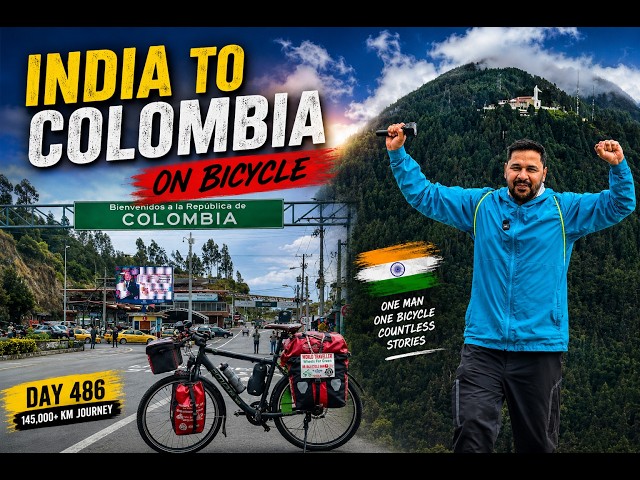
INDIA 🇮🇳 To COLOMBIA 🇨🇴 on Bicycle 🚴 Finally I Reached Colombia Ep.56
July 3, 2026
Welcome to Cycle Baba’s world journey across 136 countries. This journey is not without danger. 7 lakh…“Yes, 23… cuatro… cinco…” In this video, I’ll take you all the way to Bogotá, Colombia. Hello, Namaskar, Salaam, Sat Sri Akal and Ram Ram to everyone! Once again, …
Search
Categories
Tags
000 km From LONDON. Pole to Pole Ep.4
A Journey Through Fiji’s Capital City
Antarctica Expedition Begins from Ushuaia
Antarctica Expedition Begins from Ushuaia | Pole to Pole Ep. 2
Antarctica Wildlife || Pole to Pole Ep.8
Antarctica’s Secrets: Whales War
Antarctica’s Secrets: Whales War || Great Survival Story || Pole To Pole Ep.6
Antarctica’s Wildest Penguin City
Antarctica’s Wildest Penguin City: 10 Lakh Kings Penguin 🐧👑 | Pole to Pole Ep.7
Atacama Desert
atacama desert blog
cycle baba
cyclebaba
Cycle Baba Blog
Cycle Baba First Impressions of Iceland: A Journey Begins
Cycle Baba In Colombia
Cycling in Iceland: Winds That Test Your Limits
Dark Reality of Australia 🇦🇺 | Indigenous Life in Darwin
Discovering the Untouched Beauty of Vanuatu’s Islands
Exploring Australia’s Wilderness by Caravan
Exploring Indo-Fijian Heritage in Suva
Exploring the Heart of Australia: A 6-Day Caravan Adventure from Darwin to Cairns
Exploring Vanuatu
FALKLAND ISLANDS
Fight Between Two Giant Elephant Seals
Fiji
Fiji Look like mini india
Iceland Tour Of Cycle Baba
Life on Isolated Falkland Islands 🇫🇰 | A British Land 13
Mini India in Fiji
My Journey Through the Heart of Vanuatu
One Wild Planet
On the Way to Antarctica || Pole to Pole Ep.3
Samoa The World’s Fattest Country
Samoa 🇼🇸 – The World’s Fattest Country
The Most Extreme City on Earth Before Antarctica | Pole to Pole Episode 1
Tour of Australia
Unexplored World : FALKLAND ISLANDS 🇫🇰
Vanuatu
Vanuatu Travel Experience
World Most Remote Island
worldtour
World’s Biggest Iceberg A-23A
World’s Biggest Iceberg A-23ADelhi + Mumbai Se Bhi Bada. Pole to Pole Ep.5
World’s Most Remote Island
- Kya MEDELLÍN 🇨🇴 Colombia Ka “West Ka Bangkok” Hai? 😱 | Ep.60Last week, two buses were hijacked here. The attackers demanded money from the passengers. Hello, Namaste, Salaam, Sat Sri Akal, Ram Ram! Welcome back to another episode of my World Cycling Journey. Right now, we’re in Medellín, Colombia’s second-largest city. This city was once known as Colombia’s crime capital, but today it has transformed into one of the country’s biggest tourist destinations. We’ll explore the city for a while, and then I’ll continue my journey because I’ve already spent a week here. I haven’t uploaded any videos during that time because I was taking a proper break. Honestly, my body needed recovery after weeks of continuous cycling. Today we’re visiting a place that was once one of the most dangerous neighbourhoods in Colombia—a place where mass shootings were once common. In the previous episode, we explored the story of Pablo Escobar. Today, we’re standing in Comuna 13. Just look behind me. Beautiful murals cover almost every wall. And if you look around… …this entire neighbourhood has become an open-air art gallery. But it wasn’t always like this. Comuna 13 was once one of the most violent places in the world. Originally, people couldn’t afford homes in Medellín because land inside the city was too expensive. So families gradually began building houses on the surrounding hillsides. From the 1950s through the 1980s, Colombia experienced years of political instability and violence. Thousands of people left their villages and moved to the cities. But there wasn’t enough space for everyone. So they climbed higher into the mountains, building homes one above another until entire communities covered the hills. That’s how Comuna 13 came into existence. Then came the era of the drug cartels. During the years of the Medellín Cartel and the Cali Cartel, this neighbourhood became deeply involved in drug trafficking and armed conflict. After Pablo Escobar was killed in 1993, the large cartels began to collapse. But instead of peace, many smaller criminal groups and guerrilla organisations took over. There was a time when not a single street corner was safe. Gunfire echoed through these streets every day. Bullets came from every direction. People were afraid to come here even during daylight. Taxi drivers refused to enter the neighbourhood. In 2002, the Colombian government launched Operation Orion, a massive military operation to regain control of Comuna 13. Police and military forces, supported by helicopters, entered the area. Some reports even claim that armoured vehicles and tanks were deployed. Human rights organisations later argued that many civilians were caught in the violence. According to several accounts, around 500 people lost their lives during this period. Eventually, peace slowly returned. But the government knew military action alone wasn’t enough. If they wanted lasting peace, they had to transform the community. So they invested heavily in schools, roads, public spaces, and social programmes. Then came the artists. They covered these walls with incredible murals. Just look at this artwork. It’s absolutely stunning. These paintings transformed Comuna 13 into one of Medellín’s biggest tourist attractions. Many young people who might once have been drawn into crime instead turned towards music, dance, and street art. Today, some local children have become successful professional musicians, especially in hip-hop and urban music. It’s amazing to see how this community has reinvented itself. If you visit Comuna 13, just be a little careful. Petty theft can still happen, so keep your phone and valuables secure. I absolutely love this idea. They’ve turned old shoes into flower pots. How creative is that? Just look at these murals. No wonder this place has become world-famous. There’s a strong hippie vibe throughout the neighbourhood. Street performers… Music… Art… Everything feels alive. There’s even a skywalk here. I also tried some local traditional food. One local immediately recognised me and asked, “You’re from India?” Even bicycles have become souvenirs here. Look behind me… There’s a Honda motorcycle… There’s a TVS as well. Now look at this mural. Isn’t it beautiful? One thing I really admire about people here is their attitude towards life. They seem genuinely relaxed. Back home, we often stay stressed. Here, people enjoy life. I felt something similar while travelling through Africa. African people were also incredibly cheerful despite having limited resources. The people here seem even more carefree. They have more opportunities, earn a decent living, and still know how to enjoy themselves. Now look at these stairs. These aren’t ordinary staircases like you’d see inside a shopping mall. These are outdoor escalators built right into the hillside. The neighbourhood sits around 400 metres above the lower part of the city. Earlier, residents had to climb nearly 400 to 500 steps every single day. So in 2004, the government installed this series of outdoor escalators to make life easier for local residents and to encourage tourism. One interesting thing I’ve noticed everywhere here… They sell cannabis-infused drinks. It’s a bit like the traditional cannabis lassi you find in parts of India, except here it’s served as juice. You’ll also find artists everywhere. Look at this gentleman. He’s creating beautiful artwork by hand on stone. The biggest problem I’m facing right now is that I’m hungry… …but I don’t really feel like eating. Most of the local food here is deep-fried in the same cooking oil, which gives it a strong smell that I’m personally not used to. Just look at the atmosphere. The streets are packed with people. There’s music… Street performers… Food stalls… Souvenir shops… And even murals of Pablo Escobar. This entire place is full of tourists. The artwork is incredible. Every corner feels like an open-air museum. From here, the climb becomes even steeper. Another escalator begins. There are seven separate sections of escalators leading up the hill. Each one takes you up another few floors. Without them, climbing this neighbourhood would be exhausting. And the higher you go… …the more spectacular the view becomes. By 2004, the government realised something had to change. Instead of allowing violence to define Comuna 13 forever, they invested […]
- PABLO ESCOBAR 😱 Inside Colombia’s Drug Lord’s Prison 🇨🇴 | Ep.59The King of Cocaine—Pablo Escobar. For the poor, he was a modern-day Robin Hood. For thousands of mothers, he was nothing more than a ruthless killer. Pablo lies beneath our feet today. From Hollywood actresses to professional football players and even entire football teams, people came here to stay. Right now, we are standing in Medellín, Colombia’s second-largest city—a place that was once known as the crime capital of the world and the cocaine capital of the world during the 1990s. Hello everyone, welcome back to my channel. You have all heard the name Pablo Escobar. There was a time, during the 1980s and early 1990s, when one man controlled nearly 80% of the world’s cocaine trade. In today’s video, we’re going to visit every place where he left his mark—his birthplace, the location where he was killed, the 20-kilometre area where he built his own empire, and the prison where he spent two years… a prison that he built for himself. There are countless stories about him. For the first time, I’ve tried making this video in a documentary style, so stay with me until the end. If you enjoy it, don’t forget to like, share, and subscribe, because after Colombia, we’ll be heading towards Panama. So, let’s begin our journey through the places where Pablo Escobar built his empire. Today, I’ll tell you his complete story—from his birth to his death. Did the police really fire the bullet that killed him? Well… not exactly. There’s a much bigger story behind his death, and I’ll reveal it at the end of this video. The aircraft standing behind me is the very plane that carried cocaine into the United States for the first time. Cocaine was hidden inside its tyres during those early smuggling operations. Behind these gates lived a man who reportedly earned 42 million US dollars every single week. People say he never counted money—he weighed it. Every month, he spent thousands of dollars just on rubber bands to bundle stacks of cash. The world called him the King of Cocaine. To many poor families, he was a hero who built homes and football grounds. To thousands of grieving mothers, he was simply a murderer. Official records claim he was responsible for around 5,000 murders, although no one knows the real number. In the last video, you saw that we arrived late at night after a long ride. From there, I travelled through Rionegro before reaching Medellín. Why am I mentioning Rionegro? Because this is where Pablo Escobar was born. He was born on 1 December 1949. His father was a farmer, and his mother was a schoolteacher. There were seven children in the family, and Pablo was the third. This is his mother. This is his father. His elder brother, Roberto Escobar, later became his accountant and business partner. The other siblings were not involved in his criminal empire. Pablo was a devoted Catholic who deeply believed in God. You’ll notice religious symbols associated with him almost everywhere. When he was born, Colombia was in turmoil. Massive protests and political violence were spreading across the country. One night, armed men entered their home. After that incident, the family left their village and moved to Envigado, a small town near Medellín. Pablo spent most of his childhood there. Let’s visit the neighbourhood where he grew up. Now we’ve arrived at the place where Pablo spent his early years. Look at this football ground in Envigado. Contrary to what many people believe, Pablo wasn’t born in Medellín. The international airport is located behind us. His father remained on the family farm throughout his life, while his mother moved here with the children. Everyone in this neighbourhood knew Pablo personally. The house you see in front of us is where he spent most of his childhood. He moved here when he was around three years old. The football ground was built by Pablo himself. He recruited neighbourhood children, handed many of them guns, and gradually built his own gang. Money brings power, and power attracts everything else. His criminal journey began when he was around thirteen years old. A friend asked him to transport marijuana from one place to another. For the first time, he made money through crime. By the age of sixteen, a new drug called cocaine had entered the market. He only had to move one kilogram from one location to another and would earn thousands of dollars in profit. That was the beginning of his rise into organised crime. By the age of seventeen, Pablo had already made a name for himself. When he was just thirteen, he told his friends something remarkable: “If I don’t become a millionaire by the age of twenty-two, I’ll shoot myself.” Imagine the confidence of a thirteen-year-old boy saying that despite having almost nothing. There must have been something extraordinary about his ambition. Have you ever set yourself such a bold deadline? I’ve set one for myself—to cycle across the entire world by the year 2030. Pablo had that level of determination when he was thirteen, while I developed mine much later in life. By 1970, Pablo had become well-known throughout the region. He began recruiting young men from nearby neighbourhoods. This marked the birth of what would later become the infamous Medellín Cartel. In 1976, he married a girl who was only fifteen or sixteen years old. Her family opposed the marriage, but Pablo went ahead anyway. They had two children—a son and a daughter. Despite all the violence he unleashed on the world, he loved his children deeply, especially his daughter. I’ve always believed that every human being carries both good and evil within them. Pablo certainly had both. Let’s pause the story for a moment. One of Pablo’s most famous phrases was: “Plata o Plomo.” It means: “Silver or Lead.” Either accept my money and work for me… Or refuse—and face a bullet. During the 1970s, cocaine became hugely popular in the United States. Cocaine is […]
- COLOMBIA 🇨🇴 ke KHATARNAK aur KHUBSURAT Roads pe Akela INDIAN 🇮🇳 Ep.58Hello, Namaskar, Salaam, Sat Sri Akal, and Ram Ram Ji! Once again, welcome back to my channel. Right now, I’m in Bogotá, the capital city of Colombia, and today we’re starting our ride from here. It’s already 10:00 AM. I had planned to start early in the morning, but it was raining, so I couldn’t leave. It’s still drizzling a little, but now I have no choice—I need to get moving. The thing is, it can rain here at any time, on any day. So, before leaving the city, I’ll stop at an Indian restaurant, pack some food, and then continue my journey. Today, I’ll probably ride around 50–60 km. The first 100 km is mostly downhill, and after that, the climb begins. Right now, we’re at an altitude of 2,650 metres above sea level. Even if I leave around 12 or 1 PM, riding at an average speed of 15 km/h, I can comfortably cover around 90 km in 5–6 hours. So, let’s get going. My bicycle, Dhanno, is all set. I cleaned it thoroughly and got everything ready. I stayed at this hotel for four or five days. It was a bit expensive, but overall, it was a nice place. Come on, Dhanno, let’s go! I’ll keep this flag on for a while, although it’s broken from here. Once I get into the local areas, I’ll remove it. But inside the city, I’ll keep it on. I’m waiting at a red light right now. Just look at this house! The artwork and mural painted on it are absolutely beautiful. We’re heading towards an Indian restaurant nearby. There are supermarkets like D1, OXXO, and another major chain here. Slowly moving ahead… Here we are! There are three or four Indian restaurants and also a few Pakistani restaurants in this area. This is Ajay Bhai. They even keep the restaurant gate locked from the inside for safety. “Namaste, brother!” “Namaste! How are you?” Preparations are going on inside. Alright, I’ve left the Indian restaurant now. I had my meal and also packed two parathas, which will be enough for tonight’s dinner. Now let’s continue. The underpass here is really well built. If you want to reach the city centre, you just take this route. I’ve now left the city behind. There are so many motorcycles here—Honda, Hero, Bajaj, and TVS are the most common brands. Just like back home, motorcycles are everywhere. Look at their national flag. There’s a football match today, and people here are absolutely crazy about football. I decided not to take the highway. Instead, I’m riding through the city streets. Bogotá is a well-planned city. The streets don’t have names—they’re identified by numbers. Honestly, riding through cities has its own charm. These green buses you see are electric buses, while the blue ones are regular buses. Public transport here is excellent. There are buses everywhere. Bogotá is the largest city in Colombia. The city I’m heading towards is the country’s second-largest city. What’s this? “Tejas.” And look—there’s a Honda showroom. Hero also has many dealerships here. Looks like it’s going to rain again. It had only just stopped. The roads are quite rough in places. There’s another red light ahead. That’s a Ford truck. And here’s the toll plaza just outside the city. They’ve done one good thing—they’ve made a separate lane for motorcycles. I’ve already ridden about 20–25 km outside Bogotá, but the traffic on the opposite side is still heavily congested. The drizzle has started again. We’re approaching a place called Madrid. Of course, Madrid is also the capital of Spain, and across Latin America, you’ll often find towns and cities named after famous places from other countries. And here we are—Madrid. Wow! There’s even a cycling lane, although it’s full of junk. This is Hospital Maria. This appears to be the city centre. I’m not even sure whether this is Madrid or the neighbouring town because both cities are connected so closely. I’m riding at a great pace now. The weather is perfect because there isn’t much sunlight. Oops… it’s raining again! So I’ve stopped for a cappuccino. I’ll have a coffee before continuing. The coffee machine is acting up, so they asked me to wait for five minutes. By the way, when I stayed in Lima, then Quito, and now here, I was lucky enough to find Indian restaurants everywhere. I’d eat proper Indian food there and also pack an extra meal for later. Thanks to all that delicious Indian food, I’ve gained back the weight I lost while cycling through Bolivia. Now I’m fit again—but honestly, I need to lose some weight because I get slightly out of breath. Right now I’m at an altitude of around 2,580 metres, and I can already feel it. Imagine what it would be like at 3,700 or 3,800 metres. I’ll leave once the rain eases. These public buses are quite aggressive on the roads. Coffee’s done, and the rain has become lighter. Let’s continue and see how far we can reach today. This shopping centre reminds me so much of India. There’s just one major difference—people hardly use their horns here. Otherwise, it’s just like back home. Vehicles keep squeezing through traffic, there are roadside shops, roadside parking—everything feels familiar. Let’s keep moving. Cycling and motorbikes are extremely popular here. Interestingly, you’ll see more women riding bicycles and motorcycles than men. Wow! That’s a new-style motorcycle. Come on, Dhanno! The sun is out, yet it’s still raining. Back home, we say, “The ghosts are getting married,” whenever it’s sunny and raining at the same time. Even this small town has a Domino’s Pizza. And once again, the rain has started. Today’s destination is a place called Villeta. It’s about 60 km away. It’s already 2:00 PM, but I still have about four hours of daylight left. If the rain doesn’t become too heavy, I’ll easily make it because after another 10–20 km, the downhill section begins, and then my average speed should increase […]
- Colombia 🇨🇴 Ki Rangeen Rajdhani — Bogota Mein Ek Din! | Ep.57Oh my goodness! The clouds rolled in so quickly. Just look how everything disappeared into the mist. This area has witnessed the deaths of many people in the past. On the other side of these mountains, the Amazon rainforest begins. The ancient tribes who have lived here for generations are still known for their fascination with gold. Just look at how beautiful Bogotá looks from up here. Hello, Namaskar, Salaam, Sat Sri Akal and Ram Ram to everyone! Once again, welcome back to my YouTube channel. Right now, I’m in Bogotá, the capital city of Colombia. In the previous video, you saw how I finally made it here after quite a difficult journey. Behind me is the hotel where I’m staying. I’m paying around 97,000 Colombian Pesos per night, which works out to roughly US$30, or about ₹3,000 per day. Today is my third day here. Yesterday, I visited the Indian Embassy. One thing you’ll constantly hear here is the noise from these birds behind me. Security is a major issue in Bogotá. Look at that house behind me—you can see security fencing with electric wires on top. Almost every house has similar protection. Even at my hotel, whenever I leave my room, the staff unlock the main gate, let me out, and immediately lock it again. Everything is electronically secured. Yesterday, I visited the Indian Embassy, and honestly, I’ve never seen such tight security at any Indian Embassy anywhere in the world. Another thing about Bogotá—it rains almost every day. For the last two or three days, it’s been drizzling continuously. The city sits at an altitude of around 2,625–2,700 metres above sea level, so we’re already quite high. Today we’re going on a city tour, so make sure you watch until the end of the video. I also noticed that only about 20% of the people watching my channel have subscribed. The rest of you haven’t subscribed yet. Subscribing doesn’t cost anything, but of course, it’s entirely your choice. I don’t usually ask, but today I felt like having a heart-to-heart conversation with you all. Anyway, let’s begin exploring the city. Joining me today is my friend. “How are you, brother?” “I’m doing well. How about you?” “Everything’s good.” He’s from Pakistan. Our mutual friend, Manish Bhai, introduced us, and since he lives nearby, he helped me find this hotel. My Uber has arrived. Uber works here just like it does in India. I’ll sit in the front. It’s a small car. You can see the mountains right in front of us. That’s where we’re heading first. It’s already started raining. If you’re travelling in Bogotá and want to stay safe, I’d strongly recommend using Uber to get around. Try to avoid carrying luggage on local buses because incidents like pickpocketing and snatching do happen. Ultimately, your safety is in your own hands. As they say, “Once bitten, twice shy.” Since I was recently robbed, I’m naturally much more cautious. That’s also why I chose to travel by bus from the border to Bogotá. Our driver has dropped us off. Since it’s raining, we’re now heading towards the ticket office. Here’s the ticket price. It’s quite expensive. From Monday to Saturday, a round-trip ticket costs 35,000 Colombian Pesos, which is around US$10 or roughly ₹1,000. Anyway, we’ve bought two tickets—one for my friend and one for me. Now it’s time to go up. This is the cable car. It was built here in 1950 by a Swiss company. It’ll take us around 500 metres higher. You can already feel the thinner air up here. I’m slightly out of breath. Honestly, I’m also a little nervous. The cable car doesn’t leave unless it’s completely full. As you already know, I’m afraid of heights. There we go—it’s moving! Just look at the incredible view of the entire city. The journey from the bottom to the top takes about five minutes. I’ve chosen to stand in the middle. We’ve arrived! The wind up here is incredibly strong. There’s also a beautiful church here. Wow! The view is absolutely breathtaking. Only the strong wind and rain are making things a little difficult. There’s a statue over there. “What is this place called?” “Guadalupe.” “Oh, Guadalupe.” It’s even higher than where we are now. A road also leads all the way up there. We’re now standing at around 3,150 metres above sea level. Let’s walk over there. This church dates back to the 1700s. It was later renovated. Just imagine how difficult it must have been to carry all the construction materials to such a height back then. They’ve built something truly remarkable. There’s also a café and a small market nearby. Bogotá looks absolutely magnificent from here. The city lies right in the middle of the Andes Mountains. It’s surrounded by mountains on every side. We’re not planning to buy anything here. They’ve got all kinds of local souvenirs. Now we’ve reached the other side. These mule handlers transport supplies up and down the mountain. Look at that mule! It’s carrying so many bottles of beer. Just look at this tree. It’s even more beautiful than the flowers around it. We’ve explored this area now. Let’s head back and I’ll show you one more panoramic view before we continue into the city centre. There’s one special attraction in Bogotá that I’ll show you towards the end of the video. The weather has cleared slightly. Earlier, it was raining over there. That’s mountain weather for you—it changes constantly. Let’s head back towards the church. After that, we’ll continue. What could anyone possibly steal from a church? Yet even here, security is a major concern. This church was originally completed around 1730. The Spanish arrived in this region during the 1500s. Although Bogotá already existed, it was the Spanish who developed the city on a much larger scale. There’s Bogotá’s international airport. The entire city lies inside this vast valley, surrounded by the Andes Mountains. The mountains on this side are the eastern […]
- INDIA 🇮🇳 To COLOMBIA 🇨🇴 on Bicycle 🚴 Finally I Reached Colombia Ep.56Welcome to Cycle Baba’s world journey across 136 countries. This journey is not without danger. 7 lakh…“Yes, 23… cuatro… cinco…” In this video, I’ll take you all the way to Bogotá, Colombia. Hello, Namaskar, Salaam, Sat Sri Akal and Ram Ram to everyone! Once again, welcome back to my channel. Right now, I’m in Tulcán, the last city of Ecuador, which is my 135th country. I arrived at this hotel last night and stayed here. It’s called Park Hotel. Today, I’ll be crossing the international border. The border is only about 10 kilometres from here. I chose this hotel because it’s close to the Tulcán bus terminal. There are serious safety concerns in this area. You’ll notice them yourself as we continue the journey. Dhanno (my bicycle) is ready to cross the border, so let’s get going. I’ll keep talking as we ride. Oh wow! I just spotted the first car I ever owned in my life. I’m now riding through the city. The roads here are constantly going uphill and downhill. I had expected northern Ecuador near Colombia to be fairly flat, but it’s been nothing but steep climbs and descents. This is the city’s Plaza de Armas, with the church on one side and the public square in front. That’s what they call the Plaza de Armas. Here is the municipal office of Tulcán. The security presence here is incredible. Even early in the morning, there are police officers everywhere. Here’s another park. The border is still about 6–7 kilometres away. Look at this modern church. There’s also a sports complex here. From this point, you can hire transport directly to the border. All these vehicles are waiting to take passengers there. Tulcán is quite a large city, and it even has an international airport. It’s roughly 150–200 kilometres from Quito. Yesterday I arrived very late, so today I’m heading towards the border as early as possible. As you know, I never like crossing borders in the evening, especially dangerous ones like this. You can really feel the tension here. Look around—even in the narrow streets, police officers are patrolling with firearms. They all have revolvers on their belts. The first city in Colombia is said to be even more dangerous. The markets haven’t opened yet. I left at around 8:00 a.m., so I should reach the border between 8:00 and 9:00 a.m. I want to cross into Colombia as quickly as possible and then decide my next move once I’m there. I don’t know much about Colombia yet. There are significant safety concerns. Someone has decorated their home beautifully. There are also plenty of private hospitals, pharmacies and orthopaedic clinics here. Colombia recently had elections, and crime often increases during election periods. The elections ended the day before yesterday, so now it’s time for me to enter Colombia. Once I’m there, I’ll see how safe it really is and make decisions accordingly. All the advice I’ve received has come from the Indian Embassy and other experienced travellers. Everyone has suggested that I take a bus instead of cycling. The reason is that only one international border crossing between Ecuador and Colombia is currently open, and the area where I’m entering isn’t considered very safe. As they say, “Once bitten, twice shy.” Since I was recently robbed, I’m naturally more cautious now. I think it’s wiser to cross this unsafe stretch by bus. Once I reach Bogotá, Colombia’s capital, I’ll reassess the situation. In this video, I’ll take you all the way to Bogotá. Here’s a petrol station. I’m stopping for a coffee. It costs $2.50. Even leaving my bicycle outside while I go in for a coffee makes me nervous. I keep worrying that someone might steal it. People seem to stare at your belongings in a strange way here. This is the first time I’ve genuinely felt that. Usually, people look at me with curiosity in a positive way, but here the attention feels different. Anyway, that’s not my concern. I’ll enjoy my coffee and continue. There’s a bakery here. I bought some bread and two enormous biscuits. The two biscuits cost $1. Honestly, I’ve never seen biscuits this big in my life. I’ll pack them up and carry on. Look over there—vehicles belonging to the United Nations are parked nearby, and several police vehicles are stationed here as well. We’re now riding alongside a river, which eventually becomes the international border. We’re getting very close now—only about 3–4 kilometres remain. These people are coming from the border while we’re heading towards it. Entry isn’t allowed from this side, so we’ll use the designated route. It’s currently a one-way road, with traffic only moving towards the border crossing. This is E35, the famous Pan-American Highway. Here’s the village located right beside the border. Although it’s commonly known as the Tulcán Border Crossing. We’ve finally reached the border. Now it’s time to exchange currency. You can see the sign saying “Gracias Ecuador”, and ahead it says “Colombia”. Immigration is just ahead, but before that, I thought I’d have one more coffee. I bought a coffee from a local lady. After a little caffeine and some fresh energy, it’ll be time to enter another country. I am feeling slightly nervous. The main issue is the visa. Fortunately, if you already have a valid US visa, Colombia allows visa-free entry, but you still need to complete an online entry form. I tried filling it in, but there was no option for land entry, so I couldn’t complete it. Let’s see what happens. First, I’ll finish my coffee and recharge. I had a terrible headache throughout the night. Yesterday, we got completely soaked in the rain. It started raining as soon as we left Quito. I cycled for a while, then accepted a lift to reach Tulcán. There are also lots of dogs here. It reminds me of travelling through the mountains. In fact, we’re currently at an altitude of about 2,800 metres above sea level. “Seven lakh…”“Yes.”“Okay.”“Gracias.”“No problem.”“Twenty-three… […]