

INDIAN Robbed in PERU? The Truth About My Ecuador Crossing, Ep.51
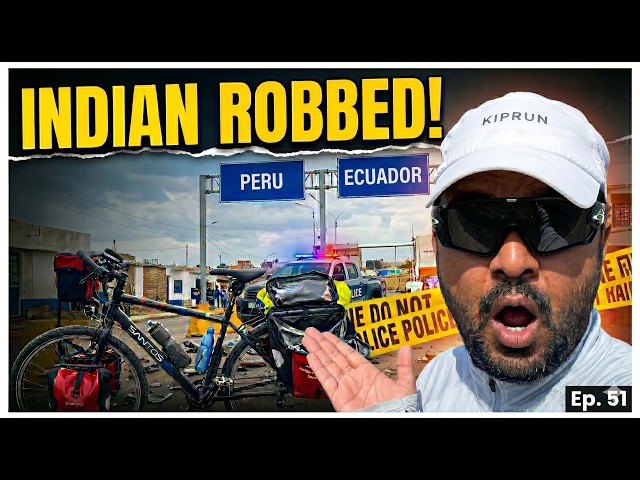
A gun wasn’t pointed at me here, brother — it was pointed right here. This is the area where most thieves live.
I changed my tyres and set off.
Hello everyone, Namaskar, Salaam, Sat Sri Akal and Ram Ram Ji. Welcome back to my channel.
At the moment, we are in the beautiful city of Tumbes. This is my last city in Peru. I travelled here all the way from Lima, but unfortunately, something unpleasant happened on the way. I was robbed. They took my money, my two cameras, and one of my mobile phones.
I still had one phone left, so I thought it would be better not to take any more risks. I covered around 500–600 kilometres by bus.
The gun wasn’t pointed here, brother — it was pointed right here. But what hurts me the most is that I lost all my footage. I lost an entire month’s worth of recordings. I hadn’t uploaded many proper videos during that month either. There were two videos from Lima and another three or four from the journey. Around five or six videos are gone forever.
The financial loss was significant too. Around $1,000 in cash was taken. The only reason I got away relatively lightly was because of the dollars I was carrying.
Do you know what happened? As soon as they stopped me, they took both cameras and my phone because they were visible from the outside. Then they demanded my wallet.
I had exchanged money with my friend Ratan before leaving. I transferred money into his account in India, and he gave me US dollars. Fortunately, he had given me mostly $20 notes. The robbers mistakenly thought they were $100 notes because there were so many of them.
Once they saw the cash, their attitude changed. They told me, “Go now, go now,” and let me leave.
It was a very frightening experience. And it wasn’t even dark. It was only around 5 p.m. It usually gets dark around 6 p.m. I had just left the highway and turned onto a smaller road. Barely 200 metres after turning, they stopped me.
I suspect someone tipped them off. Around 10–15 kilometres earlier, I had stopped for coffee and taken out my wallet. I think they started following me from there.
Anyway, these things happen.
Now it’s time to say goodbye to Tumbes because I am heading to Ecuador.
Getting an Ecuadorian visa took a very long time. That’s one of the reasons I spent nearly a month in Lima. You may have noticed that I uploaded very few videos during that period. For almost three weeks, there were hardly any uploads.
During my stay in Lima, I completed two important tasks. First, I obtained a Canadian visa. That process took time because I had to provide biometrics, wait for the decision, and then get the visa sticker placed in my passport. Altogether, it took around 15 days.
Getting the Ecuador visa was also very difficult. I’ll tell you the full story once I reach the Ecuador border.
This is the city’s Plaza de Armas. Every city, town and village here has a place like this. It is the central square, also known as the “Centro”. Children come here to play, there is a park, and usually a church stands on one side. The city spreads out around it. My hotel was somewhere over there.
Things are about to become even more dangerous as I enter Ecuador.
To be honest, travelling in South America has started to feel a little scary now. One incident happened in Bolivia, and now another one has happened in Peru. What’s surprising is that people generally consider Bolivia and Peru safer than Ecuador and Colombia.
I am heading further north now.
I’m thinking about reducing the amount of gear I carry. Fortunately, my larger Sony cameras weren’t in the bag they stole. I had already shipped them to the USA. I’ll collect them when I reach Mexico. Otherwise, I would have lost another $8,000–$10,000 worth of equipment.
Altogether, my losses amount to roughly $5,000, which is about ₹5 lakh.
For one whole day, I felt completely devastated. Then I told myself that whatever is meant to happen will happen. Life goes on. God will provide. If you all continue supporting me, I’ll recover from this. If not, that’s okay too. The journey must continue.
About 30 kilometres from here is the border.
This city is also known for its crocodile farm. Over there is the police station. It really is a beautiful city.
The problem is that I don’t have any network coverage. I actually carry two phones. One has my Indian number and the other contains a local SIM card. I had an iPhone 15 and an iPhone 16. The local SIM was in the iPhone 15, and that’s the one that was stolen. The iPhone 16 remained with me.
Look, there goes a Suzuki Alto.
I’ve already walked 4–5 kilometres through the city. It’s quite large. Since it’s the last city before the border, that’s understandable.
Earlier, most of the auto-rickshaws here were Indian-made. Now Chinese models are becoming increasingly common. Chinese products are gradually taking over the market here as well.
I had already recorded all of this before, but now everything is gone. Still, I’ll try to show you whatever I can.
Those robbers were riding motorcycles and wearing helmets. They came out of nowhere and cornered me. At that moment, I was terrified. Now that some time has passed, I can talk about it more calmly.
We’ve now left the city behind.
There’s plenty of farming in this area. Rice has been planted, and some farmers are already harvesting it. In a few places, the crop is still green. Within another 15 days, it will be ready.
Summer has begun here. In fact, this region stays warm almost all year because we’re getting close to the Equator.
The coast is only about 4 kilometres away. Let me explain exactly how the robbery happened.
About 10–15 kilometres earlier, after stopping for coffee, I resumed my journey. It was nearly 5 p.m. The next city was 40 kilometres away. I saw a small village near the coast with a few hotels and decided to head there for the night.
I turned off the highway and had barely travelled 200 metres when they stopped me. That’s all it took.
They pointed the weapon at me and ordered me to stop. I looked back and immediately realised it was real. I was angry, but there was nothing I could do. At least they didn’t physically harm me.
You can see the harvested rice packed into black sacks. Here, they transport it by truck. Back home, we’d usually use tractors.
The border is now only 11 kilometres away.
I’m continuing to ride, but I have to admit I’m feeling nervous.
Yesterday in Tumbes, I met a man named Suresh who has lived in Ecuador for 30–35 years. He warned me that the towns near the border, especially Machala and a few others, are known for high levels of theft.
Because of that, I don’t plan to stay in any major border cities. As soon as I cross into Ecuador, I’ll head directly towards the mountains. The coast is only 5 kilometres away from here, while the mountains begin around 20 kilometres inland.
This entire region is flat, but I want to get through it as quickly as possible.
Another challenge is that I don’t have a working local phone or mobile network anymore.
I still have a phone. It’s the one with my Indian number, so at least I have that. I’ve downloaded offline maps as well. The very first thing I’ll do once I get into Ecuador is buy a local SIM card and reconnect with the world.
Thankfully, I made it through.
There’s a small village ahead. It’s the last village before the border. One road goes directly into the village, while the road on the side leads to the frontier. In Spanish, “frontera” means border.
The police are checking people here. Some people come across illegally from that side. In the past, many migrants trying to reach other countries used to pass through this area. They would travel through nearby villages, cross a river between the two borders, and continue their journey.
The navigation still shows 5 km to immigration.
Come on, Dhanno, keep pulling!
I’ve got coriander seeds with me, and I’ll have to get rid of them because seeds aren’t allowed across the border. If I had ground them into spice powder, it would have been fine, but whole seeds aren’t permitted.
I also have a piece of fruit and some onions that I’ll need to dispose of. Most of the time nothing happens, but if there is a problem, it can become a very serious issue. People advised me to be especially careful at this border.
At the moment, this is the only border crossing open between Peru and Ecuador.
I’ll throw away these coriander seeds before reaching the border. Apart from that, I don’t have anything else that might cause problems. I’ll eat the fruit and then cross the border.
I’m feeling slightly nervous while crossing. I don’t know why. Normally I don’t feel this way. All my documents are in order, but it’s still a border crossing.
The GPS was telling me to take another route. A lady explained that I needed to go around and continue for another kilometre.
There are so many neem trees in this area. This is actually the first time I’ve seen neem trees in South America, and they’re full of fruit as well.
The border force here is called CEBF.
They checked my immigration documents and said everything was fine. However, I still didn’t have my Peru exit stamp. They told me I would get that stamp further ahead.
I asked in English:
“No Spanish. I’m going to Ecuador. I’m coming from Lima. Where is Peru immigration?”
She replied that I needed to travel another 4 km, where they would stamp my passport.
“Salida” means “exit” in Spanish. So I needed to go another 4 km to the Peru exit point. I think both countries handle the procedures in the same area – one counter for Peru and another for Ecuador.
Now I’m travelling through the no-man’s-land between the two countries. There are huge banana plantations everywhere.
We’ve reached the region around the Equator. In fact, Ecuador gets its name from the Equator itself.
We’re heading towards the capital, which is around 500–600 km from here.
To be honest, I’m still a little nervous. I haven’t officially exited Peru yet, nor have I entered Ecuador. The exit and entry procedures for both countries are carried out in the same location. I’ve seen this arrangement before, but it’s still unusual.
Then I saw a sign saying:
“Thank you for your visit.”
The Peru authorities were essentially thanking me for visiting their country.
I joked to myself:
“You’ve just had me robbed, and now you’re thanking me for visiting!”
And then there it was:
“Welcome to Ecuador.”
A sign stood right in the middle, welcoming visitors to Ecuador.
So here we are – welcome to another country on Cycle Baba’s world tour.
Welcome to Country Number 135: Ecuador!
Welcome, welcome, welcome!
The roads of Ecuador had finally begun.
I still hadn’t received my exit stamp at that point, but soon I reached the immigration building.
The yellow taxis you can see are Ecuadorian taxis. Up to this point, Peruvian taxis bring passengers, and from here Ecuadorian taxis take over.
At the immigration office, both countries operate from the same room. One counter belongs to Peru, and the other belongs to Ecuador, although different officers sit at each desk.
Now I was officially entering Ecuador.
Customs and police were ahead. The officers stopped me briefly and said they needed to inspect customs documents. In reality, they simply checked the passport stamps and waved me through.
At this point, you could still make a U-turn and go back into Peru. But once you continue on this road, you’re officially entering Ecuador.
No more document checks now.
Come on, Dhanno, let’s see how far we can go today.
It was around 11:00–11:30 in the morning, so I still had plenty of time.
Friends, the signboards ahead point towards Machala and Guayaquil. These cities are known for having high crime rates, so I have decided not to visit them.
Instead, I’ll head directly towards Cuenca. It’s about 200 km from here. Today I’ll cover around 60–70 km and reach there tomorrow.
I’ll head back into the mountains.
The roads are good so far, although I don’t know what they’ll be like further ahead.
My plan is to reach Santa Rosa, which is around 60–70 km away. After another 20–30 km, the climb into the mountains will begin. That will make tomorrow’s ride much easier.
So, Santa Rosa it is.
I’ve now travelled about 25 km beyond the border.
It’s hot – very hot.
Once I start climbing into the mountains, the temperature will gradually drop. But because we’re getting closer to the Equator, the heat keeps increasing.
The trees and vegetation are beautiful, but it’s still hot on the road. The temperature is around 30–32°C.
Slowly but surely, we’ll get there.
About 40 km from here, the mountain climb will begin. I can already see the mountains in the distance.
I bought a bottle of water.
A local man stopped me briefly. We chatted for a moment, and then I continued.
Look at this park – it’s beautifully maintained. They’ve even built separate areas for birds and installed public facilities.
I kept walking and cycling, and eventually rain arrived.
After covering around 80–90 km, I reached a small town.
I had climbed from sea level to around 1,400 metres above sea level. Much of the journey was uphill, and I even had to walk sections of 8–10 km.
There was a hotel available here, so I decided to stop for the night.
I don’t yet know what life in Ecuador will be like. Tomorrow I’ll continue to Cuenca, one of the country’s major tourist cities. It’s still about 100 km away, but I’ll reach it easily because most of tomorrow’s climbing will be done early in the morning.
I must say, though, I had a wonderful time in Lima. I still have some drone footage from there, which I’ll show you later.
I also had Dhanno’s tyres replaced in Lima.
Many people supported me there, especially Ratan Bhai and Pramod Patil Ji. I would also like to give special thanks to the Indian Embassy. Getting an Ecuador visa was extremely difficult.
Once I get to my room, I’ll explain exactly how I managed to obtain the Ecuador visa.
First, though, I need to find a hotel because sunset is approaching, and I don’t want to take any risks.
At the hotel, the owner asked:
“Where are you from?”
I replied:
“I’m from India.”
After discussing the room price, he offered me a room for $15.
“Fifteen dollars? Does that include everything?”
“Yes.”
“Okay, thank you.”
“No problem.”
I was exhausted by that point.
Come on, Dhanno.
We’re back in a lush green area now. That’s one of the advantages of climbing into the mountains.
One interesting thing about Ecuador is that the country’s currency is the US dollar. They used to have their own currency called the Sucre, but now everyone uses US dollars. Only some old coins from the Sucre era remain.
I still haven’t bought a SIM card. I’ll get one once I reach Cuenca.
There was a friendly animal here that looked eager to play, and honestly, I felt like playing with it too.
I’d already unloaded my luggage while they cleaned the room.
This is actually a camping site. Because rainfall is common in this area—and it had already started raining during my ride—I decided it would be better to stay in a room instead of camping.
Look at this campsite. It’s beautifully designed.
Even the farming equipment is very similar to what we use back home, although some parts of the plough and yoke are slightly different.
It’s now 6 p.m.
School has just finished, and the children have come out to play. You can see them gathering around.
And let me tell you one more thing…
My pyjamas have torn! 😄
Look at this. It used to be black in colour. This was its original colour, and now it has turned completely white from wear and tear. I kept putting things into the pocket, and eventually it tore.
I’ve used these trousers for about a year to a year and a half. The best thing about them is that they have a rear pocket and zipped side pockets, so there is no fear of losing anything. I can safely keep my passport and other important belongings in them.
Anyway, I went to the supermarket and bought a few different types of bread, some water, and coffee. I’ll make something simple here. I can cook some porridge. So I’ll prepare that and eat.
The room is decent overall, and the weather has become much cooler here. Back in Tumbes, the temperature was around 35°C. Even after leaving Lima, within just 10 kilometres the heat became intense. It stayed around 30–35°C all day. I was cycling through the desert, with the sea on one side and the desert on the other, and the humidity was very high.
I’ll take a shower, get some rest, and then catch up with you later.
Good morning, friends!
I’ve woken up and I’m getting ready. The owner of the hostel prepared breakfast for me this morning.
“Hey, come here! Go outside now!”
I’ve already packed my luggage. I’ll have breakfast and then continue the journey.
I told them that I’m vegetarian, so they mashed something up for me, fried some bananas, gave me fresh bananas, bread, and bread with cheese inside. This is their local drink, something similar to tea or coffee.
Let’s taste it.
It’s sweet, with a flavour similar to berries or strawberries.
They’ve also given me avocado, but I’m allergic to avocado, so I don’t eat it.
Another thing is that the oil people use here has a strange smell. I’ve tried many times, but I simply can’t eat food cooked in it. The smell doesn’t suit me at all. It could be because meat and other foods are fried in the same oil, which gives it that strong smell. Whatever the reason, I just can’t eat it.
So I won’t eat these items. I’ll stick to the bananas, bread, and this drink.
There we go, Dhanno is ready to go.
The hostel owners had already taken Dhanno outside and parked her for me this morning.
Their dog is incredibly cute. I spent quite a while playing with him. In fact, he tired me out!
Let’s get moving.
It’s around 7:20 in the morning. We should reach our destination fairly early. There’s a climb ahead that will take about one or two hours, and after that the road should be much easier.
I noticed a painting and asked:
“What is this exactly?”
They replied:
“We call it Uma.”
“And what is this?”
“This represents protection.”
“And this one?”
“This is for agriculture.”
“We call it a plough.”
They said:
“We call it Arado.”
“Arado?”
“Yes, Arado.”
“And this?”
“Yugo.”
“We call it Jua.”
The words are surprisingly similar.
You know how animals follow you when you feed them with affection?
Well, this dog followed me for nearly a kilometre.
Now I’m struggling to send him back.
“Hey buddy, go back!”
Look, he’s still walking alongside me.
He’s already followed me for almost 2 kilometres.
How do I make him go home?
I don’t have the heart to hit him or scare him away.
Look at him.
He’ll stop for a moment, hide behind something, and then quietly start following me again. He really doesn’t want to leave.
We’ve climbed higher now, but I can see rain coming towards us. We’ll probably get soaked before long.
There are lots of eucalyptus trees here.
Yesterday, near the beginning of my ride, I saw cocoa plantations as well. Now that I’m at a higher altitude, there isn’t much cocoa, but farming is still very common.
I had expected Ecuador to be much poorer because of all the stories about crime.
But honestly, the country seems quite decent overall.
It’s clean, the roads are good, and the management appears organised.
I’ve already ridden on three highways. This is the Pan-American Highway, but even the local roads are in good condition.
The country’s bad reputation mainly comes from crime. Apart from that, everything seems fine so far.
I’ve now entered the Andes region.
The local tribes have started appearing, and their traditional clothing is very distinctive.
Someone is unloading gravel nearby.
I’m now at an altitude of 2,700 metres above sea level. I’ve climbed back up into the mountains.
The views are absolutely stunning.
Greenery everywhere.
The whole landscape feels like a giant garden.
Small streams flow down the hillsides.
It’s incredibly beautiful.
The traffic is quite heavy on this road, which makes filming difficult. Otherwise, I’d be enjoying the ride even more.
And what I feared has finally happened.
It’s raining.
It’s raining!
What a poetic moment.
Come on, Dhanno, let’s keep going slowly.
Apparently, it rains here almost every day. Usually there’s light rain between 8 and 9 in the morning, and then heavier rain again around 3 or 4 in the afternoon.
Oh no, the drizzle has started again.
We’re now only about 10 kilometres away from Cuenca, so we’ll reach it very soon.
It’s starting to feel like evening.
I haven’t even checked the time.
Since I only have one camera and one phone left, I’m being very careful with them.
I bought a replacement camera in Tumbes so that I could continue making videos. I still have my iPhone 16 Pro Max as well.
The traffic here is heavy, so I’m riding very cautiously.
And look at this!
I replaced Dhanno’s tyres and serviced everything.
I changed the chain, serviced the gears, and replaced the gear oil as well.
All of this work was done in Lima.
These tyres were shipped from Europe, from a company in the Netherlands. The parcel took over a month to arrive.
The shipment was delivered to Ratan Bhai’s house, and then another friend helped forward it to me.
I had to pay around $50 in customs duties.
These tyres weren’t available locally, so importing them was my only option.
Now Dhanno is completely ready for another long journey.
The only thing that’s not fully ready is me.
My mind is still unsettled after the robbery.
I keep thinking about what happened.
I know I’ll feel better once I reach Cuenca. It’s the first major city since everything happened. There will be places to explore, things to see, and hopefully some familiar faces.
That should help me get back to normal.
Right now, though, those memories are still running through my mind.
Let’s keep moving.
The drizzle is still continuing.
Come on, Dhanno, pull hard and get us there as quickly as possible.
This rain is becoming a nuisance.
And finally, I’ve reached the city centre.
There are two or three Indian restaurants showing up on the map.
I’ll head to one of them first.
There’s always a reason I visit Indian restaurants when I enter a new country. You can learn a lot from the people there — where to stay, which areas are safe, how much crime there is, and plenty of other useful local information.
There’s a place nearby called Punjabi Rasoi, so I’ll go there first.
Most of the hotels also seem to be concentrated in this area.
We’ve arrived right near the city centre.
Wow!
Look at those wall paintings.
And over there I can see what looks like a very old building.
I’ll show you all of that in the next video because, honestly, I don’t know much about the city yet myself.
But it certainly looks beautiful.
It’s a tourist city, and I think we’re going to enjoy it a lot.
So wait for the next video!
There’s a restaurant ahead called Taj Mahal Restaurant, and I can also see a Sikh Nishan Sahib flag nearby.
Looks like there are some fellow South Asians around here.
I’ve booked a hotel called Quito Hotel.
It costs $25 per night.
A little expensive, perhaps, but it’s fine.
After everything that’s happened, a comfortable room is worth it.