

Life on Isolated Falkland Islands 🇫🇰 | A British Land 13,000 km From LONDON. Pole to Pole Ep.4
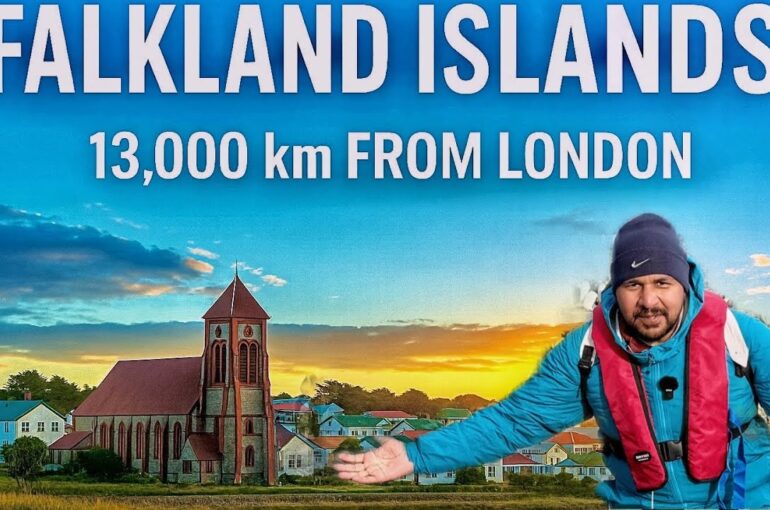
Where even Ravi has not reached, where even poets have not reached, Indians have reached there.
This gem costs ₹300. It gives a little emotional feeling. “Here, take the card and go.”
As soon as we got down from the port, we were given a day visitor pass. Brother, welcome to the land of the Defenders. Once again, our boat kept moving through the night from here and finally brought us here.
Hello. Salam. Sat Sri Akal. Ram Ram ji to everyone.
Welcome once again to a brand-new video.
Today is the fourth day of our cruise. When we woke up in the morning, we saw that our ship was anchored right at a port. Today, we have reached the capital city of the Falkland Islands – Stanley.
I’m calling it a city because it was officially declared a city only two years ago, in 2022. Before that, it was not recognised as a city. Even so, it is the capital. Our cruise ship has been docked at the port here.
Today, we have the entire day to rest and explore the Falkland Islands. Behind me, you can see my cruise ship. Earlier, the flag flying on the ship was Argentina’s flag, but now you can see that it has been replaced with the Falkland Islands flag. There is a very big story behind this.
The story begins in 1982, when Argentina captured these islands. Later, the Falkland Islands regained control. I will explain this entire story to you in detail. Because of this history, ships flying the Argentine flag are not allowed here. That is why the ship’s flag was changed.
This ship is registered somewhere in Africa—Lomé, I think, which is the capital of Togo in West Africa. Today, the entire city will be explore
d on foot by me and one more person. The rest of the group has gone by bus. There are buses every 45 minutes for around 4 km, but since we want to show you the entire port and the city properly, we decided to walk.
Beside us, you can see a marine pilot vehicle—like a police car, but for the sea. It’s basically the sea police vehicle.
The main reason this city exists is because of this port. These are all old docks. There is another ship anchored here as well. This is not a cruise ship; it’s something else. That ship is registered in another country. You can see the Togo flag at the back and “Lomé” written on it.
I had already told you about this. The exact reason for such registrations is not clear to me—maybe it’s related to taxes. That could be why ships get registered elsewhere. The payment for this cruise had to be made in USD, through a US bank account and address. The owner of the cruise is from Argentina, the ship is built in the USA, and the registration is from somewhere else altogether.
We were mistakenly walking from the wrong side when a driver stopped us and told us that there is a separate pedestrian walking path made especially for walkers.
When we got down at the port, we were given a day visitor pass. This territory comes under the United Kingdom, and we have arrived here from Argentina. Our passports are with the cruise authorities, who shared our details. That’s why we were issued day passes.
A special thing about these islands is that you don’t need a visa to enter here. You can enter visa-free. However, you will need a visa for the next destination—South Georgia, which we will visit later. I’ll explain that in detail when the time comes.
The port played a huge role in the development of this city. Why? Because this is a very deep-water port. The sea here becomes deep very close to the shore. From 1800 to 1915, before the Panama Canal was built, all ships travelling from South America to South Africa used to pass through here. This was their major resting and refuelling point.
Until around 1920, this port was always full of ships. After that, the importance of the port reduced. Today, only a few ships come here—mostly Antarctica-bound cruise ships, some South American cruises, or an occasional ferry.
Here, you need to get your card checked by security, and then you can proceed.
As soon as we stepped outside, the houses started looking different. The feeling completely changed. It feels like a UK-style system, just placed in a very remote location.
Friends, they have built fuel tanks here—petrol and oil depots. Many ferries come here, store oil, and refuel. Pipelines are laid directly from these depots to the ships.
Our total walk today will be about 8–10 km. We’ll walk to the end of the city, then return the same way. Tonight, our cruise will start sailing again, and for the next two or three days, we’ll be out at sea. Rough seas will begin today. That’s why we decided to walk a lot and tire ourselves out.
We’ve already walked around 1 km. We’ve reached the first supermarket. We’ll explore it properly while returning.
One thing I’ve noticed—there are so many Land Rover Defenders here. Every third vehicle is a Defender. Everywhere you look—Defenders, Defenders, Defenders.
There is a Range Rover parked here. That one is a Land Rover. There are so many of them.
The total population of this country is around 3,500—not even that, roughly 3,300 people. And for so few people, there are probably more cars than people here.
For just 3,000 people, look how big the supermarket is. Not one—there are two or three supermarkets here. I really feel like this is the land of Defenders. Look behind—another Discovery Defender. That one too—Land Rover, Land Rover, Land Rover. Defender, that’s also fine. This truly is the country of Defenders.
An ambulance just passed by—and even the ambulance is built on a Defender. What more can I say? There’s a Defender parked at homes, old ones too. There are so many old vehicles here.
Honestly, this place feels like the UK outside the UK. The houses look exactly like the UK—same patterns, same style. A few years ago, there was a referendum here. People were asked whether they wanted to stay with the UK or become an independent country. 99.2% said they wanted to stay with the UK. Only 0.8% wanted independence.
That means around 27–28 people voted against it. I wonder what their lives must be like now. The rest of the people would probably make life very difficult for them. In our country, that’s exactly what would happen.
This is a lodge. The Wates Foundation has built the Liberty Lodge here in Stanley. This road is called Ross Road East. You can see the UK flag and another local organisation’s flag.
These lodges are built because many people come here for tourism, cruise travel, and even flights do arrive here—it’s not like flights don’t come at all.
And look—another Defender has arrived. The season has just started, so more people will come now. Port work increases, and there are many kinds of jobs here. People from the UK probably come here to work. I’m sure I’ll find at least one Indian here.
People have stacked firewood outside their houses, and everything is arranged in a UK-style way. Water tanks are kept outside, not on rooftops like in our country—because strong winds and snow could knock them down.
This feels like walking through a small village in the UK’s Lake District. There’s a Defender parked here, and two Defenders parked at that house—old ones. They look so powerful. What incredible vehicles they must have been.
They’ve planted plants here, and look at how much effort they’ve made to protect even one tree. It’s fenced all around, covered with green material, just to stop the strong winds. Winds here are extremely powerful and can destroy trees. Their care for the environment really deserves appreciation.
Yes, in the past, they may have done questionable things—but at present, they are genuinely serious about protecting the environment.
Almost every house has a different coloured roof. Earlier, I told you these were water tanks—but they’re actually oil tanks. People store fuel at home. The metal used is so heavy that you’ll find ship graveyards around this area. Many ships were damaged here and left behind, because this was once a very major port.
There is pin-drop silence here. Hardly anyone is outside. But one thing you keep seeing—Defenders.
Look—another Defender!
The vehicle registration numbers here start with the letter “F”. We’ve reached Shackleton Drive. You all know Shackleton. He was an extraordinary man—an incredible leader. His South Georgia story is legendary. He rescued his crew from Antarctica against all odds.
If anyone wants to learn leadership, they should study Shackleton. This is the cemetery of this country. And look—Land Rover again, old ones everywhere.
Nature looks like a design studio here. Honestly, my heart wishes for a small house in a place like this. Not a big house—just one room, one roof. Only as much stuff as I carry on my bicycle—about 40 kg. Nothing extra. I could live peacefully like that.
Welcome once again to the land of Defenders. You might think I’m repeating “Defender, Defender,” but I’m genuinely surprised myself. Back home, many YouTubers who make a bit of money buy Defenders. And look here—these old Defenders are even more expensive than the new ones, because they’re antiques.
Look at this house—beautiful, probably 100–150 years old, made of iron sheets. Two Defenders parked outside—one 60–70 years old, another about 50 years old. Incredible.
Those yellow huts between the houses look lovely. Colourful houses everywhere. This hut looks amazing. That’s a children’s school—there’s a separate one for older kids.
Now we’re reaching shops. I hadn’t seen shops earlier. Wow—there’s a museum ahead. That’s the end point of the city. This is the main road—Ross Road. I’ll sit here for a while, talk to you, and rest.
I won’t go too deep into history, but I’ll give you a basic overview.
Before 1500, there were no humans here. Around 1520, an explorer passed by—waved and left without landing. Then no one came for 200–250 years. Later, a Spanish explorer came, then a French explorer in 1764.
Back then, Europeans claimed land by planting flags. Spanish, Portuguese, French, British—everyone did it. The French arrived first, then the British planted a flag on the eastern island. A few years later, the Spanish planted theirs on the western side.
The British left but placed a marker claiming the land. Later, Spain controlled it because South America was already under Spanish rule. In 1820, they even renamed the islands.
This port became very famous because ships travelling from Africa to the west coast of America stopped here. That’s why monuments from the 1800s still exist here.
In 1833, the British returned with the Royal Navy and took control again. They developed the port and collected revenue. But after the Panama Canal opened around 1915–1920, ships stopped coming this way, and the port declined.
In 1982, Argentina attacked and captured the islands. Britain responded, sending forces that took 60–70 days to arrive. Heavy fighting followed. Argentina lost around 650–700 soldiers, Britain lost around 250, including some British Indians. Memorials list their names.
After that, Britain regained control.
I usually don’t talk this much history, but today I felt like sharing it properly.
This is West Island, that’s East Island. The 45 Commando Group won the war here in 1982—We will remember them.
In 2022, Queen Elizabeth granted Stanley official city status.
This pillar dates back to 1820—it guided ships. It’s now kept as a memorial.
Now we’re heading to the National Museum of the Falkland Islands. Here you see old boats, propellers, cannons from 1902, printing presses from 1848, the first newspaper, old typewriters, stamps, registers, and tools.
Before machines, people transported goods manually. Jackets were made from seal skin, shoes from animal hide. Life was extremely tough in such cold conditions.
This memorial honours scientists, soldiers, sailors, and explorers who died on Antarctic missions. Bomb damage is still visible in places, though authorities confirmed in 2020 that unexploded bombs were cleared.
Here’s the map of the Falklands, our route, and distances. You’ll see old radio, telegraph systems, and the hut from where signals were sent to the world.
Finally, we stopped for coffee. A coffee costs around ₹500—cheaper than I expected. And honestly, this cappuccino is amazing. I wish our cruise served coffee like this.
That old printing press, the mechanic’s workshop, laundry area, radio department—everything connects to how this place once communicated with the entire world.
Radio signals were sent from here. Just look at how signals were transmitted in those days. Think about how much the world has changed between that time and today. How much effort humans have put in to reach where we are now.
This is where they used to connect the lines. Signals were sent like this. I vaguely remember something similar from old telephone exchanges. Back then, everything was done by hand. If someone said, “Please connect my line,” they would physically unplug one wire and plug it into another. There was no automation at all.
These electricity meters—you can still see similar ones in many houses in India even today. Honestly, it feels like I’ve come from big London to a smaller version of London somewhere in the south. Maybe a small town in southern England. I really enjoyed walking around this place. I’m liking it a lot.
On our way back, we plan to do two things. First, send a postcard. Second, exchange some currency at the bank. We’ll do that shortly.
This is the Historical Dockyard Museum. Postcards are still sent from here. In India, our postal system feels like it might shut down one day, but in the UK, the US, and Europe, post offices are still very actively used.
So, I came out of the museum, and as soon as I stepped outside, it started raining heavily. If you get soaked here, your entire tour can be ruined. So instead of going anywhere else, we decided to head to the bank.
I thought I wouldn’t meet any Indians here, but I was told that an Indian lady works at the bank, although she wasn’t present at the moment. The person handling the counter was a Filipino gentleman. He told me that one Indian lady works there. I was amazed. Truly, Indians reach places where even imagination doesn’t go—we’ve reached the Falkland Islands too.
Coming back to the point, I exchanged currency. I had $60 in cash. They gave me Falkland Islands currency—notes and coins—totalling 43 Falkland pounds, with proper bank stamps. Falkland pounds are equal in value to British pounds.
Then something amazing happened. I finally got to ride a bicycle here as well. I stopped a lady who was cycling and asked if I could take one round. She agreed. It was such fun! Even in a place like this, I managed to ride a bicycle.
Now we reached the post office. I bought postcards and stamps. The staff inside the post office were extremely helpful and kind. They explained everything so politely. The prices were reasonable too. I bought stamps for my collection and postcards to send.
I paid a total of four pounds. Falkland pounds are equal to British pounds, so it’s about ₹450. Falkland Islands stamps are very precious—not because of money, but because of where they come from. You’d never imagine finding such stamps back in India.
I decided to post the postcard at the beautiful post box near the museum. It felt special. Penguins, penguins, penguins everywhere. Normally, the postcard will take one and a half to two months to reach India.
It started raining again. They say you shouldn’t get wet in this weather, but I already was. The weather here changes every minute. One moment it’s sunny, then rain, then hailstones.
We had to return to the cruise by 5:00 pm. It was already past 3:00 pm. The last bus was at 5:45 pm. We waited near the police headquarters. Behind it is an old army prison built in 1850.
Once the rain slowed down, we started walking again. We needed to visit a supermarket because for the next 20 days, there would be no shops at all. We needed to prepare—maybe dal, snacks, anything would help.
We entered the supermarket. Prices were not as high as I expected. Pizza was around £6–£10. Milk was about £1.65 per litre. Coffee, vegetables, fruits—some things were expensive, some reasonable. Apples were cheap, but avocados and lemons were costly.
I spoke to a Filipino worker there. He said around 20 Filipinos work in this store alone. Their company is contracted from the UK. They work here for two to three years and then return home.
I bought coffee, Bombay mix (bhujia!), and snacks. Imagine finding Bombay mix at one of the most remote places on Earth! Truly, where poets and explorers couldn’t reach, Indians did.
The city really feels like the “Land of Defenders.” Almost every vehicle is a Land Rover Defender. Old ones, new ones—everywhere.
We passed beautiful antique buildings. One house had “1887” written on it and is still perfectly maintained. We visited the Native Plant Park, showcasing local plants of the Falklands.
Suddenly, wildlife appeared. Sea lions! We were missing wildlife until now, and finally, we saw them. Penguins also come here in season, though not at this time.
Our bus arrived. This bus was our last transport back to the cruise. This cruise is our home now—for the next 22–25 days.
We returned with rice, Maggi, snacks, and good coffee. Our tour bus was from Falkland Island Tour & Travels. That marked the end of today’s journey.
For the next two or three days, we won’t be stepping onto land at all. Our cruise will now head towards South Georgia—a journey of two and a half days across the ocean.
We’ll meet again in the next video.
Till then—stay happy, stay busy, stay fit.
Jai Hind. Jai Bharat.