

I Found an ALIEN CITY in Bolivia’s (Darkest Secret ) Ep. 45
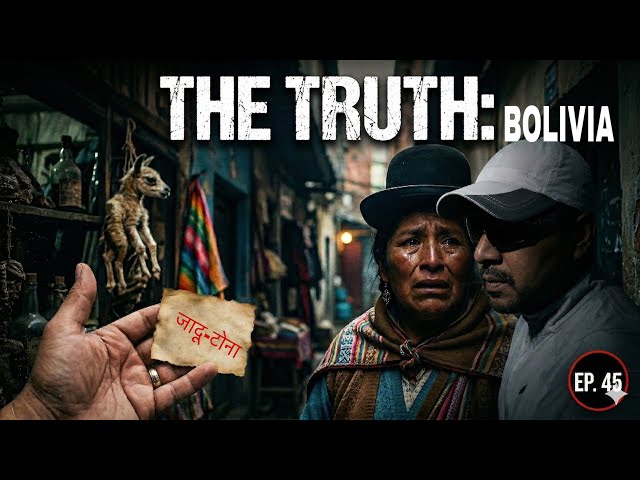
People are not buried underground here, brother. Here, people are buried inside the walls. If you look down, this whole area is La Paz city. Three types of rituals are performed here. A llama is buried in the foundation of houses. People worship Mother Earth here. You can even keep your family members inside as well. This is the kind of tradition here.
The country Bolivia is named after a freedom fighter.
Namaskar, Salaam, Sat Sri Akal, Ram-Ram ji. Once again, welcome to my Bolivia series of the Pole-to-Pole journey. At this moment, we are in the capital of Bolivia, La Paz. This city is extremely beautiful. I would say it is one of the most beautiful capitals in the world. I will show you everything, so watch the full video till the end. I will show you the full history of Bolivia and what all can be seen in La Paz.
Before talking about La Paz, let me first talk a little about Bolivia. Bolivia is a very historical country. It has a very ancient history. In South America, you could say it has one of the oldest histories. Thousands of years ago, there was a civilisation called Tiwanaku (I will write the name on the screen). After that came the Inca civilisation, which arrived around a thousand years ago. We will talk much more about the Incas when we travel to Peru later.
After that, the Spanish arrived here. Around the 1500s, the Spanish started coming to this region. By the early 1800s, the local people expelled them. Around the 1820s, there was a very famous person here named Simón Bolívar. I will also write his name on the screen. He was a freedom fighter. The country Bolivia is actually named after him. This is the first time I have heard of a country named after a freedom fighter.
Although he was originally from Venezuela, he tried to unite the whole of South America and played a major role in the independence movement here. That is why the country is named after him.
Now let’s come to La Paz. La Paz is the capital city here. Interestingly, Bolivia has two capital cities. One is La Paz and the other is Sucre. Sucre is the place you might have seen in my previous videos when we visited Uyuni and nearby areas. The Supreme Court and some government institutions are located there. However, most of the administrative work happens here in La Paz.
This capital is also the highest capital city in the world. The city centre of La Paz is located at around 3700 metres above sea level. Nearby there is a town called El Alto, about 2–5 km from here, which is around 4100–4200 metres above sea level. So right now we are in the highest capital region in the world.
Even while walking, I get out of breath. You can probably hear it in my voice. I can hardly even speak properly because of the altitude. And this is happening even after staying here for 15 days. For the last fifteen days I have not done much here, I was mostly resting. Sometimes even while sleeping my breathing felt difficult.
So I will try to go down to a lower altitude soon. But before leaving, I want to explore the city. In today’s video I will show you two or three famous things here. There are about five or six very famous attractions in this city. One is the viewpoints, another is the metro or transport system, one is the cemetery, and another is the local culture.
In today’s video I will show you two things: the local culture and the cemetery.
The whole city is built like a bowl. Mountains surround it from all sides, and the city centre is in the middle at the bottom. The closer you go towards the centre and lower areas, the more expensive it becomes. Wealthy people live down in the valley, while poorer people live higher up on the hills.
This is the first time I have seen such a system. Normally rich people live on hills and poorer people live below, but here it is the opposite.
This place here is an Indian curry house. Before leaving, I will have breakfast here and then start exploring. We will have tea at the station.
Now we have reached close to the city centre. I needed some medicine, so I am looking for a medical store. Here they call medical stores “Farmacia.”
This is the main city centre. This is the local transport here. Small vehicles like these operate within the city. If you want to go a little further, then these older vehicles are used. They are not exactly buses or trucks, something in between. We saw similar vehicles earlier in the Philippines, like jeepneys.
The buildings here are quite old, but new buildings are also being constructed alongside them. Here you can see people standing in a queue for the bus. They are waiting for the bus to arrive.
This is a memorial here. And that building there is a club of La Paz. It is the oldest clubhouse, built in 1882.
Right in front of this park, on the other side, there is a prison. It is a very famous and unusual prison. I will tell you its full story once we reach there. It is called San Pedro Prison.
So friends, the wall you see behind me is the wall of San Pedro Prison, located right inside La Paz city. One very unique thing about this prison is that inside you can actually rent a room. Prisoners have to pay rent depending on the type of room they want. Some rent a bed, some rent a room, and the richer prisoners can afford better facilities.
There are even restaurants and other facilities inside the prison, and prisoners can also live there with their families. This is the kind of prison system here. It is quite famous.
Tourists are not allowed to go inside anymore because too many tourists started visiting in the past. Earlier, tourists could even go inside the prison.
This is San Pedro Prison. The walls are extremely high — probably around 50 to 60 feet tall.
These walls are very high. Look at this – the Anglo Americano jurisdiction building, and the court was also here from 1945 to 2025.
These people are waiting here to go inside. They are family members, carrying belongings to take inside.
Here is another station for the wooden cable car system.
Brother, this entire street is filled only with hotels. Everywhere you look, there are hotels. A lot of tourists come here. One thing I have noticed – there are so many Israeli tourists here, you can’t even imagine.
Look, there is a church. Now we have arrived at a square. See how beautifully they have designed the square. Look at the vehicles.
Oh wow, the police have set up their barriers here. These women are selling fruits. There are police everywhere. Maybe some programme is happening today, or perhaps some important person is coming. There is heavy police presence everywhere.
While walking around, I have reached the city centre. There is quite a crowd here. If you look closely, most of the tourists you see here are Israelis. Either you will see locals or Israelis – it’s rare to see other tourists.
Now there is a bridge-like walkway here. Let’s walk across it. It feels quite nice walking around here. Honestly, I spent almost 10 days here without exploring much, which was a mistake.
People are sitting everywhere. Maybe some programme will happen here today. Everyone seems to be waiting. People are sitting all around.
Today is Good Friday, so that might be the reason for the big crowd.
This place here is the Centro Plaza, the central square. Because it’s Good Friday, there is a lot of gathering here. Something is likely to happen soon.
Look at the beautiful sunset light coming from behind the buildings. It looks amazing.
There is a line of people stretching at least 5–6 kilometres. Look over there – it’s incredible.
See this bread shop – the entire shop is filled only with bread. Many times this place gives a feeling similar to India.
Look here – there are barber shops lined up together. One, two, three, four, five barber shops on one side, and more on the other side. Just like in India, where many barber shops are located together.
This is the Tourist Police Station, meant to ensure tourists are not harassed. Most tourists stay in this area. I was also staying here.
You will find many people here calling out loudly offering currency exchange. Bolivia currently has a shortage of US dollars.
But the city streets are extremely steep. Walking uphill inside the city is quite difficult.
I exchanged 200 dollars, and I received 1882 Bolivianos. You will find currency exchange shops everywhere here. Usually, they offer rates between 900 to 950, depending on the place. This shop gave me a good rate.
Just like we use Ayurveda in India, the locals here use traditional herbal medicine. For example, in this shop you can see aloe vera and many other local medicinal plants.
Let me show you something interesting. You can see incense sticks, herbs, and different types of leaves here. These are used to make traditional medicines.
In Bolivia and Peru, the ancient tribes had very old spiritual beliefs. Although most people today are Christians, they still follow many of their ancient traditions and beliefs.
They worship Pachamama, which means Mother Earth. Pachamama is very important here. Whenever they start any work, they make offerings to Pachamama.
The offering rituals are quite unique. Just like we perform havan rituals in India, they also perform similar rituals here.
Look here – all the items needed for the ritual are kept here. There is coal, herbs, incense, and small wooden sticks used in the ritual fire.
Another important thing here is coca leaves. Coca leaves are extremely popular here. People chew them regularly, just like people chew paan in India.
Coca leaves mainly come from the region near the Death Road, where I had gone earlier. That area produces most of the coca leaves.
People chew coca leaves because it helps prevent altitude sickness at high elevations.
Here you can see the wooden sticks used for ritual ceremonies. Everything needed for the ritual is available here.
Now let me show you the most surprising thing.
What you see here is a llama fetus. It is a dead baby llama. In some places you can even find the entire fetus preserved.
Whenever someone starts building a new house, they bury this llama fetus under the foundation.
Yes, the llama fetus is buried in the foundation of the house. It is believed to bring good luck and protection, so that no problems come to the home.
Just like we have priests or spiritual practitioners in India, they also have similar spiritual practitioners here.
The reason they bury the llama is as an offering to Pachamama. The llama is the main animal found in this high-altitude region. Very few other animals survive at such high altitudes.
There are also other types of rituals performed here – some rituals for love and relationships, and some for wealth and money. So mainly there are three types of spiritual rituals practiced here.
This entire area is called the Witches’ Market. In English it sounds like “witch market”, but in reality it doesn’t mean something negative. For locals, this market is considered auspicious and sacred.
So according to us it might sound like a “witch market”, but for them it is a holy or lucky market.
You can see llama fetuses and ritual items everywhere here. The whole market is filled with such shops.
And just ahead in this same market is the room where I was staying.
So this was the story of the Witches’ Market.
The dress that these women are wearing is the traditional dress here. You will notice many women walking around with two long braids. They belong to a specific community. I will explain their full history properly in the next video because you will see them everywhere in this region.
This is the local lifestyle and culture here. From here to there, it’s about a 100-metre stretch of similar shops.
I stayed in this building here. Compared to other countries, it’s quite cheap here. I got a decent room in a good hotel for 18 dollars, which is roughly ₹1700.
There are also many music instrument shops here. Almost every third shop sells musical instruments. There are many traditional instruments used by the locals.
The city is beautiful from above as well. Many clothes here are made from llama wool, and you can find many handmade clothes. Although sometimes it’s hard to tell whether they are truly handmade or imported from places like China.
You see this woman sitting here with two braids. I will explain the full history about this community in the next video. Perhaps by the next video we might also leave this place.
So friends, there has been a small problem. I had gone to an Indian restaurant to eat food. A brother there accidentally changed the camera settings, and it got switched to slow motion. Because of that, I am doing the voice-over for this entire video.
As I mentioned earlier, La Paz is the highest capital city in the world. It is also the only city in the world where cable cars function like a metro system.
There are 10 different cable car lines across the entire city. Just like Delhi has multiple metro lines, La Paz has multiple cable car lines.
The ticket price is only 3 Bolivianos for a ride. With just three Bolivianos, you can travel from one place to another.
Now we are going to take the cable car towards El Alto, which is located at about 4150 metres above sea level.
This is the highest-altitude large city in the world, with a population of around two million people. In the beginning, it was settled mainly by poor people. Slowly more people started moving there. Poor communities gathered and over the last 30–40 years it has developed into a proper metropolitan city.
Earlier, wealthy people used to live in La Paz, but many workers had to travel up to El Alto for work. Because of this, there used to be heavy traffic jams. So the government gave a contract to an Austrian company to build a cable car system.
This cable car network was completed in 2008. Since then, it has become the main transport system of the city. It connects La Paz, El Alto, and surrounding areas. In total there are about 40 kilometres of cable car lines here.
If you look below, this is the entire La Paz city. Now we are travelling towards El Alto. La Paz city is shaped like a bowl. It is surrounded by mountains on all sides, with the main city lying in the valley in the middle.
Around one million people live inside La Paz city itself, and the larger metropolitan region has around 3–3.5 million people. Roughly 25–30% of the country’s population lives in this region alone.
Now I have reached El Alto. El Alto used to be known as a city of poor people, but now it has developed quite a lot. One of the largest free markets in the world takes place here. For about 5 kilometres, you will find only second-hand goods being sold. In simple words, you could call it a huge flea market or thief market.
This market takes place only two days a week – Thursday and Sunday. Today is Friday, so there is no benefit in going there now.
So from here we will go to another beautiful place. We will take another cable car to a very famous location called the General Cemetery.
Now we have taken the Red Line cable car. Just like in India we have Yellow Line, Blue Line, Magenta Line in the metro, here also there are different coloured cable car lines. This one is taking us towards the General Cemetery.
Look how beautiful the entire city looks from here.
Friends, now we are entering one of the most unusual cemeteries in the world. Here people are not buried underground. Instead, they are placed inside the walls.
And the most shocking thing about this place is this: each small compartment you see contains one dead body. And these compartments are actually rented.
A body can stay here for a maximum of 10 years. After ten years, if the family is wealthy, they can remove the remains and place the bones in a smaller compartment built specially for that purpose.
Wealthy people can afford larger spaces in the cemetery, while poorer people use smaller spaces.
At one time, around 500 to 800 bodies can be placed here. The government places a sticker notice on each compartment. Once the 10-year period ends, the family receives a notice to remove the remains.
Another fascinating thing here is the artwork. Painters from around the world have come here and created beautiful paintings on the graves and walls.
This place is truly extraordinary. I have never seen a place like this in my life.
The ladders you see standing here are used by families. If someone’s grave is on the third or fourth row, people use these ladders to climb up, clean the grave, or perform rituals and prayers.
People even rent these ladders for that purpose.
Just like in India priests come to perform last-rites rituals, here too there are people who perform similar ceremonies and rituals for the dead.
It is a very strange place. I have never seen anything like it before. From a distance it looks almost like another city built within the city. In a way, you could say this area is a city of the dead.
This cemetery is not outside the city; it is located right in the middle of the city. The first burial here took place in 1828.
Because the entire area is a valley, burying bodies underground was very difficult. That is why this cemetery system was created. Earlier people used to bury the dead inside churches, but later burials started happening here.
This system became so common that across the country many multi-storey cemeteries began to be built.
Now I have arrived in this area. There are three or four Indian restaurants here. One of them belongs to an Indian brother from Agra. He is also a yoga teacher and has married a local Bolivian woman. Let me introduce you to him.
Among the three or four Indian restaurants here, this one belongs to my friend. This gentleman is a yoga teacher from Rishikesh.
“Namaste brother.”
“How are you, brother?”
“Sat Sri Akal.”
“Namaste, Namaste. How are you, Deepak ji?”
“Very good, very good.”
He has arranged a small seating area here.
“I’m just roaming around today.”
“Come in the evening.”
“Yes, we’ll meet in the evening.”
“Okay, take your time.”
He opened this restaurant about a year ago. In this street you will find all the Indian restaurants.
But now it has started raining. Sometimes when I feel like exploring, something unexpected like this always happens.
There is another Indian restaurant here run by Rana ji from Uttarakhand. Two more are ahead. In total there are four main Indian restaurants in La Paz.
The place is nicely arranged. There is a Curry House here and another restaurant called Haveli across the street.
Usually I eat regularly at this brother’s place. If I want tea or parathas quickly, I come here. Otherwise in the evening I go to the other restaurant.
“Namaste brother.”
“Namaste brother, how are you?”
“I’m very good. You tell me.”
“Everything is good.”
“Feed me something nice today!”
“My friend, whatever your heart desires.”
“No, you decide what to cook, I’ll happily eat it.”
“Whatever you like, make it.”
“I like younger brothers like you – whatever you cook, I’ll eat.”
“Make something simple… we’ll eat dal and roti and thank God.”