

PERU 🇵🇪 Ka Pattalok, WORLD’S HIGHEST FLOTING ISLAND , Ep. 47
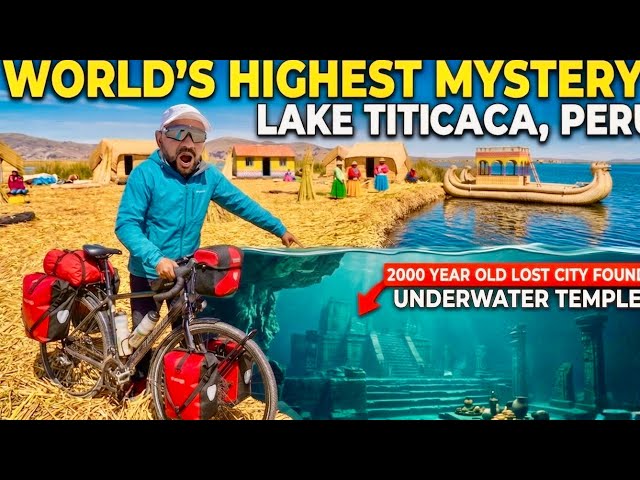
It is easy to build these islands here, but very difficult to maintain them. A small watermelon costs ₹27 here. This is one of the biggest lakes. Earlier, houses were built in a different way, but now they are made like this. There is a variety called quinoa. This is their traditional dress. I have never seen so many dental hospitals in one place in my life.
Hello, Namaskar, Salaam, Sat Sri Akal, Ram Ram ji! Once again, welcome to my journey.
Today is my third day in Peru. Right now, I am in a small town called Juli. From here, I will go to Puno, which is about 70–80 km away. It is around 9:00 in the morning. It was raining, and everything is wet.
Last night, I stayed in a hostel which cost me ₹1500. There is still light rain, but I will leave anyway. I am having some breathing problems, so I might not go towards Cusco. Instead, I will try to go down to a lower altitude because I am finding it difficult to breathe here.
Let’s move ahead.
Friends, this is the church of Juli. The bell rings here every hour. The town is surrounded by small mountains from all sides, and it looks very beautiful. It is called the cultural tourist capital of Lupaca.
In every city here, there is a small park in the centre, and they maintain it very well. Even yesterday evening and now in the morning, security guards are standing here.
Some tourists from Brazil are here. I am able to cycle, but I cannot speak properly because I get breathless while talking. I have been in this region for more than a month now, but still facing this issue. Maybe my body cannot handle this altitude.
Anyway, I will now leave for Puno. There are chances of rain again.
This is a small town. Look at the stadium—very well built. The roads are good, but you can see poverty as houses are basic. Still, the government has done a good job with infrastructure.
Now I have left the city. Puno is 70 km away. The road along the lake is good. They have also removed encroachments here.
I have covered about 25–30 km. I am just eating bananas and apples because I don’t feel very hungry. I don’t even feel like cooking. Slowly, I will reach.
The weather is getting worse. I think I will reach by 2–3 PM because the road is mostly flat.
I am riding fast now. There is no shoulder on the highway, but the wind is in my favour. I hope I reach before it rains again.
I have entered Puno at 2:00 PM. I covered 75 km in 5 hours. If the road is flat and the wind is supportive, it becomes easy.
The city is quite big. We will go inside the city and then towards the lake.
Welcome to Puno! This is the first big city I have seen in Peru. The whole city has election banners everywhere. This is the police headquarters, and that side is the army area because the lake acts like a border. Half of Lake Titicaca is in Bolivia and half in Peru.
This is a cemetery, similar to the one I showed earlier.
Now I am in Puno. Yesterday, I went to an Indian restaurant run by a man named Salim bhai from Pakistan.
This was my hostel. Now I will explore the city and show you Lake Titicaca.
This is Salim bhai. He helped me and dropped me at the place where I can get boat tours.
He told me to try quinoa. So now I am eating quinoa. It is similar to bathua or rajgira. It is a type of seed. They boil it for a long time and eat it for breakfast. It is very healthy—100 grams of quinoa contains about 12–14 grams of protein.
People eat it with bread. It makes a light and healthy breakfast.
Look at this Bajaj auto—it is very well designed here compared to India.
Now I have reached Lake Titicaca. Salim bhai dropped me here. From here, I will take a boat.
Lake Titicaca is very famous. I will explain its history later while sitting in the boat.
The boatman was asking for 40 soles for two people. Since I was alone, I asked him to take me alone, and he agreed.
Be careful here, as some people charge up to 100 soles. Thanks to Salim bhai, I got a better deal.
Now we will go to the lake.
Wow, this is amazing! Lake Titicaca is the highest navigable lake in the world.
Usually, these boats carry 8 people, but I am going alone.
There are different types of islands here. Some are spiritual islands, especially on the Bolivia side. People believe their sun god originated from there.
Now we are going to another island called the Uros Islands. These are floating islands. People have built them using reeds and wood.
Let’s go and see how people live there and learn about their culture.
The boatman waited for some time hoping more people would come, but finally, he started the ride with just me.
There are many ducks swimming in the lake.
Now we are reaching the islands. There are small islands everywhere. We are moving between them.
Welcome to Lake Titicaca!
Now we have reached the floating islands. The ground is moving slightly. To stop the island from drifting, they have fixed it with long wooden poles underneath.
These are floating houses built here. Everything is made from this material. She is asking me to sit here. They have turned this into a business.
She is speaking a bit of Spanish.
“Where are you from?”
“I am from India.”
“What is your name?”
“Raj.”
“My name is Ana.”
“Nice to meet you, Ana.”
“Welcome.”
“Thank you.”
She is explaining that there are about 20 islands here. On this particular island, around five families live, making a total of about 20 people.
Look at this island—these are their houses. This is the root material used to build everything. These are the modern houses, and those are the old-style houses. Earlier, houses were made like that, but now they are building more modern ones.
They also use this same material to make boats. The school is on another island, so children travel there by boat every day.
This area is called the Uros Islands. There are about 20 such floating islands, and among them, there is even a floating school, which is quite unique in the world.
These handicrafts are all handmade. Now they are selling these items to tourists. They are trying to sell them to me as well, but I am wondering how I will carry them.
Now they are saying that if I want to ride their traditional boat, I need to pay 20 soles for a 10-minute ride.
These islands are made by layering reeds (a type of grass). They keep adding layers on top, and even water tanks are placed on them. It is quite amazing how they have built everything.
Now let’s return to the boat.
Let me tell you a bit about Lake Titicaca.
It is the highest navigable lake in the world. “Navigable” means boats can operate here. It is located at 3,812 metres above sea level. It is the only lake in the world at such a high altitude where boats can still run.
The depth of the lake goes up to about 284 metres. It is around 180 km long and about 80 km wide, covering roughly 12,000 to 18,000 square kilometres.
By area and water volume, it is the largest lake in South America.
How was it formed? Long ago, due to tectonic plate movement, a basin was created. Mountains formed around it, and glaciers filled the area. Over time, the glaciers melted, forming this lake.
Earlier, this lake was even bigger and was known as Lake Boliviano, but it has been shrinking slowly over time.
I am still struggling to speak properly because of the high altitude. My speech is getting affected.
There are about 20 small floating Uros islands here, but there are many more islands in the region.
The earliest tribes here used to farm around this lake. They believe that the sun and stars originated from this lake, so they consider it very sacred.
It is a freshwater lake, which is quite rare.
Now the boatman says we should leave. This place has become very touristy now.
If you look at the sky, it looks like cotton bundles spread across it—very beautiful clouds.
Let’s move to another place.
Talking about wildlife—there is a type of duck here that cannot fly. The reason is that it has lived in this lake for so many years that it gradually lost its ability to fly.
There is also a frog that never leaves the lake. It breathes through its skin.
We stayed on the island for about half an hour. The boatman showed me around and then asked to return.
How are these floating islands made? First, they fix wooden support underneath, then layer reeds on top continuously. This is how the floating structure is created.
Look over there—they have even kept pigs on the island.
This lake is also called the “Pearl of the Andes” because it is surrounded by the Andes Mountains and looks like a pearl in between. It is also an important freshwater source.
Around 25 rivers flow into this lake, and only one river flows out.
From above, the shape of Lake Titicaca looks like a puma catching a rabbit.
Astronauts who went to the Moon could even see this lake and Salar de Uyuni from space.
In winter, the surrounding temperature drops to -5 to -10°C, but the lake water remains between 10 to 15°C and never freezes.
A few years ago, divers explored the lake and found a 1,500-year-old temple underwater. Interestingly, the current tribes are only about 500 years old, so the temple is much older.
People here worship the Sun as a god and Pachamama (Mother Earth). The water of this lake is considered sacred.
The earliest known tribe here was the Tiwanaku civilisation, famous for architecture. Many ancient constructions in this region belong to them. They existed around 500 years before Christ.
After them, other tribes developed here, especially known for farming, particularly maize cultivation.
Later, in 1668, the Spanish arrived in this region (though they had reached South America earlier). They came here mainly because they discovered silver in nearby mountains. They exploited the area for 150–200 years.
There was also an iron boat built in the 1800s, one of the oldest to operate on this lake.
Building these floating islands is easy, but maintaining them is very difficult. Every 15–20 days, a new layer of reeds must be added because the bottom layers rot away. Without maintenance, the island would disappear.
The traditional boats here are called balsa boats. They are expensive to make and last only about six months before the reeds decay.
The people living on these islands belong to the Uros tribe. They speak their own local language.
For thousands of years, two main tribes lived here—the Aymara and the Quechua—each with their own languages. The people on these islands still speak their native languages.
Brother, the guy was asking for an island ticket. First, he said 10 soles, then he reduced it to 8. I asked him to give me the ticket, and he handed me an old ticket which actually had a price of 5 soles. So I gave him 5 soles only.
Honestly, at tourist places, some level of cheating happens everywhere. Peru is a very popular tourist destination. Especially after Machu Picchu became famous, tourism increased a lot. Earlier, it was a hidden place in the jungle, but after it was discovered, the whole country became more touristy. And wherever tourism grows, people become more sharp and business-minded. I saw the same thing here.
Now, let’s say goodbye to the Uros Islands and head back to the beautiful city of Puno.
So, we are back again. That was Lake Titicaca. Now let’s move towards Puno city.
Puno is a very historical city, located on the banks of the lake. Many tourists visit here. Like other Spanish-influenced cities, it also has a central square called Plaza de Armas.
The population of this city is around 120,000. It is the second-largest city in the Titicaca region. Another nearby city, Juliaca, has a population of around 300,000.
Look at this beautiful statue—it represents their Sun God. The entire city is surrounded by hills on three sides and the lake on one side. It feels like the city is sitting in the lap of the mountains, slowly moving towards the lake.
You can see women selling and eating food right here on the streets.
This region has been famous for farming for many years. Speaking of farming, quinoa is very popular here. It is a type of seed, similar to bathua or rajgira. It is very rich in protein. People say the best quinoa in the world grows in this region.
Most houses here are not painted. If they paint their houses, they have to pay more tax, so people avoid colouring them.
One sol is about ₹27. Look at this small piece of watermelon—it costs ₹27.
Now I am heading towards Plaza de Armas through a beautiful street.
Brother, I have never seen so many dental clinics in one place in my life! Everywhere—one after another—dental shops, dental hospitals, orthodontists, paediatric dentists… it feels like every third person here is a dentist!
In between, you also see nail salons, ultrasound centres, and small shops.
The houses look very similar to Indian village homes—metal shutters, grills, and simple structures. Some multi-storey buildings also remind me of Indian colonies.
Look at this wall painting—it is amazing. It shows the entire history beautifully.
This street is quite famous. If there were no vehicles, it would look even better.
Now we have reached the city centre. In front, you can see the famous church. The Spanish used to design cities like this—with a central square, church, court, and administrative buildings.
That building is the court, and over there is the police headquarters. This area preserves culture while also being modern and clean.
There are also many Chinese restaurants here. In fact, across South America, you will find Chinese restaurants and shops in almost every city.
Here is another beautiful park with a church.
I am not sure if I will leave tomorrow because there are elections here on Sunday, which might cause some issues.
This is a simple house—completely raw structure.
And this is the Indian restaurant run by a Pakistani man. I had met him earlier in La Paz, and then came here.
After eating at the restaurant, I went to get my laundry done. It has been many days since I washed my clothes.
Security is quite strong here. You can see police officers everywhere throughout the day.
Look at their traditional dress:
- Women keep two braids
- Wear a hat on their head
- Carry children or सामान (belongings) tied on their back
This is their traditional attire.
Now I am in the central market. You can find everything here—fruits, eggs, milk, groceries, and daily items.
There is also a small temple where people light candles.
Wearing a hat here is important because the UV radiation is very high at this altitude. Without protection, there is a risk of skin damage or even skin cancer.
This is the local rickshaw.
There is only one big supermarket in the city—Plaza Vea. I have come here to buy some items and check the prices.
I bought basic things like soap, toothpaste, milk, and toothbrushes. Taking care of teeth while travelling is quite difficult, especially during long journeys.
Now I have made another decision.
From here, I will go to Arequipa, which is around 250–300 km away. After that, I will go to Nazca, and then move towards Lima.
So, let’s end today’s video here.
Stay happy, stay busy, stay positive, and stay healthy.
Jai Hind, Jai Bharat 🇮🇳