

Antarctica’s Wildest Penguin City: 10 Lakh Kings Penguin 🐧👑 | Pole to Pole Ep.7
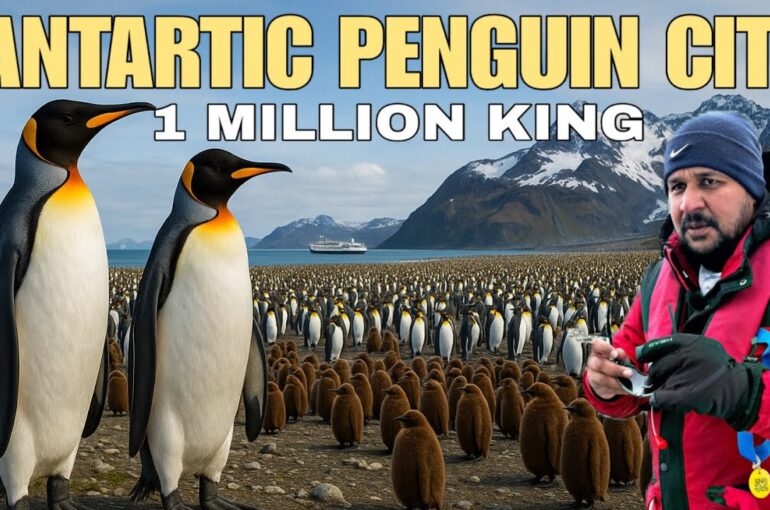
This gentleman here was heading for mating. He came running because this is his territory. No one is allowed to take over his area. There are millions of them here, but even then, a mother always recognises her child. Suddenly, one will rush out and grab you if you’re not careful.
At this moment, I am standing in the largest colony in the world.
Good morning, salaam, namaste, Sat Sri Akal, Ram Ram ji.
Today is the eighth day of our journey, and I warmly welcome you to Day 8. Behind me, you can see this massive ship in which we travelled all the way here.
I started the video a bit late today. I could only start recording after landing. It’s raining, and the rain has made conditions quite bad. Nothing is coming out perfectly, but we’ll keep trying and keep filming.
Today, we are going to Salisbury Plain. You may have heard this name before. In England, there is a famous place with many stones. But here in South Georgia, Salisbury Plain is something else entirely.
We have stepped off our zodiac boat and arrived in the plain area. This is the first time I’ve seen such a flat area in the whole of South Georgia. Flat land is very rare here. This area is around 2 to 5 kilometres wide. About 80% of South Georgia is covered by glaciers. They may not look like glaciers now, but they’ve formed massive mountains. Some peaks rise up to 3,000 metres.
Right now, we’ve arrived at a huge king penguin colony. King penguins are truly the kings of this region. Only one penguin species is larger than them, and I’ll show you that one later in Antarctica.
Look at this beside me — this is a female elephant seal, and both the mother and her pup are sleeping together. On the other side is a male elephant seal pup. This one must be 15–20 feet long. From far away it looks small, but up close it weighs 3,000 to 4,000 kilograms.
Let me show you something interesting. Near the tail, there is a gland that releases oil. They take this oil with their beak and spread it over their entire body. Because of this, water does not stick to them at all. Even at 300 metres deep in the ocean, their bodies remain dry, which helps maintain their body temperature. They can easily survive –10 to –20 degrees Celsius.
Because of the rain, I can’t shoot properly, but I’m still trying to show you everything. Look how the rainwater just slides off its body and falls behind. It doesn’t stick at all.
This one here is a lone king, walking around in his own style. Look how many there are here — these black and white dots you see everywhere are all king penguins. You can’t count them with the naked eye. This data is collected scientifically by area. As I go further, the colony becomes even bigger.
Right now, I am standing in the largest king penguin colony in the world, at Salisbury Plain. People in England know of Salisbury Plain there, but this Salisbury Plain in South Georgia — the gateway to Antarctica — is breathtaking.
This place is truly a king penguin paradise. Around 400,000 pairs of king penguins live here. That means 800,000 adults, and the chicks are extra. In total, there are over one million king penguins here.
Everywhere you look, it’s flat land with colonies every 50 to 100 metres. Some colonies have 100 penguins, some have 50. King penguins are the true rulers of the ocean. They can dive 300 metres deep. Only one penguin dives deeper, and I’ll show that one later in Antarctica.
Some facts about king penguins:
They live in pairs and try to remain with the same partner the following year. The female sits on the egg for four months continuously, during which she can lose up to 40% of her body weight. Normally, their weight ranges between 10 to 16–17 kilograms.
Some penguins start following us from behind. It’s fun watching them. I’ve shown penguins before in earlier videos, but these are on a completely different level. They are more attractive. Their long beaks and the colourful fur around their necks make them look like beauty queens wearing necklaces.
Alright, I’m joking — but sometimes the beauty of the place really gets to me.
Look at this one — sitting so gracefully, completely at rest. When they sit on eggs, they have to stand continuously, so now it’s resting after coming out of the sea. You can see snow falling on it, but it doesn’t stay — it just slides off.
Soon, we’ll start seeing chicks. You’ll notice smaller penguins with fluffy brown fur — those are the chicks.
Standing here feels like I’ve landed on another planet. Penguins everywhere. The smell of the ocean is strong, glaciers behind us — it feels unreal.
We’ve already walked about 2 kilometres, and still, penguins are everywhere. People laugh when they see us because both of us are YouTubers. Sometimes we irritate people, sometimes they enjoy watching us.
At this moment, around 200,000 king penguins are present in this area. The mist is hitting my face strongly. You can even see penguins climbing up mountains — I have no idea how they manage it, walking like that and still climbing so high. They’re sensitive creatures, and watching them is pure joy.
As we move further, we’ll see more chicks. Winter has just ended, and the mothers are returning from the sea. Right now, the population looks smaller, but during peak season, there isn’t even space to place your foot.
The mothers spend four months at sea, collecting fish. When they return, they look very fat because their stomachs are completely full of fish. They come back to feed their chicks. During winter, the chicks stay alone and lose weight. Some weaker chicks don’t survive. Occasionally, you’ll see dead chicks. Look — here’s one that didn’t make it.
But look there — that chick following its mother. Its mother has returned. She’s telling it to wait while she gathers the partner. Now look — mother, father, and chick are together. The family is complete.
This entire process takes 12 to 16 months. Four months on the egg, four months at sea, then the chick grows and eventually goes into the ocean. After that, they all part ways.
One amazing thing — the chicks return to the same place every year. They don’t abandon their birthplace. Even at sea, they travel in pairs. Some travel up to 10,000 kilometres, mainly collecting fish. They often stay near whales because fish gather around whales.
Nature is incredible. We’ve spent almost three hours in this area. Watching what nature has created makes you realise the power of the Creator.
Now they’re done cleaning their chicks and heading to the river for a bath. They’re taking a proper shower in the river, and we’re crossing the same river too.
We’re walking through snow within the colony. The scenes here are unbelievable. If you want to see such views, you can follow and subscribe — more amazing places are coming. We’re slowly heading towards Antarctica now.
This one decided to stay here — either it’s scared or posing like a model penguin. Look at that one walking alone confidently.
The weather has started to clear a bit. All around you can see glaciers everywhere. As far as your eyes go, it’s penguins and penguins. You can truly call this a Penguin Paradise.
And over there, in the distance, you can see our cruise ship waiting.
Now, all these penguins you see have just come out of the sea. From here, they will all move in that direction, because their chicks are over there. Look at this one — it’s searching for its chick. It has chosen this route. Slowly, it will start hearing its chick’s call. The moment it recognises the voice, it will suddenly speed up and run in that direction.
This is how they do it. Right now, it’s just calmly searching. It will call out, then stop, then call again. Once both the parent and chick recognise each other’s voices, it will reach very close to the chick.
You can see this water path here. These paths usually form when water flows down from the mountains and glaciers. Many paths are also formed by penguins’ feet. You might wonder how — but penguins follow the same route again and again. When they come out of the sea, they need a clear path to their colony. These routes are called “Penguin Highways.”
Why Penguin Highway? Because everything around is snow, and penguins use a single fixed route to go from the sea to their colony. If you stand in the middle of their colony, they usually stop and wait.
This is how penguin colonies work.
Now, it’s finally time to leave this place. I really don’t want to go, but our team is asking us to move quickly. A storm is expected, and they want us out before it arrives.
Look how far our ship is — all you can see between here and the ship is penguins everywhere. Those yellow-looking ones are all king penguins. What a sight! The colonies have now mixed together, and this is just the beginning of the season. As the season progresses, you’ll see bones everywhere — bird bones, seal remains — things I haven’t even shown you properly.
Look at this — the entire colony seems to be moving along with us. I really don’t want to leave this place, but we have to. Our zodiac boats have already started leaving, slowly taking people back.
You can still see small pieces of icebergs floating in the sea. These have broken off from the glacier nearby. I’ll walk towards that glacier now.
Until around 1910–1912, there was no lake here. This lake exists today only because of climate change. If we don’t protect the environment, the future will not be good. We may not feel it today, but glaciers here have already retreated 1,500 metres. That’s huge.
Let’s go down and explore the opposite side. They won’t take us too close to the glacier because glaciers constantly break and collapse, making loud cracking sounds.
Everyone is waiting for us. And look — our routine starts the moment we return: cleaning our boots. This is mandatory.
This bird here looks like a white sea pigeon. It’s probably another seabird, but to me, it looks like a big pigeon.
In the morning, the sea here was extremely rough. Now, it’s completely calm. Ice pieces are floating gently. The two glaciers I mentioned earlier — both of them used to meet here. This entire area used to be covered in ice. Over the last 80–100 years, it has all disappeared. The glacier’s length has reduced by 1,500 metres.
Let me tell you something personal. When I reached Ushuaia, I was confused whether I should go to Antarctica or not. Even till the last day, I wasn’t sure. But I feel that if you’re alive, you should at least see Antarctica once in your life.
The route we are travelling through is extremely historic. You could say this is where Antarctica was “born.” For the next two or three days, we’ll explore this region further, and then we’ll go to another island — a very historic one — where our legendary explorers once arrived. Coming here 100 years ago was unbelievably tough. Truly admirable.
Our zodiac crew is waiting. Two lines are still left. We usually go last — that’s our habit. We decided to go last so we don’t disturb anyone.
The glacier remains on one side as we are taken to a flat area where we’ll walk and explore more. The water is calm now. Otherwise, boarding the zodiac becomes extremely difficult. This morning, eight people were pushing it together.
Look around — ice everywhere. That glacier over there is covered with clouds. The ice from glaciers is fresh and drinkable. But the ice floating in the sea is salty and not usable.
They are taking us around 2–3 kilometres from the zodiac. If the sea is calm, they race the zodiac like crazy. The jolts you felt just now were caused by waves from the first zodiac that left quickly.
After all the chaos in the morning, the sea is now unbelievably calm. But tomorrow, the sea is expected to be dangerous again — the captain told us.
We’re about to reach in a couple of minutes. Today, they dropped us much deeper into the water than usual.
Now look behind me — there are two large male elephant seals. One of them rushed forward earlier because another male tried to enter his territory. These fights happen often.
Here you see one male with several females and some pups. They are resting now.
Along with elephant seals, you’ll also see fur seals here. Fur seals are extremely fast swimmers, unlike elephant seals, who are lazy — just like me. Fur seals are predators. This one here is a pup, lying down and resting.
You have to be very careful. If you go near a fur seal and its mother sees you, you’re in serious trouble. Our guide has 20 years of experience and warned us never to walk on grass. Many seals hide in the grass. In a small area like this, there can be thousands of seals. They can suddenly rush out and chase you — sometimes up to 100 metres.
The guide has been coming here for 20 years and is also a scientist researching Antarctica, South Georgia, and the Falklands.
Behind the glaciers, I finally got a chance to see the sun. It’s been very tough — the cold freezes your hands. Even gloves sometimes stop working. This morning, the temperature was –34°C. Right now, it’s around 2–3°C, which is manageable. Cold alone isn’t the problem — wind is. Wind can destroy you here.
Now we’ll walk to the other end and then return from there. You’ll see bones everywhere. Nobody knows how old they are. Wherever you walk, bones appear every few steps.
That bird there can snatch things from your hand — like an eagle back home. I’m standing just 3–4 feet away, and it still hasn’t moved.
Look at this elephant seal — it’s around 15 feet long. Look at its trunk, like an elephant’s. I’ll zoom in, but we can’t go closer. It’s watching me carefully — don’t scare me, brother.
Look — a pup is breastfeeding while the mother sleeps peacefully. When they are young, they’re darker in colour. Later, the colour changes.
Thousands of seals are resting here. You’ll hear loud calls all around. What a paradise this is.
This is a seal-dominated area, so you’ll see fewer penguins here. Penguins keep their distance because seals attack them. On the other side, seals even hunt penguins underwater.
That one there is a fur seal — small but dangerous. It violently attacks penguins and has sharp teeth. It loves sitting on grass and raises its pups here. That’s why we were warned not to step on grass.
Look at the frozen ice — you can tell how cold it is. Over there, female elephant seals are lying with their pups. The pups are being playful, and the mothers are correcting them.
They say weather here can change in two minutes — just now it was drizzling, and suddenly bright sunshine appeared. Nature is incredible.
As seals end, penguins appear again. Watching them reminds me of an old song — “Chammak Challo, zara dheere chalo.” Don’t worry, I won’t sing it again.
We’re slowly walking back towards our zodiac. The day has been long and very busy. Please keep giving your love and blessings, and don’t forget to share the video. The more you share, the more YouTube promotes it. I’ve been waiting for one viral video for three years. Once that happens, the journey will become smoother.
Look at this beautiful view — the glacier behind us. That peak you see is about 400 metres high, completely covered in ice. This entire region is blanketed in snow. As glaciers break, ice keeps sliding down continuously.
If this is South Georgia, imagine what Antarctica will be like. I’m truly excited. I’m not usually this expressive, but I want to show you something very few people ever get to see. This journey is expensive, and only 2,000–3,000 people visit here annually. Antarctica itself only gets about 500 visitors a year.
That’s why I’m trying to show you everything, speak as much as I can, and capture the beauty — even though the camera cannot fully do justice to it.
Look — seals sitting in every patch of grass, with a stunning glacier behind them. Bones everywhere — seal bones, jaws, teeth from whaling times.
You can see our cruise in the distance. It looks tiny in front of the glacier, even though the ship is 100 metres long. This entire lake formed later — when Captain Cook arrived in 1775, this lake did not exist. This was solid ice.
That was the first human landing here in 1775. Before that, no humans had ever been here.
Look how beautiful seals and penguins look in one frame. Seals are lazy like me, penguins are round but still keep moving.
Now it’s time to say goodbye to this place. Our zodiac will speed across the lake — around 2 kilometres in just 3–4 minutes.
Thank you so much. Back to the pavilion. Hello Captain, how are you?
And now we follow our cleaning ritual once again.
We say goodbye to these glaciers and to you as well. I’ll see you tomorrow with a new video. Until then — stay happy, stay busy, stay positive, and don’t forget to press the subscribe button.