

Fight Between Two Giant Elephant Seals | One Wild Planet | Antarctica Wildlife || Pole to Pole Ep.8
Even satellite technology is used for counting them. How many would there be in total, brother?
In the middle there is a river, the sea, and right in front of me is the sun. What a combination this makes.
It picks up penguins, throws them around, and then eats them.
This ship has a very strong connection with Fiji. After that, the Norwegians came and started working on it, and later the British joined as well.
Namaskar, salaam, Sat Sri Akal, Ram Ram ji to everyone. Once again, welcome to Day 10 of my Antarctica journey. At this time, we are in South Georgia, and today is our fourth day here. Right now, we have reached Ocean Harbour, which is a very beautiful small harbour and is historically very famous.
For a long time now, no one lives here. During the whaling period, a small station was set up here, but it was not very successful, so it was later abandoned. Today, for the first time since we arrived in South Georgia, we finally have proper sunshine. This sunlight will last until about 12–1 pm.
So, our cruise will spend one more day exploring this area, and after that, we will head towards Antarctica. Today, I will take you to Ocean Harbour, and after that, to another very beautiful place. Stay with me, and we’ll meet there.
We have now arrived at Ocean Harbour. Look at the view of Ocean Harbour. And brother, give this place even a little empty land and someone would build a railway here. Another ship is standing here as well, and we will tell you about this ship once we reach closer.
Now our Zodiac boat will take us and drop us somewhere here. Ocean Harbour lies about 50 km south of the main town and whaling station. There is a valley where you can take photos and interact with wildlife.
On this side, you can see many icebergs floating in the sea, because there are many glaciers around this area that are part of South Georgia. Icebergs keep breaking off from these glaciers and slowly move forward. You can call them icebergs, or simply pieces of ice. Icebergs are usually larger; these might be slightly smaller. If anyone knows the exact size definition of an iceberg, please comment and let me know.
Let’s head towards the Zodiac and meet you on board.
It rained quite a bit last night, and they’ve washed the entire deck. The sound you can hear is the engine. Our room is right above the engine, so sometimes we can hear the noise inside our cabin as well.
This is an emergency ship. Before boarding the Zodiac, we complete our daily ritual – washing our boots properly. After that, two groups are still left. Once they finish, it will be our turn. We are always the late ones, going last.
We say bye-bye to the boat crew. Everyone has walkie-talkies and stays in constant communication. Now the driver really speeds up the boat – he’s a fun guy. Sometimes the boat lifts up from the front, which is thrilling. One driver with white eyebrows is especially entertaining.
Look at this view – absolutely stunning. These mountains remind me a little of the Swiss Alps, and some areas look like Ladakh. We are about to land again. Ahead is a seal colony, mostly elephant seals. Behind them, you can also see a small whaling station.
Welcome once again to Ocean Harbour. Our Zodiac has dropped us here. Behind me, you can see a small house-like structure, a room, and many machines lying around. A small whaling station operated here for a short time, but it didn’t last long and was shut down.
Over there, you can see a cemetery where sailors who died here were buried. The view here is absolutely incredible. There is also a skua bird sitting here, so be careful – it can snatch your phone and run away.
This area is mainly a seal colony, and you will see very few penguins here. It’s a male-dominated society – the strongest and heaviest male controls the largest area.
Look at this broken-down area. Wooden planks were laid here long ago. Imagine the effort it must have taken to bring all these materials from the UK or Europe, carry them here, and set everything up. Many machines from that time are still lying here.
We’ve been instructed to stay at least 20 metres away from seals and 20 feet away from penguins. Seals are extremely fast, both in water and on land. Fur seals are even more dangerous, with sharp teeth.
They grab penguins, throw them around, and eat them. Even penguins of similar size are not spared.
The weather today is so beautiful that it makes you want to keep walking and exploring. But the winds have started picking up again, and clouds are returning. Still, the scenery feels like walking in Sonmarg.
Ocean Harbour has a unique history. Most harbours were built by the British, but this was the first whaling station started by Argentinians. Later, Norwegians and British joined in. Between 1910 and 1940–50, around 300 people lived here. It shut down early due to international pressure in the 1920s.
Behind me is Larsen Hill, named after a man named Larsen who died while climbing it. From the glacier above, crystal-clear streams flow down peacefully. If we weren’t here, this place would be completely silent.
This station shut down nearly 100 years ago, yet scrap and remains are still scattered everywhere. Removing them costs more than leaving them here, so everything was abandoned.
Coal from old steamers is still visible. Let’s cross this river – it’s quite wide. You can see penguins standing far away, staying cautious of the seals.
The main reason I came here was to see that ship. The water here is crystal clear, even purer than Fiji water, as it comes directly from glaciers.
Behind me is a waterfall. I went up there, but didn’t take the camera because it was very slippery with ice. I didn’t want to risk losing all my data.
The ground here is extremely marshy and dangerous, even though it looks green and soft. Always follow your instructor’s guidance. Even after following instructions, my foot suddenly sank into a hole.
Signs of whaling can still be seen here – skulls, melted iron, hooks, and equipment left behind. Everything was abandoned because taking it back was expensive.
We cross another river. This is the doctor’s emergency kit, carried everywhere in case of an emergency. Seaweed is often seen in bays like this, and it keeps getting stuck in the Zodiac’s engine, causing it to stop repeatedly.
Nature has taken over this ship in the last 100 years. Grass has grown on it, penguins have made homes, and seals are often seen resting here.
We wash our boots once more and say goodbye to this place.
We returned to the Zodiac, took a refreshing wash, had a good lunch, and rested for about an hour and a half. Suddenly, we heard an announcement that the Zodiac was heading out again. This time, we are going to visit another penguin colony.
There are two large penguin colonies here.
Yesterday we saw one place, and today we are going to show you another one. This place is called St Andrew’s Bay. We are going inside this bay now and will see how it is. Let’s see which one was better – yesterday’s place or today’s. You compare and tell us; you will understand it yourself.
So once again, we are getting into the Zodiac boat. We have to follow the same process every time. And where are we going? Straight to the penguin colony.
So once again, we have reached St Andrew’s Bay, after getting down. This is another paradise of King Penguins. I thought the previous place had the maximum number, but what I am seeing here… these penguins look ready to salute us. They are standing in a line, welcoming us. You might think – can nature really do something like this? Look at this. All of them are standing in a straight line, saluting us. And this line is not short – it goes on for kilometres.
This was just the trailer; the full movie is still left. There are so many penguins here. In December, their numbers are even higher. They say that here, you either get space to walk in the marsh, or you walk on the “penguin highway”. Otherwise, there is no space anywhere.
Today, we are going to walk around 4 kilometres, and a river is flowing alongside, making a beautiful sound. Penguins are sitting near the river bank. I cannot describe this in words.
Let me tell you about St Andrew’s Bay. It is about 4 km long and 2.5 km deep. It is a bay, or you can call it a gulf.
Now our boss has arrived. He will guide us.
He says: “As you can see, this is the nervous and shallow place. We have checked everywhere, and this is the gap we found across the stream. You have to make a human chain. Take it easy, go slowly, and make your own decision.”
So everyone has formed a human chain. There are stones below, very slippery. Our shoes got wet, water went inside. Just like penguins sit together in a chain, humans have also made a chain here. Penguins are sitting peacefully, forming their own system.
Look how beautiful this view is. Behind me are thousands, maybe lakhs, of King Penguins. Behind them is our cruise ship. In between is a river, then the sea, and in front of me is the sun. What a combination! And in the middle of all this, your brother is standing on the route to Antarctica, in South Georgia.
Only about 1,000 people visit here in a year, and I am one of them. I need your love and blessings like this always. Life feels amazing. You should also enjoy life like this. If you have money, then travel. The more you travel, the more you see the world, the more people you meet, and the more your knowledge grows.
Everyone crossed the river using a human chain. The water was around 1.5 to 2 feet deep. Everyone’s shoes got soaked. People are going crazy because they want to see this King Penguin colony, which is one of the biggest in the world. Sometimes that colony is bigger, sometimes this one is bigger. I even read that King Penguin colonies can be seen from satellites, because they cover such a huge area.
The penguins started giving way to humans. They moved aside and said, “You go, we will move.” There are at least thousands in this area. All this brown fur you see is from penguin chicks – they shed it here. And they have done green droppings everywhere; the snow has turned black here.
Look, this entire area is a colony. As we walk forward, the penguins step back. Look, a penguin chick has died here. Maybe its mother never came back.
We have walked almost 2 km now. People are still far behind. The view in front of me… there are no words to describe it.
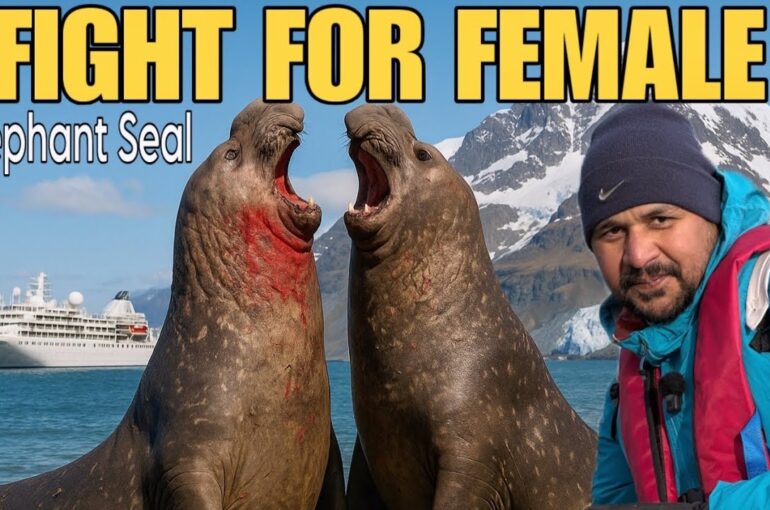
Now behind me, you can see two elephant seals fighting. This fight is for a female. Whoever wins will become the dominant male and the king of this colony. Just like kings used to fight in old times. One has backed off, the other has won, and the female has gone with the winner. It was like a swayamvar fight.
So friends, these were the world’s first and second largest King Penguin colonies. You compare both videos and tell us which one was bigger. Comment and share. Satellites are used to count them. Who knows how many there are?
Now it’s time to leave. Everyone is going back. From behind, they look black; from the front, they look white. They are moving towards the river because humans are coming. Wherever humans are, penguins move away.
Right now, I can see lakhs of penguins standing in front of me. This is probably the last time I will see King Penguins. I may never come here again. If any of you come here, you will see them.
Nature has placed them so perfectly, standing in discipline. Even our PT teachers were not this strict. The view is unbelievable. Behind us, our cruise has arrived.
Everyone is crossing the river again using a human chain. Penguins are standing on both sides, waiting for us to pass so they can go back to their places. Evening has arrived, and the sunlight looks beautiful.
The sea is very disturbed today. Normally, they allow cameras, but today they said no one will carry cameras. All bags are being taken in waterproof bags. A storm is approaching.
Where I am standing now, there used to be glaciers. They have melted and gone into the sea. You can see many icebergs in the distance, broken from these glaciers. Our Zodiac boat is waiting there, but boarding is difficult due to rough sea.
We must follow a ritual – checking boots for cleanliness. The Zodiac is being lowered. Each Zodiac carries 8–9 people. What a tough process! They do this twice a day.
Most Antarctic cruises allow only one landing per day. This cruise allows two landings per day. Our journey is 22 days, and for 11 days we will land twice daily. Only 77 passengers, so everyone lands together. The rule is: only 100 people can land at a time.
Today is Day 11 of my Antarctica journey. We are in South Georgia, but a storm is coming, so we are leaving one day early. The captain explained everything in detail. One storm will pass in front of us, another is coming from ahead. We will be at sea for 2.5 days, facing two storms.
This is the historic route that Sir Ernest Shackleton travelled, covering 1,500 km in a 7-metre boat to save his crew. We will complete it in 2.5 days. Waves will be 4–4.5 metres high, winds at 40–50 km/h.
We are still inside the bay. The open ocean starts near the icebergs ahead. A safety meeting is being arranged for seasickness and safety instructions.
Now we are saying goodbye to South Georgia. Look at this iceberg – it looks small on camera, but it is 25–30 metres tall above water. Only 20% of an iceberg is above water, so imagine how big it is below – almost 200 metres. It is hollow inside and can break anytime.
All these icebergs are parts of A23A. Waves have already started rising. The storm has begun. The doctor has advised us to eat and sleep, and take seasickness tablets.
Look at this iceberg – it is like a 15–20 storey building. Mountains look small in front of it. This is just the beginning. We are heading to Antarctica, but the storm has made everything challenging.