

No Hotel in Chile… So I Slept in a Kabarstan (कब्रिस्तान) 🇨🇱 Ep.35
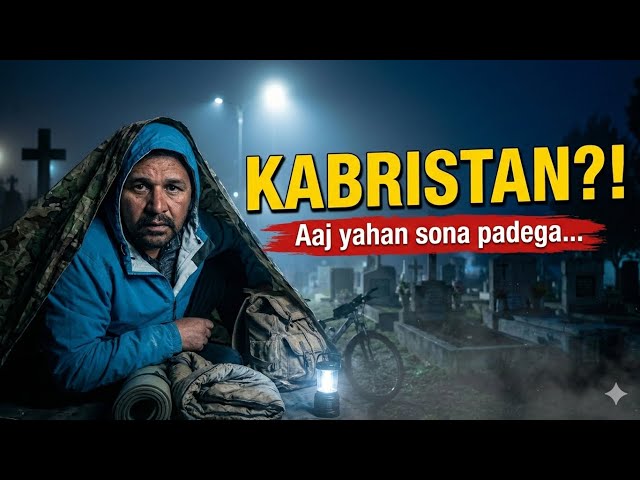
So today we will probably sleep in a cemetery. This is an amazing natural view that has emerged from beneath the earth. Travelling here is even more dangerous than travelling in Ladakh.
There is a famous story about this city — people say do not go outside after dark.
One thing I can say with certainty is that China has, in a way, taken control of Chile.
Hello, Salaam, Namaste, Sat Sri Akal, Ram Ram ji. Once again, welcome to my YouTube channel and to a new day of the Pole to Pole World Bicycle Journey.
At this moment we are in Copiapó, the capital city of the Atacama Region in Chile.
We reached the Atacama region this morning, but we have run into a problem — actually two problems.
The first problem is that my laptop screen has started malfunctioning.
The second problem is related to the data from the last four days. I tried to transfer my footage from the Osmo camera, but the data did not transfer and it is not even showing on the memory card.
It is a 512 GB memory card, and I have kept it safely for now. If it ever starts working again, I will upload that video later. Something similar happened once before as well.
The footage that is missing was from La Serena to Copiapó, which was a completely desert region.
In between there were no big towns where I could stop for the night. There was a small city called Vallenar, but I reached there late at night and left early in the morning.
From La Serena I have travelled about 300 kilometres, so about 300 kilometres of footage is missing. If I ever get the chance in the future, I will recreate that video.
This place is famous for its copper, gold, and silver mines. Everywhere around here you will see mines after mines.
Now we have properly entered the desert region.
Right now it might look like a beautiful green place, and you might think there is no desert here at all. But in reality, there is desert all around this city.
And not just any desert — the kind of desert you might never have imagined.
I have seen many deserts around the world, but even I am seeing this kind of desert for the first time.
This city is considered the capital of the Atacama Region of Chile.
In old times, the first railway in Chile was started from this area.
I arrived here around 11:00–11:30 in the morning, and right now we are standing in the city centre.
Behind me you can see Plaza de Armas. In most Spanish cities, the city centre has a central park with historical statues, and that place is called Plaza de Armas.
This small area is the only green part of the city. Apart from this, you will not see greenery anywhere else.
Look — they have even built special chairs for shoe polish workers here.
This city was actually established by the Spanish for mining, so it can also be called a mining city.
When I was outside the city earlier, there was nothing but desert. For almost 100 kilometres there was absolutely nothing.
The good thing for me was that the wind was blowing from behind, so I was able to ride very fast.
Tomorrow morning we will see what the wind conditions are like, because now I have to go back towards the coast, which is about 70–75 kilometres away.
I have booked a hotel here, which I will show you later. It costs $40 per night.
Let me tell you one thing — if I talk about the countries where my expenses have been the highest, this country definitely comes in the top three.
It is now 7:00 in the evening, and most of the market is closed.
But there are many Chinese people here as well. Look at this — this shop is Chinese-owned. You will find Chinese markets everywhere.
I can say one thing with confidence — China has, in a way, taken control of Chile.
There is another reason behind this. These shops are just a way of moving money around.
The real work Chinese companies are doing here is related to mining — especially copper and silver mines.
They manage money in ways that we cannot even imagine. Chinese people are very sharp-minded — I have personally observed this.
Now you will start seeing desert everywhere around.
There is Unimarc supermarket. I will buy something to eat from there and tomorrow morning I will show you more of the city.
You can see these old buildings here.
Before going into Unimarc, let me show you the highway from where I came and where I have to go.
I have been travelling on Ruta 5 highway.
Look there — a Chinese man standing alone. He is probably running this casino. Chinese casinos handle huge amounts of money.
Here you can find both Unimarc and Lider supermarkets, so it is a reasonably big city.
Look at the name of this bar — Lolitas.
This is the bus terminal.
From here onwards you will see nothing but desert, both in front and behind.
And this is a very large supermarket.
One problem in this area is that you should not go out after dark. It is not safe, and I have personally felt that.
You can sense it immediately.
For example, that woman over there looked intoxicated and she was trying to talk to me.
There is a meat section on one side and a bread section on the other side.
Let me buy something from the bread section.
These are good for instant energy while travelling, so I will take some of these.
These cost about ₹1000. Six pieces cost ₹100.
Let me buy a few things.
Now the total has become around ₹12,000 — milk, juice, fruit, bread and a few other items.
This country is expensive, whether you believe it or not.
After travelling through so many countries, I can clearly feel that this one is expensive.
You will find drug addicts everywhere here.
Look at that man — he is buying alcohol now. After drinking, he will go home. Many people you see around here behave like this.
At night they often sleep on the streets, and some of them later get involved in crime.
That is why this crime factor is scary.
On the way I had passed through a city called Vallenar, where I stayed for one night.
Look — there is also a McDonald’s here, and across the road there is a cinema hall.
From here onwards, for the next 500–600 kilometres, there will be no major city. This is the largest city in this entire stretch.
These are very old houses here. Some of them might even be abandoned.
Ahead you will only see desert and mountains, and this will continue for a very long distance.
From La Serena, after just 20–30 kilometres, the desert had already started.
Then there was a 1400-metre climb, and after that it was desert after desert.
Right now the temperature is quite hot. Along the coast it will remain warm for some time, but later the heat will reduce.
Look how far this town is from everything.
Even here there is a Chinese restaurant called Comida China, and it is quite big.
Even in small villages, Chinese restaurants have opened.
Look at the paintings and murals here. They decorate every wall and shutter with colours and artwork.
You can also see the security concern here. This was an old house, and they had to install iron grills for protection.
This is a church. And look, there is an Alto 800 here. Not a Maruti 800, just Alto 800.
And here we are — this is my hotel. It is actually a restaurant hotel.
Look here — my Dhanno (my bicycle) is parked here. My luggage is lying around; you can see how scattered everything is. They have given a small fan, nothing fancy. I also make my coffee here. Now I will have to cook my food here as well.
My flag pole broke, so now I feel scared to attach the flag. I am worried it might get completely damaged. So I only attach it when I reach near a city, otherwise I keep it packed.
And we also have this equipment. If someone does not know, the total camera gear including lenses costs around ₹6–7 lakh. And now this camera has stopped working, and one memory card is also missing.
But that is okay. On such a long journey, these things keep happening.
So friends, we have woken up in the morning and it is time to get ready. Dhanno is packed and ready.
This place was actually more like a hostel-cum-bar. On the other side there was a bar, and the DJ played music the whole night. There was constant noise.
On the other side of my room there was a road, so sometimes loud motorbikes passed by in the middle of the night. Around 2–3 a.m., the noise kept disturbing me.
The place is nicely built, but what is the point of building it nicely if the guest cannot sleep peacefully?
Okay, bye-bye.
Actually I had to go towards the back side, but I am going from this side. I am looking for a place where I can fly my drone and show you the valley around this city.
Today the wind will probably be against us, so we will ride slowly. Today the target is only 75 kilometres.
But first I need to check all my data and devices.
I tried to fly my drone from here, but it is showing that both the internal memory and the memory card are full. I do not understand what is happening.
For the past two or three days, I have been facing problems with electronic gadgets.
Now let me tell you a famous story about this city.
In 2010, there was a mining accident in a nearby mountain called San José. During mining, a landslide occurred, and 33 miners were trapped underground.
Everyone thought they had died, because they were trapped 700 metres below the earth.
Later they drilled into the mine and discovered that all of them were still alive.
It took 70 days to rescue them.
They drilled three tunnels. The first one failed, the second one also failed, but the third tunnel succeeded.
They created a special rescue capsule and sent it down into the mine. One by one, the miners were placed inside the capsule and brought up to the surface.
When their families heard that the miners were alive, they set up camps outside the mine and stayed there for 70 days.
This story was covered by media all over the world, and because of that, this place gained global recognition on the world map.
Now we have to go this way.
There is quite heavy traffic on this road, which I was not expecting. Maybe this traffic will continue for the next 70 kilometres, because there is a coastal city ahead where people might be heading.
Copiapó is now behind us.
Look — the entire city runs on electric buses. People here seem to love travelling by bus.
There is also a railway line in the city, but I do not think trains run anymore. I have not seen any train operating.
Now the sand dunes have started appearing on the sides.
So now Dhanno and I are making our way through the dunes.
Here is a Copec petrol station right after leaving the city. Let’s stop for a coffee.
I cannot imagine a Copec station without a coffee shop, because Copec is the most famous and biggest fuel brand here.
Alright, let’s start the day.
This coffee machine does not look very good. Let me try another one.
So we had medium coffee, and both I and my legs are refreshed now.
Now I am preparing Dhanno again. This is the last petrol station here. After this, there will be no fuel station for 50–60 kilometres.
Our target today is 70 kilometres from here.
Look at those mountains. Along the mountains, they have built small temples.
And here — I think this is a cemetery. Yes, the whole area ahead looks like a graveyard built along the mountain.
We will stop at Caldera. After Caldera we will go further.
There is an airport in Caldera — the biggest airport in this region. The next major airport is about 500 kilometres further ahead.
That highway over there is Ruta 5, and the truck you see is coming from that route. We are currently coming from inside roads.
Actually Copiapó lies about 20 kilometres inside from Ruta 5. I had to travel around 20 kilometres extra.
Normally it would have been shorter, but since Copiapó is the historical capital of the Atacama Region, I wanted to pass through the city.
Soon we will join Ruta 5 again.
As you can see, Copiapó is actually built in a valley. Sometimes when it rains, this valley becomes slightly green.
This green belt is roughly about one kilometre wide and continues all the way towards the sea.
It feels nice to see a Mahindra vehicle parked in the streets here.
Let us eat something while riding. The map shows another petrol station 10 kilometres ahead, but suddenly I felt low on energy, so I thought I should eat something.
Here is another petrol station. After this one, the next station will come only after 140 kilometres.
Let’s see what I can eat. I have parked my cycle over there.
I do not feel like drinking cold drinks, and I already had coffee.
Actually the problem here is that it is difficult for vegetarians to find food.
Let’s see what is available.
Petrol stations here have washrooms, ATMs, and other facilities.
Finally I decided to take Pepsi and fries.
They have given me a number. They will prepare the food and call me.
Buying fountain Coke is cheaper because you can refill it, while a bottled drink would be expensive.
Okay, thank you — gracias.
He had already taken the money but was not giving me a glass, so I told him that is not how it works.
Here they also have juice machines, where you can drink two or three glasses with the same payment.
Even here, outside the city, you will find people begging.
A lady here was telling me to eat watermelon.
This area reminds me of Morocco. It feels like I am travelling somewhere in Morocco, or maybe even Greece, because the environment is similar.
These are olive trees. The older the tree becomes, the better its fruits are. That is why people keep olive trees that are 50 years old.
Someone has planted a large olive orchard here.
You will continue to see this greenery for another 400–500 kilometres, and after that it will disappear completely.
Then we will start climbing the mountains and enter the real desert.
So stay connected — it will be really exciting.
You must have seen many videos about Ladakh, but travelling here is even tougher than Ladakh in many ways.
You will only understand that if you subscribe to the channel and watch the next videos.
I am really excited.
Look, there are thorny desert trees here, similar to the ones we used to call Kikar trees in villages.
Here comes another toll gate.
Motorbike: 500 pesos (~₹50)
Car: 1750 pesos
Bus: 3100 pesos
That is quite a high toll.
But we crossed it without paying because bicycles do not have to pay toll.
In the middle of the desert there is also a police checkpoint where they check vehicles.
There is even a police station and facilities like showers here.
Now only 25–30 kilometres remain today. I am thinking of going a little further before stopping.
Let me eat some fruit first.
Look here — another cemetery. In this country, the graveyards are usually outside the towns or villages.
There is one strange thing here. As the evening approaches, the sunlight becomes stronger.
Right now the time is 4:44 pm, almost 5:00 pm. The sunlight will remain strong until 6:00 pm, and after that it will start getting weaker.
Since I am travelling towards the north, sometimes I ride slightly towards the west in the evening, so the sunlight does not hit directly in front of me.
I rested for a while earlier.
And every 10–15 kilometres, whenever there is a small village, they build a small bus stop.
Sometimes I stop there for a short rest before continuing my ride.
So the target for today was 75 kilometres, and now only about 5–7 kilometres are left. But I am thinking of riding another 10–11 kilometres ahead, because tomorrow’s target is 95 kilometres. If I move ahead today, tomorrow’s ride will become easier.
If I see a small town within 10–15 kilometres, I will stop there and stay. For now, I am trying to avoid camping for a while. Until Mexico, I will probably avoid camping because the dangerous regions will start.
Although Bolivia is quite safe, especially the desert areas, after that things might become difficult. So camping will become less frequent.
Oh wow! There is the ocean, and there are boats standing in the water. I think there must be a port here.
Today our target was Caldera, but now we will move ahead towards the next station, Chañaral. However, we will ride only 10–15 kilometres more today and then stop, because Chañaral is still about 95 kilometres away. If I reduce that by 10 kilometres today, tomorrow will become easier.
Let’s see if I find a petrol pump ahead. Usually towns have one, but you never know.
There is also a small port here, probably not for big domestic flights.
All around there is nothing but desert.
And here goes your Baba riding along happily, just riding and riding.
Yes my friends, how are you all doing? Come on, let’s have some coffee.
The wind is blowing strongly from the front. After a short distance, this highway will also become a single road, which will make things more challenging.
Earlier I had coffee at a Copec petrol station and started riding again. The map shows a small village about 10 kilometres ahead, and it seems there might be one or two guest houses there. Let’s see if I find something.
Look — small shops are starting to appear now. Slowly you begin to notice poverty in the region.
That truck is carrying a load of tomatoes. There is also a hotel called Cabañas, but I am not sure how good it is.
Let’s ride another 10 kilometres at least.
Look, the village has ended, and now we have to ride another 500 kilometres on Ruta 5.
After that we will turn towards Calama.
Tomorrow we will reach Chañaral.
The day after tomorrow we will reach Taltal.
Then after two days we will reach Antofagasta.
From there it will take two more days to reach Calama.
Then we will reach San Pedro de Atacama, and from there we will enter Bolivia.
That is the route plan, and we will move super fast.
If I skip Antofagasta and go directly to Calama, it would actually be shorter.
This is the town where I planned to stop. There are a couple of boats and even a large ship here. It is a small port, but the atmosphere still feels very dry.
Even though we are near the ocean, there is no humidity. It still feels dry.
Look at this soil. You can actually see copper traces in it. When copper reacts with water, its colour turns slightly green, and you can see that shade here.
Further ahead there will be large copper mining areas. So the copper zone has already started.
And that’s it — the four-lane highway has ended. It will become four lanes again only when we get close to Calama, which is still about 100 kilometres away.
Now I have to ride very carefully, because heavy mining trucks pass through this road.
I have entered the city, and look at the crowd here. There is a long line of vehicles because people have come to the beach.
Today is Friday, so there is a lot of crowd. People have even set up tents near the beach. This continues for about 4–5 kilometres.
I do not think I will find a room in this town. Even in the previous city, everything was showing fully booked.
So it looks like today again I might have to spend $40–$50 for accommodation, if I even find one.
Otherwise I will have to camp, because near the coast it becomes sticky and humid if you do not take a shower.
Look at how many cars are parked here — this goes on for 5–6 kilometres.
I asked in three places whether there was a room available. All three said no. There are no hotels here; people mostly run small homestays from their houses.
Now this was the last gate where I rang the bell. If there is no room here either, I have no option left.
Then I will move ahead and do wild camping.
Honestly, I should have stopped earlier. That would have been a better option.
Just then, a car driver stopped me and told me that I would not find any room here. He suggested that I should buy food from the supermarket, and then go about 3 kilometres ahead, where there is a tourist attraction. He said I could camp there safely.
So I will go there. First I will buy some supplies.
I bought three bottles of water, another bottle, and some fruit — two bananas and peaches.
Now I have enough food and water. Even if I do not find anything, there is no tension.
Look — this is the tourist attraction. I will have to ride about 1 kilometre on a dirt road, but that is fine.
If I find a good spot there, I will set up my camp.
There is my Dhanno standing, and I have walked down to show you this rock formation.
Friends, this place is called Granito Orbicular.
It is a beautiful natural formation that emerged from deep within the earth. It was first discovered here in 1981.
These rocks are completely natural, not man-made. The patterns on the stones were formed naturally inside the earth.
Just look at how beautiful the designs are.
When lava erupted long ago, the magma left these patterns inside the rocks. That is the story behind this formation.
There is a small café here, but no one is around.
I have travelled so far to reach here, but if there are no people around, it might be risky. Sometimes drunk people come here at night, and that can create problems.
So it is better that I go back to the highway, ride another 2 kilometres, and then set up my tent near the road once it gets dark.
I will ride 2–4 kilometres more. If I find a good spot, I will camp there.
In about 20–25 minutes the sun will set, and after sunset I will start setting up my camp.
Actually, I wanted a nice camping spot today, because I want to watch the stars. The stars will look even better further ahead in the desert, but we will see them here as well.
And now, the sun has set.
I am still riding. I can see something ahead, so I will check that area and then decide.
Otherwise I will just set up my tent behind some rocks, which is safer because you cannot be seen directly from the road.
Look — the sunset is completely finished now.
I can see some structures ahead, maybe a temple or something. I will go there and see.
There is a map here showing the Desert Route. This place seems to be some kind of temple or monument.
So I will probably camp somewhere around this area.
It is part of a tourist circuit.
Let’s go a little inside between the rocks. Look how beautifully nature has shaped these stones.
First I checked the instructions here to make sure camping is not prohibited. Sometimes camping is not allowed and the police can trouble you at night.
Here it only says no fire allowed. There is no rule against camping.
So let’s set up the tent behind these rocks.
Maybe tonight we will even see some ghosts here among these rocks!
Alright — the tent is ready now. I will put my things inside.
Over there the red glow of the sky looks amazing, and beyond that area there is something like a cemetery.
Yes, this whole area around here is actually a graveyard.
So tonight we will sleep in a cemetery.
Now I will cook something and eat.
Tonight I will try to record the stars and take photographs of them.
The biggest problem here is that there is no mobile network at all. There is no internet.
Anyway, I will stay here tonight.
Now I will cook my dinner, eat, and go to sleep.
Today my total ride was about 105–107 kilometres, even though I did not plan to ride that much.
Tomorrow I will ride around 80–85 kilometres, then take some rest. After that I will ride faster again.
So let’s end today’s video here.
Until then —
Stay happy, stay busy, stay cheerful, and stay healthy.
Jai Hind, Jai Bharat. 🇮🇳