

MY LAST RIDE? 😰 | Almost Died in Bolivia 🇧🇴 | India to Alaska Ep. 42
“Where are you from?”
“From India.”
“From India.”
I have finally reached a hostel. My condition is very bad right now. I just vomited. I will have to walk almost 20 kilometres. I have already worn inner layers because last night the temperature dropped to –2°C.
They stamped my passport. Later they kept me in a clinic. I was on oxygen for 46 hours. Motorcycles like the Royal Enfield Himalayan are very common here, but honestly this was one of the toughest days of my entire journey.
Welcome to the 133rd country of Cycle Baba’s world journey. I am not joking—scenes like this you probably have never seen before.
Namaskar, Salaam, Sat Sri Akal, Ram-Ram Ji. Once again welcome.
Right now we are at Chile immigration, leaving Chile. The place where I am standing is at 4650 metres above sea level. In my journey across 132 countries, I have never crossed an international border at such a high altitude. This is the first time I am doing it.
My bicycle “Dhanno” is parked inside. Immigration is done. They also returned the PID slip that Chile gives you when you enter. Whenever you visit Chile, never lose that slip. Without it you will not get exit permission, and you might even have to file a police report.
Now I will move towards Bolivia. The Bolivian border is a little ahead. The two mountains you see behind me—half of them are in Chile and half in Bolivia.
With many sweet and memorable experiences, I am saying goodbye to this beautiful country and heading towards Bolivia.
10 years of travel, 132 countries, and the 90 days I spent in Chile were truly unforgettable.
After spending three months here, it is time to say goodbye.
As soon as I crossed the border—wow! Suddenly very cold winds started blowing. The road immediately turned into a dirt road. In Bolivia it becomes mostly gravel.
The border is about 34 km from here. Right now I am travelling in the no-man’s land between the two countries.
Slowly moving forward… look at that glacier! It looked far away earlier but now it is very close. There is snow everywhere and it is very cold. It is nearly 1 pm, yet the temperature feels freezing.
I am feeling thirsty again and again and have a slight headache. The Bolivia border is around 100–200 metres lower, so once I reach there I will rest.
About 5–6 km after the border there is customs. After customs I will rest properly. I can also see something called a refugio ahead. In places like Ladakh you find small stops where people sell noodles or tea and sometimes offer tents to sleep in. This looks similar.
The Bolivian border building is now visible ahead.
Suddenly I met another cyclist.
“Hola! How are you?”
“Good! Where are you from?”
“From India.”
“And you?”
“Poland.”
She had started travelling six weeks ago, exploring this region alone. She started from Santiago, travelled through Salta, and will finish in San Pedro.
Amazing people you meet during travel.
Now the border is right here. There is about a 5 km gap between the two borders.
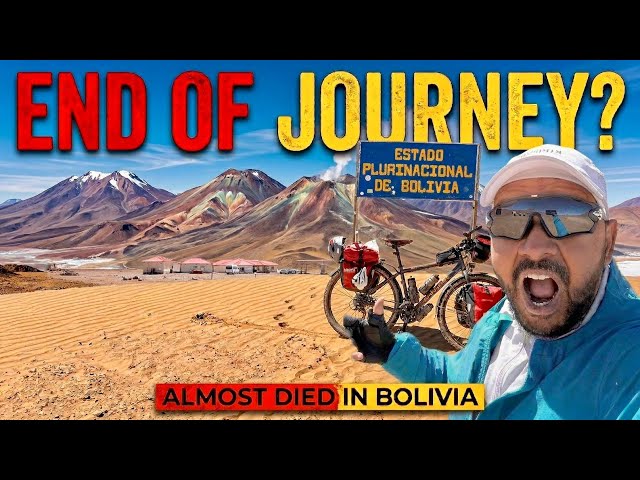
Here it is—Welcome to Bolivia.
On one side is Republic of Chile, and on the other side is Bolivia. Right now my bicycle Dhanno is standing exactly between the two countries.
Friends, welcome to a new country in Cycle Baba’s world journey. I have reached Bolivia.
This is the Bolivian flag, and these are Bolivian vehicles. Chilean cars stop here, and from here onward 4×4 vehicles operate because ahead lies the Salar de Uyuni region where only strong vehicles can travel.
Now I move towards Bolivia immigration.
Earlier immigration used to be done in a small room here, but now a new building has been constructed.
They stamped my passport. I asked them for 60 days, but they said my visa allows only 30 days. However, they wrote a note saying I can extend it later from immigration in La Paz.
The entire process took less than half a minute. Just one stamp—no computer entry, nothing.
“Welcome to Bolivia.”
So now I have officially entered Bolivia.
Welcome again to rough roads! In the next few videos you will see a lot of gravel roads because here mainly 4×4 vehicles travel.
After about 3–4 km, there is customs. Immigration and customs are separate here.
The wind is extremely strong. Look there—that white mountain is a volcano, and on top of it there is an observatory where scientists work.
After reaching customs, I had to fill out a form and submit it to the police.
This entire area is part of a national park, so you must buy an entry ticket. If you are local it costs 30 Bolivianos, and if you are an international traveller it costs 150 Bolivianos.
I bought the 150 Bolivianos ticket.
Then I asked about accommodation. They said there is a small hotel nearby.
So I paid 120 Bolivianos for food and a room. Honestly, I expected it to be expensive, but Bolivia seems cheaper.
Finally I got a room. There is a bathroom but no running water. They said they will fill a bucket if needed.
The room cost only about 10 dollars, which is very cheap for such a remote place.
My headache has become very strong due to the altitude, so now I will rest for a while.
Good morning, friends.
I am ready now. Last night my condition became quite bad. I started having a severe headache. It was altitude sickness – the mountain sickness that happens at high altitude. Even now I am a little short of breath, but it is not too serious. I am thinking of continuing the journey.
After about 40–42 kilometres, there will be a hot spring, and we will stop there. First I have to climb a mountain and then go down. Right now we are at 4,400 metres above sea level. We need to go up to around 4,700–4,800 metres, and then at night we will again sleep at around 4,600 metres.
I came here, had food that they prepared for me, and then I went inside the tent and slept. I kept drinking water the whole night. I asked them for hot water and kept the glass in my pocket. I kept filling it again and again and drank water throughout the night. Because of that, I think I managed to avoid serious problems. I did not need to take oxygen; otherwise it could have become difficult.
I took a shower the day before yesterday. Yesterday I could not take one, and today I also cannot. There is no hot water here. What can we do? It’s a compulsion. For the next three or four days I might not be able to shower either. If I get a chance somewhere, that would be good; otherwise we continue.
I had dinner, and last night the temperature went down to –2°C. I had some coffee and also ate a little with it while sitting inside. This is the hotel where I stayed.
And this is the border area. The actual border is about 5 kilometres ahead, this is the customs point.
You can still see the moon in the sky. Even during the day the weather is so clear that the moon looks beautiful.
The drivers of the 4×4 vehicles have filled the place with dust. Now the real desert will begin. The next 400 kilometres will be a real test for us. From here we have to go to Salar de Uyuni, which is about 400 kilometres from here. The entire road is gravel and very rough, so it will be a dangerous but exciting adventure. Keep watching; it will be fun.
Even without rain, the temperature here at night can drop to –5°C to –10°C, and during the day it can go up to 25°C. My condition will probably become difficult. I will try to stay in hotels whenever possible because breathing problems can happen at night at these altitudes. Sleeping at 5,000 metres above sea level is not a good idea.
Look, the drivers are preparing their vehicles. Now let’s start the journey in the name of God.
These vehicles are coming from that side. If I follow them, they will create too much dust. So I am thinking of taking a path through the lake area. Someone told me that it is possible to go from here. Maybe I am taking an unnecessary risk, but sometimes you have to.
Both roads will meet later anyway. This way might add about half a kilometre, but at least there will be less dust. Otherwise, for 400 kilometres, the dust and vibration will completely exhaust me.
Look over there — that’s where I slept. The official route is through that dusty road where all the vehicles go. There are two lagoons here: one here and another on the other side. There is a small dry path between them. Sometimes both lagoons connect, but this year there has been less rain, so the path is dry. I will cross from there.
This area is also famous for flamingos, so I will try to show you flamingos as well.
Here you can see both lagoons. I crossed from there and flew my drone in active mode. I had to leave the remote behind for a moment and then walk back over these rocks to get it. It was quite difficult.
Now I have to travel another 40 kilometres and then I will find a place to stay for today.
I have reached the viewpoint. The cars usually bring tourists here because you can see the full reflection of the mountain in the water. This is one of the main attractions of this country.
This rock here was shaped by nature. Winds kept depositing particles on it for years, and it formed this beautiful shape.
Someone asked me:
“How are you? Where are you from?”
I said, “I am from India.”
We talked about the journey. They said Chile is an amazing place but quite expensive.
My bike is very heavy, which sometimes becomes a problem on these roads.
Behind me you can see a couple travelling on a Royal Enfield Himalayan. They are from France. They bought the bike in Colombia and started their journey from there. They are riding all the way across countries.
Many travellers do journeys like this. The Royal Enfield Himalayan is very popular here, even more than the Royal Enfield Bullet 350. One like for Royal Enfield definitely deserves to be given!
Look at the view in front. We just have to cross that mountain. Every few kilometres I have to get down because the bike starts slipping on the loose gravel.
The view is unbelievable. It feels like I have made a road on Mars.
Finally, I reached Salvador Valley. The hot spring is just ahead, but the wind is very strong here. I will stop there only for 5–7 minutes because my condition is not very good. The sooner I leave this area, the better.
I am having breathing problems.
Now I have climbed the uphill section towards the hot spring. From here it is about 15 kilometres downhill, and then I will reach the hot spring area. If I get a room there, I might stay.
But the winds become very strong after 2 PM here. The next place is about 40 kilometres away, where there is a red lagoon. I might try to go there.
I asked the hotel here for a room. Do you know how much they asked? $50. Another place asked $100, and another one $150. That’s too expensive.
So I decided to have a coffee first and then continue my journey. The view behind me is absolutely amazing.
Honestly, staying here at night would be nice, but not for $150.
Look at that truck – it’s a very old Dodge truck standing there. I have finished my coffee, and now I’m heading out again. Honestly, I feel like staying here, but then I think to myself that I can’t pay $50 for a room. With $50, I could stay for four days somewhere else.
I’m sitting here and eating something. I’ve wrapped a scarf around my neck because the winds have become colder. I have now reached 4,900 metres above sea level. Breathing is becoming difficult, and the wind is blowing directly against me. I have to go that way through a dirt road.
The wind is extremely strong. This is probably one of the toughest rides of my entire journey so far.
I’m trying to eat a little bit – some bread. I’m not really hungry, but I keep drinking water again and again because I feel very thirsty. Still, I will try to keep eating small amounts. If I don’t, I might faint ahead on the road. That happens sometimes at high altitude.
But with your blessings and God’s grace, I am still able to continue. Otherwise, I saw at least 20 vehicles on the road carrying bicycles on top of them. Many travellers start the journey with enthusiasm but quit halfway.
I am trying my best. If everything goes well, I will reach my destination. If something goes wrong, vehicles pass here every half hour or so, and I can request help.
There is a red lagoon ahead where I plan to go. My condition is getting worse, but so far I have not needed oxygen. I am trying to continue without using oxygen, drinking water again and again.
The lagoon is around 20–25 kilometres away. I could have taken a direct route, but I was told that road is extremely bad. The French couple I met earlier who were riding a Royal Enfield Himalayan told me not to go that way. So I took a slightly longer route, which added 2–3 extra kilometres, but at least it was rideable.
From here I will continue towards the lagoon, where there is a place to stay for the night. I can already see some houses in the distance. Maybe I will stay there.
One thing I have learned: you should not ride here after noon. I promise I will never do it again. After 2 PM, the winds become so strong that riding becomes almost impossible. If the wind is pushing you forward, then fine – ride. But if it is coming from the front, then don’t even try.
Right now the wind is directly against me. The road is so bad that I cannot ride at all. Sometimes I push the cycle to one side, sometimes the other. I might have to walk 20 kilometres if the road does not improve.
The main road is completely destroyed. This side path is slightly better – at least I can walk on it. On the main road, even walking is difficult.
I stopped for a moment because this place looked beautiful. The wind is extremely strong, and the lagoon is still 20 kilometres away. But the views here are incredible. If these views were not here, maybe my courage would have collapsed. Seeing this scenery gives me strength to continue.
For kilometres there is absolutely nothing around. I see grass growing here – maybe llamas come here to eat.
At high altitude, you should keep eating and drinking small amounts frequently. Since morning I have already drunk five to six litres of water, little by little. If you don’t keep drinking water, headaches and breathing problems start.
I have a slight headache already, but I’m managing.
After 9 kilometres, I will rejoin the main road, which will probably be even worse. For the last 8 kilometres, I have been walking with the bicycle. The wind is dragging me backwards.
I already knew this might happen today, and it did. Anyway, about 6–7 kilometres are left now. If I keep walking, I should reach in about two hours.
The time is 5:15 PM, and sunset happens early here. Also, because of the time difference, I am now 9½ hours behind India.
Only 1.5 kilometres are left now. I’m not going towards the lagoon directly because it’s another 5 kilometres away. I’m going towards the town instead. Now just 1 kilometre remains. The temperature has dropped below zero, and sunset is approaching.
Finally, I reached a hostel, but my condition became very bad. I vomited because I was slightly dehydrated. Right now I am at 4,400 metres above sea level, so these things happen.
This was one of the toughest days of my journey. I can barely speak now. I just want to rest.
Look at the condition of my bags – they are covered with dust and dirt. I had to unload everything. There are no glasses in the hotel here, so I had to take my own glass out just to drink water. I vomited again.
Once again, welcome to my 133rd country – Bolivia.
Last night I stayed here. Right now I am at a very beautiful but also dangerous place. Dangerous because we are still at 4,400 metres above sea level, and even while talking I feel short of breath.
I vomited several times last night. This was the room where I stayed – you can still see the mess. I just wrapped myself in my blanket and slept.
At around 1 AM, I woke up and made some porridge to eat.
I wanted to leave early today, but I got delayed because it was extremely cold in the morning. The temperature at night was –5°C, and during the day it can reach 20–25°C.
Now I will head towards Laguna Colorada, and after that the road becomes very bad. Honestly, travelling here feels like riding on Mars.
Even NASA scientists have come here for research. In 1960, NASA scientists first came to study this region.
It is an incredibly beautiful place, but also very dangerous. If your health is not good, travelling alone here can be risky because if something happens at night, help is very far away.
From here I will go about 15 kilometres to the lagoon, and then I will decide which route to take. One road goes directly towards Salar de Uyuni, and the other road goes through scenic areas.
Eventually, my health worsened. I asked for a lift from someone because I was still at 4,500 metres altitude and having breathing problems.
They gave me a lift in their vehicle. After travelling 40–50 kilometres, the vehicle broke down near 5,000 metres altitude. My condition became even worse, and I started vomiting badly.
The driver repaired the vehicle and brought me down to a nearby town. They took me to a clinic where I was given oxygen for four to six hours. I also drank a lot of water and juice.
The drivers were extremely kind. Later they brought me all the way to Uyuni. My bicycle came later in another vehicle.
I have now been in Uyuni for three days, resting in bed and doing nothing. My condition is slowly improving.
But no matter what happens, I will definitely show you Salar de Uyuni, because riding a bicycle on its reflection is one of my biggest dreams.
So that was the story of the last few days.
Now I will end today’s video here. I just wanted to update you because for the past three or four days I had not even touched the camera.
Until next time — stay happy, stay busy, stay positive, and stay healthy.
Jai Hind. Jai Bharat. 🇮🇳