

PABLO ESCOBAR 😱 Inside Colombia’s Drug Lord’s Prison 🇨🇴 | Ep.59
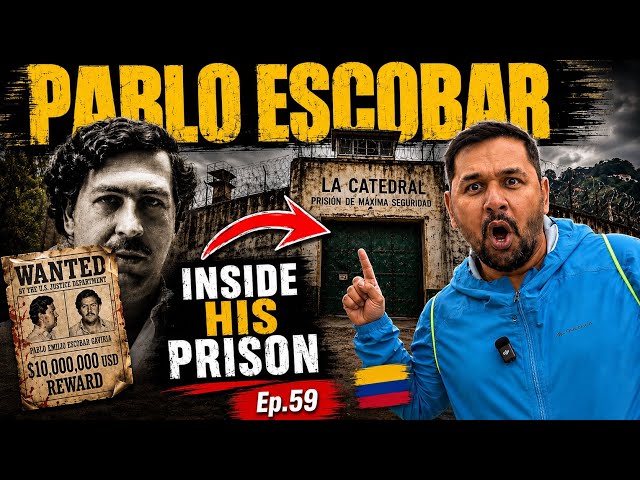
The King of Cocaine—Pablo Escobar.
For the poor, he was a modern-day Robin Hood. For thousands of mothers, he was nothing more than a ruthless killer.
Pablo lies beneath our feet today.
From Hollywood actresses to professional football players and even entire football teams, people came here to stay. Right now, we are standing in Medellín, Colombia’s second-largest city—a place that was once known as the crime capital of the world and the cocaine capital of the world during the 1990s.
Hello everyone, welcome back to my channel.
You have all heard the name Pablo Escobar. There was a time, during the 1980s and early 1990s, when one man controlled nearly 80% of the world’s cocaine trade.
In today’s video, we’re going to visit every place where he left his mark—his birthplace, the location where he was killed, the 20-kilometre area where he built his own empire, and the prison where he spent two years… a prison that he built for himself.
There are countless stories about him.
For the first time, I’ve tried making this video in a documentary style, so stay with me until the end. If you enjoy it, don’t forget to like, share, and subscribe, because after Colombia, we’ll be heading towards Panama.
So, let’s begin our journey through the places where Pablo Escobar built his empire.
Today, I’ll tell you his complete story—from his birth to his death.
Did the police really fire the bullet that killed him?
Well… not exactly.
There’s a much bigger story behind his death, and I’ll reveal it at the end of this video.
The aircraft standing behind me is the very plane that carried cocaine into the United States for the first time. Cocaine was hidden inside its tyres during those early smuggling operations.
Behind these gates lived a man who reportedly earned 42 million US dollars every single week.
People say he never counted money—he weighed it. Every month, he spent thousands of dollars just on rubber bands to bundle stacks of cash.
The world called him the King of Cocaine.
To many poor families, he was a hero who built homes and football grounds.
To thousands of grieving mothers, he was simply a murderer.
Official records claim he was responsible for around 5,000 murders, although no one knows the real number.
In the last video, you saw that we arrived late at night after a long ride. From there, I travelled through Rionegro before reaching Medellín.
Why am I mentioning Rionegro?
Because this is where Pablo Escobar was born.
He was born on 1 December 1949.
His father was a farmer, and his mother was a schoolteacher.
There were seven children in the family, and Pablo was the third.
This is his mother.
This is his father.
His elder brother, Roberto Escobar, later became his accountant and business partner. The other siblings were not involved in his criminal empire.
Pablo was a devoted Catholic who deeply believed in God. You’ll notice religious symbols associated with him almost everywhere.
When he was born, Colombia was in turmoil. Massive protests and political violence were spreading across the country.
One night, armed men entered their home.
After that incident, the family left their village and moved to Envigado, a small town near Medellín.
Pablo spent most of his childhood there.
Let’s visit the neighbourhood where he grew up.
Now we’ve arrived at the place where Pablo spent his early years.
Look at this football ground in Envigado.
Contrary to what many people believe, Pablo wasn’t born in Medellín.
The international airport is located behind us.
His father remained on the family farm throughout his life, while his mother moved here with the children.
Everyone in this neighbourhood knew Pablo personally.
The house you see in front of us is where he spent most of his childhood. He moved here when he was around three years old.
The football ground was built by Pablo himself.
He recruited neighbourhood children, handed many of them guns, and gradually built his own gang.
Money brings power, and power attracts everything else.
His criminal journey began when he was around thirteen years old.
A friend asked him to transport marijuana from one place to another.
For the first time, he made money through crime.
By the age of sixteen, a new drug called cocaine had entered the market.
He only had to move one kilogram from one location to another and would earn thousands of dollars in profit.
That was the beginning of his rise into organised crime.
By the age of seventeen, Pablo had already made a name for himself.
When he was just thirteen, he told his friends something remarkable:
“If I don’t become a millionaire by the age of twenty-two, I’ll shoot myself.”
Imagine the confidence of a thirteen-year-old boy saying that despite having almost nothing.
There must have been something extraordinary about his ambition.
Have you ever set yourself such a bold deadline?
I’ve set one for myself—to cycle across the entire world by the year 2030.
Pablo had that level of determination when he was thirteen, while I developed mine much later in life.
By 1970, Pablo had become well-known throughout the region.
He began recruiting young men from nearby neighbourhoods.
This marked the birth of what would later become the infamous Medellín Cartel.
In 1976, he married a girl who was only fifteen or sixteen years old.
Her family opposed the marriage, but Pablo went ahead anyway.
They had two children—a son and a daughter.
Despite all the violence he unleashed on the world, he loved his children deeply, especially his daughter.
I’ve always believed that every human being carries both good and evil within them.
Pablo certainly had both.
Let’s pause the story for a moment.
One of Pablo’s most famous phrases was:
“Plata o Plomo.”
It means:
“Silver or Lead.”
Either accept my money and work for me…
Or refuse—and face a bullet.
During the 1970s, cocaine became hugely popular in the United States.
Cocaine is produced from the leaves of the coca plant, which grows throughout the Andes Mountains, stretching from Colombia down to Chile.
The leaves were processed in secret laboratories, and Pablo began selling cocaine in Miami for enormous profits.
Soon after his marriage in 1976, Pablo was arrested for the first time.
But here’s how his system worked.
He first tried bribing the judge.
When the judge refused, the two key witnesses in the case were murdered.
Without witnesses, there was no evidence.
Without evidence, there was no case.
This became his trademark strategy.
Later that same year, Pablo and his brother officially established the Medellín Cartel, which would soon become the most feared drug organisation in the world.
Eventually, he purchased his own fleet of aircraft.
They concealed cocaine inside tyres and hidden compartments before flying it to the Caribbean.
He even bought an island near the Bahamas, using it as a transit point before shipping drugs into Miami.
At the height of his empire, he reportedly smuggled 15 tonnes of cocaine into the United States every single day.
At one point, nearly 80% of the world’s cocaine supply passed through Pablo Escobar’s organisation.
Some stories even claim he owned a submarine capable of transporting cocaine underwater all the way towards the United States.
There are also reports that he earned as much as 42 million US dollars every week.
Then came 1987.
The world was stunned when Forbes Magazine listed Pablo Escobar among the richest people on Earth.
From that moment on, the entire world knew his name.
Pablo Escobar was ranked the seventh richest person in the world.
At that time, his estimated net worth was between 25 and 30 billion US dollars. Adjusted for today’s value, that would be roughly 70 to 80 billion dollars.
He had so much money that he didn’t even know where to keep it.
Cash was hidden inside walls, buried underground, stored in trucks, warehouses, and secret locations. There was simply too much money to manage.
Escobar died in 1993, but the story didn’t end there.
In 2020, one of his nephews discovered 20 million dollars in cash hidden inside the walls of one of Escobar’s old properties.
There is another famous story.
Once, when his daughter was freezing while they were hiding from the authorities, Escobar reportedly burned 2 million dollars in cash just to keep her warm.
At the beginning of this video, I told you that before reaching Medellín, I was in Doradal.
In 1978, Pablo bought around 20 square kilometres of land near Doradal and built his own private paradise.
He constructed his own airport, luxury villas, private lake, football stadium, and created an entirely separate world for himself.
He even built a zoo.
People say he collected exotic animals from every corner of the world.
After his death, many of those animals were relocated by the government or taken to other zoos.
However, four hippopotamuses that he had imported remained behind.
Today, their population has grown to around 170 hippos, and they can now be found throughout the region.
Unfortunately, today is our unlucky day—we couldn’t spot any.
A few years ago, the Colombian government even approved plans to cull around 80 hippos because they had become an invasive species.
But during that time, India’s Ambani family reportedly offered to relocate some of them instead of allowing them to be killed.
Perhaps, in the future, some of those hippos may even end up in India.
So yes, even Pablo Escobar’s story has an unexpected India connection.
These are the forests where Pablo once hid from his enemies.
Right now, my bicycle is rolling through what used to be Pablo Escobar’s paradise.
He could never have imagined that one day someone from India would cycle through the very place where he once ruled.
Well done, Cycle Baba!
There was a time when not even a bird could enter this place without permission.
Today, I’m walking here completely alone.
It almost feels abandoned.
These roads have probably been closed for years.
Somewhere inside these forests, the famous hippos still roam freely.
This used to be Pablo’s mansion.
The property had six swimming pools.
Escobar loved collecting vintage cars and classic motorcycles.
One of his most famous cars can still be seen today.
When I visited his brother’s museum, I saw that the car had bullet holes all over it.
Some people believe it was attacked by rivals.
Others say Pablo himself ordered his men to shoot it.
Almost every vehicle he owned was bulletproof because he knew someone was always trying to kill him.
One of Pablo’s family members—either his brother or nephew—still lives here and runs a museum dedicated to his life.
Let’s go inside.
The ticket costs around 30 US dollars, which is roughly ₹3,000.
Even the police are here.
Let’s go inside.
This used to be his house.
Inside the museum, I saw something fascinating.
There was a flight simulator used to train pilots.
Because Escobar’s pilots had to fly at extremely low altitudes, often at night, to avoid radar detection, they practised flying here before carrying out real missions.
The people running the museum are members of Pablo Escobar’s own family, so naturally they tell the story from their perspective.
One guide claimed Escobar earned 16 million dollars every single day.
Another guide said that on some occasions he earned more than 1 million dollars in a single day.
Whatever the exact number was, his wealth was beyond imagination.
To be fair, Pablo also carried out several charitable projects.
He invested heavily in Medellín’s football clubs.
He built sports facilities, supported local teams, and donated to community programmes.
At that stage, most people believed he was simply a successful businessman.
He built around 1,000 homes for poor families in Medellín.
At that time, constructing a thousand houses was an extraordinary achievement.
He created jobs and funded many welfare projects.
But there was another reason behind his generosity.
His real ambition was to enter politics.
He wanted the support of ordinary people.
That’s why many poor families considered him their Robin Hood.
Today, however, many Colombians hate him because they remember the violence, murders, and suffering his empire caused.
Escobar was obsessed with football.
He built numerous football grounds across Medellín.
I even visited the neighbourhood where he lived, and local people told me that many of those football fields were funded by Pablo himself.
Then came 1982.
By then, Escobar believed the time had come to enter politics.
As far as the public knew, he was simply a wealthy businessman.
He contested elections…
…and he won.
As a member of Congress, he received a diplomatic passport, allowing him to travel internationally with official status.
There is even a famous photograph of Pablo Escobar standing outside the White House in Washington, D.C., with his son in 1982.
Imagine that—a future drug kingpin walking freely around the world with diplomatic privileges.
But everything changed in 1983.
A new Colombian Minister of Justice openly declared war on Escobar.
He accused Pablo of being a drug trafficker, a murderer, and a criminal.
In front of the entire Congress, he publicly exposed him.
He said Escobar’s wealth was soaked in blood—that every dollar had been earned through murder and drug trafficking.
Escobar denied every accusation.
However, the minister produced newspaper reports from Escobar’s arrest in 1976 and presented them before Parliament.
From that moment on, they became sworn enemies.
This was the turning point in Pablo Escobar’s life.
On 30 April 1984, Escobar took revenge.
He ordered two gunmen to assassinate the Justice Minister who had publicly humiliated him.
The minister was shot dead inside his car.
That single murder marked the beginning of Escobar’s downfall.
The entire Colombian government now declared war against him.
At that time, Colombia was dominated by two powerful drug organisations.
One was the Medellín Cartel, led by Pablo Escobar.
The other was the Cali Cartel, his biggest rival.
Escobar feared the Cali Cartel more than anyone else.
They repeatedly tried to kill him.
To protect his family, he built an ultra-secure residence known as the Monaco Building, located in one of Medellín’s wealthiest neighbourhoods.
Today, the building no longer exists.
A memorial now stands in its place, and I visited it.
This is where the Monaco Building once stood.
The underground section served as a parking garage for Escobar’s luxury car collection.
The first balcony contained a massive swimming pool.
The complex also included a private park, restaurant, nightclub, and entertainment facilities.
The top floor was occupied by Pablo’s luxurious penthouse, complete with a helipad.
The building was earthquake-resistant and bulletproof.
Years later, the Cali Cartel planted a car bomb containing approximately 80 kilograms of explosives outside the entrance.
The explosion was enormous.
Fortunately for Escobar, he had left the building shortly before the blast.
Although the explosion caused major damage, the building itself remained standing because of its incredibly strong construction.
During Colombia’s cartel wars, approximately 43,800 documented deaths occurred.
Today, every one of those victims is remembered through this memorial.
At night, lights illuminate the monument, creating a powerful tribute to those who lost their lives.
After Pablo Escobar was killed, the Monaco Building was eventually demolished.
In its place, this memorial was built to honour the innocent victims of the violence.
Now I’m going to show you something truly significant.
Until 1984, many people still believed Pablo Escobar was simply a wealthy businessman.
But everything changed in 1984.
That was the year he was linked to one of his first major bombing attacks, including an explosion outside the U.S. Embassy, signalling the beginning of his open war against the Colombian state.
After that, Escobar’s violence reached a completely different level.
Even religious organisations weren’t spared.
In 1988, a man refused to accept several million dollars from Escobar at a bank.
Enraged, Escobar ordered bomb attacks across Medellín.
On a single day, bombs exploded at nine different banks throughout the city.
But this was only the beginning.
His most horrifying crime came soon afterwards.
An Avianca Airlines passenger aircraft was blown up in mid-air.
The explosion killed 107 innocent people.
Between 1984 and 1986, Escobar had managed to stay relatively unnoticed by much of the public.
Then, in 1986, he crossed another line.
A newspaper editor who regularly published articles exposing him was assassinated on Escobar’s orders.
In August 1989, another shocking incident took place.
A Colombian presidential candidate was delivering a speech before thousands of people.
Escobar ordered gunmen to assassinate him right there on the stage, in front of the crowd.
Public opinion began turning sharply against him.
Then came November 1989.
This would become one of the darkest moments in Colombian history.
Escobar ordered the bombing of Avianca Flight 203.
Just five minutes after take-off, the aircraft exploded.
A total of 107 people lost their lives.
His real target was a presidential candidate whom he believed was on board.
But that politician never boarded the flight.
Instead, 107 innocent passengers were killed for nothing.
Around the same time, Escobar’s war with the Cali Cartel became even more violent.
The Cali Cartel retaliated by detonating a massive car bomb outside one of Escobar’s family homes.
By 1989, Pablo Escobar had become completely consumed by revenge.
The owner of the Cali Cartel controlled hundreds of pharmacies across Colombia.
Escobar ordered attacks on those pharmacies one after another.
His gunmen murdered employees and destroyed businesses connected to his rivals.
By now, he had become unstoppable.
Soon, even the Colombian police became his primary targets.
Escobar announced a horrifying reward:
“Kill a police officer, and I’ll pay you two million pesos.”
Teenagers, some only fifteen or sixteen years old, bought motorcycles and roamed the streets searching for police officers.
Whenever they found one, they simply shot him.
In one attack, an entire police bus was ambushed.
Nearly fifty officers were killed.
Escobar demanded proof.
He instructed his assassins to remove the officers’ police badges and bring them back to collect their reward.
One killer reportedly returned carrying dozens of badges after a single massacre.
In total, around 500 police officers were murdered during Escobar’s campaign of terror.
Later, those recovered police badges were melted down and turned into a memorial statue, which still stands today to honour the fallen officers.
By now, Pablo Escobar had become one of the most feared criminals on Earth.
The United States also began hunting him aggressively.
Knowing that being extradited to an American prison would almost certainly mean spending the rest of his life behind bars, Escobar made an extraordinary offer to the Colombian government.
He agreed to surrender…
…but only under his own conditions.
One of those conditions was unbelievable.
He would build…
…and live in…
…his own prison.
I visited that place.
For more than twelve years, Pablo Escobar seemed impossible to catch.
He could enter any house, any shop, any building, anywhere in Colombia.
If someone refused his orders…
…they were usually killed.
Today, this place has become a tourist destination.
Actors, actresses, professional footballers, and even entire football teams have stayed here for weeks.
After Escobar’s death, thousands of people searched his abandoned properties hoping to discover hidden fortunes.
For more than ten years, this place remained deserted.
Now we’ve arrived at the location where Pablo spent around thirteen months inside the prison he designed himself.
When negotiating with the government, Escobar insisted that he alone would decide how his prison would be built.
This is that place.
Medellín lies about 15 kilometres away.
Yet in just those 15 kilometres, we’ve climbed nearly 1,000 metres above sea level into the mountains.
Much of the original prison has since been demolished and rebuilt.
This area used to be the parking lot.
His private residence stood nearby.
After Escobar died, people rushed here searching for hidden money.
Even these small walls were torn apart because everyone believed millions of dollars had been hidden inside.
And remarkably…
Just a few years ago, one of Escobar’s relatives reportedly discovered 18 million dollars still hidden on the property.
That’s how much cash he had.
The Colombian government gave him complete control over a one-kilometre security zone around the prison.
Escobar initially demanded three kilometres.
The government refused.
They agreed to only one.
Inside that zone, no armed police officers were allowed.
Only two unarmed guards remained nearby.
They carried no weapons, no radios, and no communication equipment.
Escobar continued running his entire drug empire from inside the prison.
Famous singers, celebrities, footballers, and musicians regularly visited him.
He even built his own football stadium inside the prison grounds and played matches almost every day.
Eventually, Escobar discovered that two trusted members of his own cartel had betrayed him.
He imprisoned them inside underground torture chambers built beneath the prison.
After torturing them for nearly ten days…
…he murdered them.
Their bodies were burned on the property.
People living in Medellín could actually see the smoke rising from the mountains.
Eventually, rumours spread about what was happening inside the prison.
The Colombian government, supported by the CIA, launched another operation to capture him.
But Escobar escaped.
According to many accounts, he broke through a weak section of the prison wall and fled into the mountains.
Some people claim he escaped through secret tunnels.
Those tunnels did exist, but mainly to secretly bring visitors into the prison without attracting attention.
After escaping, Escobar spent the next twelve to thirteen months constantly hiding from authorities.
The government then formed a special search unit of around 600 commandos, supported by American intelligence agencies, with one mission—to find Pablo Escobar.
For months, he avoided capture.
Then he made one fatal mistake.
No matter where he was hiding, he always phoned his children.
Usually, he kept those conversations under two minutes.
At that time, telephone technology wasn’t advanced enough to trace calls that quickly.
But one day…
…it was his son’s birthday.
He stayed on the phone longer than usual.
That extra time allowed intelligence officers to trace the call.
Soon afterwards, security forces surrounded the house where he was hiding.
This is where history becomes uncertain.
The police insist they shot and killed Pablo Escobar.
There was a huge reward worth millions of dollars for his capture.
However, another theory has survived for decades.
Some believe Escobar took his own life.
He often told close friends:
“I will never allow myself to be captured alive.”
The fatal gunshot entered near his ear.
Some believe he fired that shot himself.
Others insist it came from the police.
Even today, nobody knows the absolute truth.
On 2 December 1993, just one day after his birthday, Pablo Escobar died.
His body was brought here.
Today…
Pablo Escobar lies beneath our feet.
No matter how powerful he became, his story ended here.
As the saying goes:
“Evil deeds always lead to an evil end.”
This cemetery became the final stop in the journey of the world’s most notorious drug lord.
His family is buried nearby—his parents, his brother, and other close relatives.
Today, most people in Medellín don’t even like hearing his name.
The city wants to be remembered for its transformation, not for the violence of its past.
And with that, Pablo Escobar’s story comes to an end.
If you enjoyed this documentary, please support the channel by liking the video, sharing it with your friends, and subscribing for more stories from around the world.
Until next time…
Stay happy.
Stay busy.
Stay healthy.
Keep exploring.
And keep moving forward.