

Colombia 🇨🇴 Ki Rangeen Rajdhani — Bogota Mein Ek Din! | Ep.57
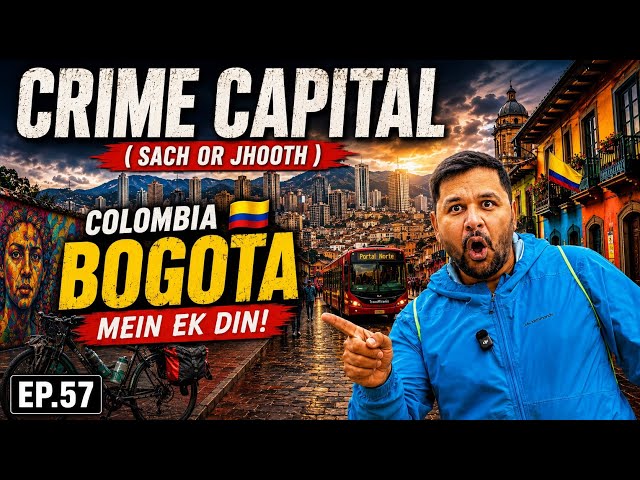
Oh my goodness! The clouds rolled in so quickly. Just look how everything disappeared into the mist.
This area has witnessed the deaths of many people in the past.
On the other side of these mountains, the Amazon rainforest begins. The ancient tribes who have lived here for generations are still known for their fascination with gold.
Just look at how beautiful Bogotá looks from up here.
Hello, Namaskar, Salaam, Sat Sri Akal and Ram Ram to everyone!
Once again, welcome back to my YouTube channel.
Right now, I’m in Bogotá, the capital city of Colombia.
In the previous video, you saw how I finally made it here after quite a difficult journey.
Behind me is the hotel where I’m staying.
I’m paying around 97,000 Colombian Pesos per night, which works out to roughly US$30, or about ₹3,000 per day.
Today is my third day here.
Yesterday, I visited the Indian Embassy.
One thing you’ll constantly hear here is the noise from these birds behind me.
Security is a major issue in Bogotá.
Look at that house behind me—you can see security fencing with electric wires on top.
Almost every house has similar protection.
Even at my hotel, whenever I leave my room, the staff unlock the main gate, let me out, and immediately lock it again. Everything is electronically secured.
Yesterday, I visited the Indian Embassy, and honestly, I’ve never seen such tight security at any Indian Embassy anywhere in the world.
Another thing about Bogotá—it rains almost every day.
For the last two or three days, it’s been drizzling continuously.
The city sits at an altitude of around 2,625–2,700 metres above sea level, so we’re already quite high.
Today we’re going on a city tour, so make sure you watch until the end of the video.
I also noticed that only about 20% of the people watching my channel have subscribed.
The rest of you haven’t subscribed yet.
Subscribing doesn’t cost anything, but of course, it’s entirely your choice.
I don’t usually ask, but today I felt like having a heart-to-heart conversation with you all.
Anyway, let’s begin exploring the city.
Joining me today is my friend.
“How are you, brother?”
“I’m doing well. How about you?”
“Everything’s good.”
He’s from Pakistan.

Our mutual friend, Manish Bhai, introduced us, and since he lives nearby, he helped me find this hotel.
My Uber has arrived.
Uber works here just like it does in India.
I’ll sit in the front.
It’s a small car.
You can see the mountains right in front of us.
That’s where we’re heading first.
It’s already started raining.
If you’re travelling in Bogotá and want to stay safe, I’d strongly recommend using Uber to get around.
Try to avoid carrying luggage on local buses because incidents like pickpocketing and snatching do happen.
Ultimately, your safety is in your own hands.
As they say, “Once bitten, twice shy.”
Since I was recently robbed, I’m naturally much more cautious.
That’s also why I chose to travel by bus from the border to Bogotá.
Our driver has dropped us off.
Since it’s raining, we’re now heading towards the ticket office.
Here’s the ticket price.
It’s quite expensive.
From Monday to Saturday, a round-trip ticket costs 35,000 Colombian Pesos, which is around US$10 or roughly ₹1,000.
Anyway, we’ve bought two tickets—one for my friend and one for me.
Now it’s time to go up.
This is the cable car.
It was built here in 1950 by a Swiss company.
It’ll take us around 500 metres higher.
You can already feel the thinner air up here.
I’m slightly out of breath.
Honestly, I’m also a little nervous.
The cable car doesn’t leave unless it’s completely full.
As you already know, I’m afraid of heights.
There we go—it’s moving!
Just look at the incredible view of the entire city.
The journey from the bottom to the top takes about five minutes.
I’ve chosen to stand in the middle.
We’ve arrived!
The wind up here is incredibly strong.
There’s also a beautiful church here.
Wow!
The view is absolutely breathtaking.
Only the strong wind and rain are making things a little difficult.
There’s a statue over there.
“What is this place called?”
“Guadalupe.”
“Oh, Guadalupe.”
It’s even higher than where we are now.
A road also leads all the way up there.
We’re now standing at around 3,150 metres above sea level.
Let’s walk over there.
This church dates back to the 1700s.
It was later renovated.
Just imagine how difficult it must have been to carry all the construction materials to such a height back then.
They’ve built something truly remarkable.
There’s also a café and a small market nearby.
Bogotá looks absolutely magnificent from here.
The city lies right in the middle of the Andes Mountains.
It’s surrounded by mountains on every side.
We’re not planning to buy anything here.
They’ve got all kinds of local souvenirs.
Now we’ve reached the other side.
These mule handlers transport supplies up and down the mountain.
Look at that mule!
It’s carrying so many bottles of beer.
Just look at this tree.
It’s even more beautiful than the flowers around it.
We’ve explored this area now.
Let’s head back and I’ll show you one more panoramic view before we continue into the city centre.
There’s one special attraction in Bogotá that I’ll show you towards the end of the video.
The weather has cleared slightly.
Earlier, it was raining over there.
That’s mountain weather for you—it changes constantly.
Let’s head back towards the church.
After that, we’ll continue.
What could anyone possibly steal from a church?
Yet even here, security is a major concern.
This church was originally completed around 1730.
The Spanish arrived in this region during the 1500s.
Although Bogotá already existed, it was the Spanish who developed the city on a much larger scale.
There’s Bogotá’s international airport.
The entire city lies inside this vast valley, surrounded by the Andes Mountains.
The mountains on this side are the eastern Andes.
Beyond these mountains, the Amazon rainforest begins.
I’ve been travelling through the Andes ever since leaving Chile, and now I’ve reached Colombia.
Another 300–400 kilometres from here, the Andes mountain range will come to an end as we enter Panama.
The Andes stretch all the way along the western coast of South America.
Oh wow!
Look how quickly the clouds rolled in.
Everything disappeared almost instantly.
From here, Bogotá looks absolutely stunning.
The city sits inside the Andes like a giant bowl.
We’re now standing at around 3,200 metres above sea level.
This church itself is located at approximately 3,200 metres.
Here’s another interesting fact.
Bogotá is the fourth-highest capital city in the world by elevation.
We’ve already visited two capitals that are even higher:
- Quito
- La Paz
There’s one more capital city in Asia that’s even higher.
Can you guess which one?
Leave your answer in the comments.
It’s actually one of India’s neighbouring countries.
Whoever answers correctly first—I might pin your comment.
So yes, Bogotá is the world’s fourth-highest capital city.
There are so many beautiful birds here.
They’re incredibly colourful.
It’s very difficult to capture them properly on camera.
Just listen to their calls.
These birds remind me of the colourful species found in the Amazon rainforest.
They’re lovely to watch.
Honestly, I don’t feel like leaving.
The view is simply breathtaking.
But I still need to show you the rest of the city because tomorrow I’ll be leaving Bogotá.
One more interesting fact about this cable car:
Each cabin carries around 20–25 passengers.
A Swiss company built it here and left it to the local authorities, creating employment for many people.
Each passenger pays around US$10 for a return journey.
With about 20 passengers per trip, that’s roughly US$200 every time the cable car goes up.
It operates approximately every five minutes, which means around 12 trips per hour.
Running for roughly eight hours a day, it generates an estimated US$2,000 per day.
Well, it’s time to head back down.
Now comes the part that scares me!
But as they say, “Beyond fear lies victory.”
We’ve safely made it back.
And honestly, the view from here is absolutely spectacular.
Looking down from up there was absolutely terrifying.
Today really proved the saying, “Beyond fear lies victory.”
There’s a llama over there.
Now it’s time to say goodbye to the llamas and head towards the city centre.
We’ve made it safely back down.
This is the University of the Andes, named after the Andes Mountains. We’re passing through its large campus.
Ahead are the city’s tall buildings, and after that we’ll continue towards the historic centre.
As we slowly enter the old part of Bogotá, you can already see the beautiful colonial architecture.
Look at that old building. Isn’t it stunning?
There’s also a statue standing in the middle.
Should we head over there?
One thing I’ve noticed here is the smell of marijuana. It’s quite noticeable in some areas, so yes, drug use exists here as well.
I must say, Bogotá has one of the best public transport systems I’ve ever seen.
It’s called TransMilenio.
Across the city, these long articulated buses run on dedicated routes stretching for around 25–30 kilometres.
They have their own exclusive lanes, so no other vehicles are allowed to use them.
If you need to travel anywhere in the city, this public transport system can take you there.
Honestly, I haven’t seen such a well-organised transport network anywhere else.
There’s a central interchange here.
Let’s head towards what I think is the city centre.
We’ll sit in the park for a while and fly my drone.
My drone is like my little bird.
I don’t know why, but I personally enjoy flying it so much.
If you enjoy these aerial shots too, let me know in the comments.
There goes another TransMilenio bus.
Delivery riders are everywhere as well.
This public transport operates throughout the entire city.
We’ve now reached the famous emerald market.
Just as India is known for gemstones like emeralds, Colombia is one of the world’s largest producers of emeralds.
Even traders from India come here to import them.
You can actually see people openly buying and selling precious stones here.
There’s underground parking beneath the market, and construction work is happening in several places.
I’ve exchanged some more money, so I’m sorted until the next city.
As we move deeper into the historic centre, you’ll notice more and more buildings from the Spanish colonial period.
Look at this gateway.
It reminds me of the grand entrances to old mansions back in India.
Sadly, most of those old havelis have disappeared over time.
All these colonial buildings date back to the period before Spain left Colombia in 1810.
They’re incredibly old.
This entire area is filled with jewellery shops selling gold and gemstones.
I honestly had no idea that so much gold was sold here.
Look at the beautiful artwork.
There are many sculptures and paintings depicting Christian religious figures.
We’ve now reached the heart of the city.
This gateway is historically significant because, after Colombia’s independence in 1810, Simón Bolívar passed through here.
The surrounding inscriptions commemorate the country’s independence.
Friends, this is Plaza de Bolívar, the oldest and most important square in Bogotá.
The Spanish first established this area in 1538.
Some historians even believe this site was important long before the Spanish arrived.
Before colonisation, the Muisca civilisation used this place as a ceremonial and religious centre.
Originally, it was known as Plaza Mayor.
After Colombia gained independence in 1810, the square was renamed Plaza de Bolívar in 1821, in honour of Simón Bolívar, the leading figure in the country’s struggle for independence.
Bolívar played a crucial role in the independence of several South American nations, including Colombia, Venezuela, Ecuador, Panama, Bolivia, and Peru.
The statue standing in the middle of the square is of Simón Bolívar.
It was created in 1846 by an Italian sculptor.
It was the very first public statue erected in Bogotá.
After that, many more statues were installed across the city.
Behind it stands Colombia’s Congress building, or Parliament.
Parliament has been operating here since 1848.
In 1985, this area witnessed violent conflict during a major siege and firefight.
Many people lost their lives here.
The building suffered severe damage and was later rebuilt.
It’s an incredible place with so much history.
There are pigeons flying everywhere.
I suppose I’m just another pigeon among them.
Whenever I visit historic places like this, I naturally become quiet and reflective.
This truly is Bogotá’s most important historical landmark.
We’re now standing in Plaza de Bolívar.
Just as people sell herbal medicines in India, there’s a local traditional healer here selling herbal and spiritual remedies.
We’ve now arrived at the Gold Museum (Museo del Oro).
The museum houses around 500 different types of ancient gold artefacts and jewellery.
Unfortunately, cameras weren’t allowed inside, so I explored it without filming.
The entry ticket costs around 2,000 Colombian Pesos.
Let’s move on to the next place.
One reason there are so many gold shops around here is because the ancient tribes of this region have valued gold for centuries.
As I travelled through countries like Chile, I noticed that most women preferred wearing silver jewellery.
Interestingly, many of the silver jewellery businesses across Latin America are run by Pakistani traders.
I’ve met thousands of Pakistani craftsmen during my journey who work in silver.
Now let’s head to the nearby handicraft market.
It’s a huge market.
If you’d like to buy souvenirs, this is a great place.
I don’t usually buy anything, but it’s nice to look around.
That wraps up our city tour.
We’ve now reached the cultural district.
Our hotel is about 2 kilometres from here, so we’ll walk back.
If we spot anything interesting along the way, I’ll show you.
Look over there.
This gentleman is operating a sugarcane juice machine.
He has only one hand, yet he’s working incredibly hard.
Let’s support him by having some fresh sugarcane juice.
We ordered two medium glasses.
His machine is fascinating.
The engine is made of iron, but much of the machine itself is built from wood.
He’s running the entire setup with just one hand.
Thank you.
Here, they add lemon but not salt to the juice.
Each glass costs around 5,000 Colombian Pesos, which is roughly ₹150–170.
After such a long time, drinking fresh sugarcane juice felt incredibly refreshing.
It was absolutely worth it.
I’ve now returned to my hotel room.
These days, I spend my free time watching football matches.
Right now, I’m making myself a cup of tea after finishing today’s video editing.
Tomorrow morning, I’ll leave for Panama.
The Panamanian border is around 600–700 kilometres from here.
Over the next six or seven days, I’ll slowly make my way there.
The route is filled with spectacular scenery, and I’ll share every bit of it with you.
I’ve made up my mind.
I’m going to take the risk and continue cycling.
Honestly, I’m not enjoying travelling without riding my bicycle.
Cycling is what truly makes me happy.
Whenever I spend the whole day riding, I feel alive.
Lying around in hotels for days is making me lazy again.
I’ve already spent four days here.
Today was dedicated to exploring the city.
The only problem is that it rains almost every day.
At the moment, I’m still at an altitude of around 2,600 metres above sea level.
After travelling a little further, I’ll descend to lower elevations.
As I continue north, the weather will become hotter.
Lower altitude means higher humidity, more heat, and heavier rainfall.
The journey ahead is going to be both challenging and exciting.
So stay with me throughout the adventure.
If you’ve watched this far, don’t forget to like, share, and subscribe.
I’ll see you in the next video.
Until then, stay happy, stay busy, stay cheerful, and stay healthy.
Jai Hind! Jai Bharat!