

Kya MEDELLÍN 🇨🇴 Colombia Ka “West Ka Bangkok” Hai? 😱 | Ep.60
Last week, two buses were hijacked here. The attackers demanded money from the passengers.
Hello, Namaste, Salaam, Sat Sri Akal, Ram Ram!
Welcome back to another episode of my World Cycling Journey.
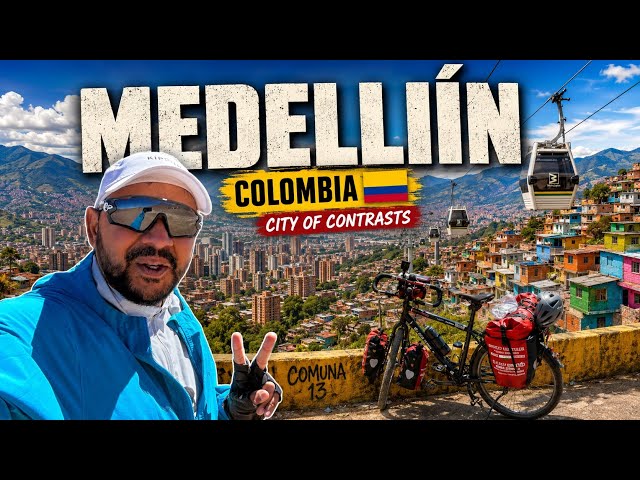
Right now, we’re in Medellín, Colombia’s second-largest city.
This city was once known as Colombia’s crime capital, but today it has transformed into one of the country’s biggest tourist destinations.
We’ll explore the city for a while, and then I’ll continue my journey because I’ve already spent a week here.
I haven’t uploaded any videos during that time because I was taking a proper break.
Honestly, my body needed recovery after weeks of continuous cycling.
Today we’re visiting a place that was once one of the most dangerous neighbourhoods in Colombia—a place where mass shootings were once common.
In the previous episode, we explored the story of Pablo Escobar.
Today, we’re standing in Comuna 13.
Just look behind me.
Beautiful murals cover almost every wall.
And if you look around…
…this entire neighbourhood has become an open-air art gallery.
But it wasn’t always like this.
Comuna 13 was once one of the most violent places in the world.
Originally, people couldn’t afford homes in Medellín because land inside the city was too expensive.
So families gradually began building houses on the surrounding hillsides.
From the 1950s through the 1980s, Colombia experienced years of political instability and violence.
Thousands of people left their villages and moved to the cities.
But there wasn’t enough space for everyone.
So they climbed higher into the mountains, building homes one above another until entire communities covered the hills.
That’s how Comuna 13 came into existence.
Then came the era of the drug cartels.
During the years of the Medellín Cartel and the Cali Cartel, this neighbourhood became deeply involved in drug trafficking and armed conflict.
After Pablo Escobar was killed in 1993, the large cartels began to collapse.
But instead of peace, many smaller criminal groups and guerrilla organisations took over.
There was a time when not a single street corner was safe.
Gunfire echoed through these streets every day.
Bullets came from every direction.
People were afraid to come here even during daylight.
Taxi drivers refused to enter the neighbourhood.
In 2002, the Colombian government launched Operation Orion, a massive military operation to regain control of Comuna 13.
Police and military forces, supported by helicopters, entered the area.
Some reports even claim that armoured vehicles and tanks were deployed.
Human rights organisations later argued that many civilians were caught in the violence.
According to several accounts, around 500 people lost their lives during this period.
Eventually, peace slowly returned.
But the government knew military action alone wasn’t enough.
If they wanted lasting peace, they had to transform the community.
So they invested heavily in schools, roads, public spaces, and social programmes.
Then came the artists.
They covered these walls with incredible murals.
Just look at this artwork.
It’s absolutely stunning.
These paintings transformed Comuna 13 into one of Medellín’s biggest tourist attractions.
Many young people who might once have been drawn into crime instead turned towards music, dance, and street art.
Today, some local children have become successful professional musicians, especially in hip-hop and urban music.
It’s amazing to see how this community has reinvented itself.
If you visit Comuna 13, just be a little careful.
Petty theft can still happen, so keep your phone and valuables secure.
I absolutely love this idea.
They’ve turned old shoes into flower pots.
How creative is that?
Just look at these murals.
No wonder this place has become world-famous.
There’s a strong hippie vibe throughout the neighbourhood.
Street performers…
Music…
Art…
Everything feels alive.
There’s even a skywalk here.
I also tried some local traditional food.
One local immediately recognised me and asked,
“You’re from India?”
Even bicycles have become souvenirs here.
Look behind me…
There’s a Honda motorcycle…
There’s a TVS as well.
Now look at this mural.
Isn’t it beautiful?
One thing I really admire about people here is their attitude towards life.
They seem genuinely relaxed.
Back home, we often stay stressed.
Here, people enjoy life.
I felt something similar while travelling through Africa.
African people were also incredibly cheerful despite having limited resources.
The people here seem even more carefree.
They have more opportunities, earn a decent living, and still know how to enjoy themselves.
Now look at these stairs.
These aren’t ordinary staircases like you’d see inside a shopping mall.
These are outdoor escalators built right into the hillside.
The neighbourhood sits around 400 metres above the lower part of the city.
Earlier, residents had to climb nearly 400 to 500 steps every single day.
So in 2004, the government installed this series of outdoor escalators to make life easier for local residents and to encourage tourism.
One interesting thing I’ve noticed everywhere here…
They sell cannabis-infused drinks.
It’s a bit like the traditional cannabis lassi you find in parts of India, except here it’s served as juice.
You’ll also find artists everywhere.
Look at this gentleman.
He’s creating beautiful artwork by hand on stone.
The biggest problem I’m facing right now is that I’m hungry…
…but I don’t really feel like eating.
Most of the local food here is deep-fried in the same cooking oil, which gives it a strong smell that I’m personally not used to.
Just look at the atmosphere.
The streets are packed with people.
There’s music…
Street performers…
Food stalls…
Souvenir shops…
And even murals of Pablo Escobar.
This entire place is full of tourists.
The artwork is incredible.
Every corner feels like an open-air museum.
From here, the climb becomes even steeper.
Another escalator begins.
There are seven separate sections of escalators leading up the hill.
Each one takes you up another few floors.
Without them, climbing this neighbourhood would be exhausting.
And the higher you go…
…the more spectacular the view becomes.
By 2004, the government realised something had to change.
Instead of allowing violence to define Comuna 13 forever, they invested in infrastructure and tourism.
Today, visitors from all over the world come here to experience the art, the music, and the incredible transformation of this community.
Especially international tourists—they absolutely love this place.
Just look at these beautiful graffiti murals.
Every wall tells a story.
You can even join a guided walking tour to learn about the history directly from local residents.
What an amazing transformation.
And with that…
I’ve finally made my way back down.
Now it’s time to book an Uber and continue the journey.
I usually book an Uber Bike here instead of a car because the traffic is unbelievable. Motorcycles can easily weave through the congestion.
But there’s one problem.
The local taxi drivers don’t like ride-sharing vehicles entering certain areas.
My Uber bike got cancelled.
Then the car got cancelled too.
I even thought about taking public transport, but I wasn’t sure about the routes, and it was already getting late.
I’d already been waiting for nearly 20 minutes.
Three different drivers had cancelled on me.
Finally, I booked another bike.
It showed just one minute away.
Earlier, it had shown a thirteen-minute wait.
Now it’s only about 500 feet away.
Perfect…
My bike has arrived.
Let’s go.
The atmosphere here feels more like a busy small-town market than a modern city.
I’ve now reached the city centre.
Wow…
The place is absolutely packed.
It feels like one huge marketplace.
Near the city centre, there’s one place I especially wanted to visit.
It’s famous for its sculptures.
And honestly…
They’re all as chubby as I am!
While I was walking around, I met members of the Hare Krishna community selling cakes.
I was hungry, and finding vegetarian food isn’t always easy here.
So I thought,
“First feed the stomach, everything else comes later.”
Now we’ve reached Plaza Botero, right in the heart of Medellín.
This is one of the city’s most famous public squares.
The plaza is filled with around 150 to 200 bronze sculptures, all created by the legendary Colombian artist Fernando Botero.
His artwork has one very distinctive style.
Every sculpture is exaggerated, rounded, and oversized.
Just like me!
That was his artistic signature.
He always said,
“This is my style—appreciate the art, not the size.”
Botero created sculptures that can now be found all over the world.
Look at this one…
People have rubbed its nose so many times for good luck that the bronze has become shiny.
During Medellín’s violent years, a bomb exploded near one of Botero’s sculptures.
Instead of removing the damaged artwork, Botero insisted it remain exactly where it was.
He personally donated a brand-new sculpture to stand beside the damaged one.
The shattered sculpture remains as a reminder of the city’s painful past, while the new one symbolises hope and renewal.
Every sculpture here is made entirely of bronze.
You can actually touch and feel the metal.
Walking around Medellín, I noticed another interesting thing.
The city has an excellent metro system.
At times, it honestly reminded me of Delhi.
The stations are crowded…
The trains are full…
It feels surprisingly familiar.
There’s also the famous cable car system.
Many neighbourhoods are built high on the surrounding mountains.
Medellín became one of the first cities to connect these hillside communities using urban cable cars.
Later, many cities—including La Paz in Bolivia and several cities in Brazil—adopted similar systems.
It’s a beautiful city.
But honestly…
Some areas still make me feel a little uncomfortable.
The crowds remind me of Delhi’s Ghaffar Market.
The streets are packed with people.
I decided not to use the metro this time.
I’d rather take a taxi.
One thing you notice almost everywhere…
The strong smell of marijuana.
You can smell it in many parts of the city.
Now I’ve brought you to what’s often called the local thieves’ market.
You’ll find shoes, electronics, and all kinds of goods being sold here.
Some locals believe many of these items are stolen.
This is considered one of the rougher parts of the city.
I’m being very careful while filming.
A couple of people have already told me,
“Don’t record videos here.”
Honestly…
I’m just trying to get out safely.
Finally…
My ride has arrived.
Now look around.
This is the main procession area in the city centre.
Crowds everywhere.
It’s actually quieter now.
Earlier, there were far more people.
People often stare at you here, especially if you’re carrying a camera.
It can feel a little intimidating.
Look at the metro.
Doesn’t it remind you of Delhi?
But there’s another comparison people often make.
Many locals call Medellín “The Bangkok of the West.”
Some even compare it to Pattaya.
People from the United States and many other countries come here in large numbers.
Whenever I visit an Indian restaurant, I usually meet fellow Indians—especially Gujarati travellers who have worked hard all their lives and now come here simply to enjoy life and travel.
So yes…
Some people jokingly call Medellín the Bangkok of the West.
Right now, we’re passing through one of the poorer neighbourhoods.
Next, I’ll take you to the city’s famous pub and nightlife district.
We’ve now arrived at a place known as the Park of Lights.
Years ago, this area had a terrible reputation.
The building across the road witnessed frequent murders.
Violence was common here.
Instead of erasing that history, the city transformed the space.
These tall illuminated columns now stand as a symbol of Medellín’s renewal.
Even here…
You can still smell marijuana almost everywhere.
The scent is surprisingly strong.
The central bus station is nearby.
I’ll book another taxi from here.
The tourist district is much safer than this part of town.
I’ve now returned from the city centre.
There are still two more places I want to show you.
First, we’ll visit a shopping mall decorated with beautiful flowers.
Then we’ll head into Medellín’s famous nightlife district—the place for which the city is now internationally known.
The neighbourhood where I’m staying is called El Poblado.
This is one of Medellín’s safest and most popular districts.
The buildings are modern.
There’s a beautiful park right across the road.
This is where my driver dropped me off.
Until the 1990s, El Poblado was mainly a quiet residential neighbourhood.
Today, it’s one of the city’s most upscale areas.
You’ll also notice homeless people living nearby.
Like every big city, Medellín has its contrasts.
Look at all these flower stalls.
Flowers are being sold everywhere because the city’s famous Flower Festival is just around the corner.
First, we’ll explore the city centre…
Then we’ll head towards the flower displays inside the shopping mall.
Look at this traffic signal.
There are even lights installed on the ground so that people looking at their phones don’t accidentally walk into traffic.
It’s a clever idea.
This is one of Medellín’s main roads.
You’ll notice police officers everywhere.
I haven’t seen this much police presence anywhere else in Colombia.
The reason is simple.
This is one of the city’s biggest tourist zones.
As I mentioned earlier…
Many people refer to Medellín as the Bangkok of the West because of its nightlife.
And now…
We’ve reached Provenza.
This is where Medellín’s nightlife truly comes alive.
Bars…
Restaurants…
Music…
Everything happens here.
One piece of advice if you ever visit.
Be extremely careful.
Someone may walk up to you and start a friendly conversation.
Don’t trust strangers too quickly.
Whether it’s a man or a woman…
Be cautious.
Drug use is common in this area, and there are many different kinds of substances.
You never know what someone might offer you—or even secretly put into your drink.
So if you come here…
Enjoy the atmosphere.
But stay alert.
Your safety should always come first.
One thing you need to be very careful about here is drugs.
Someone may offer you drugs, and if you accept, you could become intoxicated without even realizing what’s happening.
In that state, you might hand over all your belongings yourself, and by the time you come to your senses, everything could be gone.
I’ve heard this warning from many people.
They say,
“If you’ve visited Medellín but never came to Provenza, then you haven’t really seen Medellín.”
Provenza is the heart of the city’s nightlife.
This is where you’ll find the best bars, nightclubs, cafés, restaurants, and coffee culture.
In fact, Colombia is famous for three things:
Its flowers…
Its coffee…
And its nightlife.
I almost said two things—but honestly, all three are world-famous.
And one more piece of advice…
Be careful around strangers, especially in nightlife areas.
That’s something I’ve heard repeatedly from both locals and experienced travellers.
Originally, Provenza was a quiet residential neighbourhood.
Today, it’s considered one of the coolest neighbourhoods in the world.
As the night gets darker…
…the atmosphere becomes even more energetic.
Most international tourists spend their evenings here.
The area is also famous for its local food.
One of the most popular dishes is arepas, a traditional corn flatbread.
You’ll also find empanadas and paisa-style local cuisine, which people come here specifically to enjoy.
But once the nightlife begins…
The entire neighbourhood transforms.
Now let’s leave the nightlife district and head towards one of the city’s shopping malls.
We’ve just entered the mall.
Wow…
This decoration is absolutely beautiful!
In just a few days, August will begin, and that’s when Medellín hosts its world-famous Flower Festival.
Colombia is one of the world’s largest flower exporters.
Do you know which country ranks first?
I’ve already visited that country during my cycling journey.
Let me know your answer in the comments!
Nearly 40% of Colombia’s flower exports come from the Medellín region alone.
Many of the flowers you see around the world—especially during Valentine’s Day and Mother’s Day in countries like the United States—are grown right here in Colombia.
During the Flower Festival, this city becomes incredibly crowded.
People say there’s hardly any room left to walk.
Flower lovers travel here from every corner of the world.
The streets fill with musicians, dancers, artists, parades, and cultural performances.
Since the festival is still about a week away, I won’t be staying that long.
But it’s easy to see why the entire mall has already been decorated with flowers.
It looks beautiful.
Now it’s time to head back to my guesthouse.
These days, I’ve stopped staying in hostels.
Instead, I’ve rented a small guesthouse.
Before returning, I bought some yogurt…
…and packed a few parathas from an Indian restaurant.
Dinner is sorted.
Traffic in Medellín is extremely busy.
You really have to stay alert while crossing the roads.
Near my guesthouse, there’s one of the biggest hostels I’ve ever seen.
It’s called Masaya Hostel.
It’s around seven or eight floors tall.
Honestly, there isn’t much difference between that hostel and my guesthouse.
The price difference is only about ₹300 per night.
The main reason I chose this guesthouse was its clean kitchen.
Everything I need is available there.
They also serve breakfast every morning.
I’m paying around ₹2,500 per night, and they’ve even given me a safe place to park my bicycle.
This is my room.
Here’s all my luggage…
And here are the parathas I packed for dinner.
There’s one sign I wanted to show you.
“No Drugs. No Smoking. No Children.”
Unfortunately, this reflects part of Medellín’s reputation.
It’s not a joke.
The city has worked hard to change its image, but its past still influences how people see it.
So, friends…
That was today’s city tour of Medellín.
Many viewers from the United States had requested this episode, and I hope you enjoyed exploring the city with me.
There are still a few more attractions worth visiting.
This is Colombia’s only city with a metro system.
We visited several of its major tourist attractions, and of course, its famous nightlife district.
If you’re planning to visit Colombia, Medellín is definitely worth adding to your itinerary.
I’ve actually met quite a few Indian travellers here during my journey.
Now the question is…
What’s next?
A few days ago, elections were held here.
The new government hasn’t officially taken office yet.
Before the transition, political protests have continued in different parts of the country.
Just last week, two buses were reportedly hijacked, and armed groups demanded money from the passengers.
The next region on my route leads towards the Darién Gap.
Unfortunately, that area is still considered unsafe.
Some cartel groups continue to operate there.
Earlier, many criminal groups earned money from migrants travelling through the Darién route.
Now that migration has slowed significantly, some of those groups have reportedly turned to other criminal activities.
So now I have two options for reaching Panama.
I can take a flight, which would cost me around $300.
Or I can continue overland and by boat, which would cost roughly $400.
Personally, I’d love to experience at least a part of the legendary Darién Gap.
From here, it’s only about 200 kilometres away.
I also spoke with Prince Bhai, who runs an Indian restaurant here.
He told me the route isn’t considered safe at the moment—especially until 10 August, when the new president officially takes office.
According to him, it’s better to wait until the political situation becomes more stable.
At the moment, I’m still undecided.
I’m not sure which route I’ll choose.
So…
I’ll let you know in the next episode.
Tomorrow morning, we’ll begin our journey towards Panama.
Until then…
Stay happy.
Stay busy.
Stay positive.
Stay healthy.
Jai Hind! Jai Bharat!