

Did Alien’s Made These LINES Who Made The Nazca Lines? And Why? Ep.50
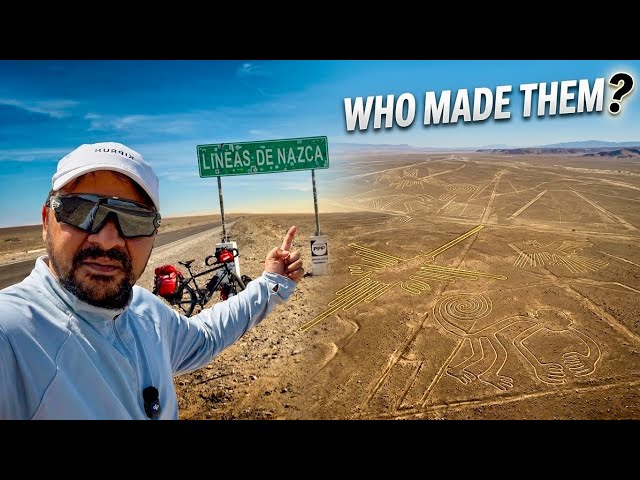
Welcome to the Nazca Lines, a World Heritage Site. These incredible geoglyphs are believed to be between 2,200 and 2,500 years old.
Namaskar, Salaam, Sat Sri Akal, Ram Ram Ji!
Once again, welcome back to my channel.
It’s 2:00 p.m. and I’ve only just woken up. Right now, I’m in Nazca.
In the last video, you saw how we made a super-fast ride from Arequipa and finally reached Nazca at around 11:30 p.m.
Nazca is a historic town. You could also call it the Nazca Desert.
We are now at an elevation of around 570–580 metres above sea level, so breathing feels much easier compared to the high mountains.
This beautiful little town is famous for its history. Most of you have probably heard stories about aliens and the mysterious Nazca Lines. Many people have watched documentaries about them as well.
This is that very Nazca.
Some of you may also have heard legends linking this area to “Patal Lok” because it lies almost on the opposite side of the Earth from India. There is also a famous geoglyph known as the “Trident,” which some people connect with ancient myths and legends.
The Nazca Lines are enormous designs etched into the ground. Even today, nobody knows exactly how they were created, why they were made, or what purpose they served.
That mystery is what makes Nazca so famous.
The Nazca Desert is essentially considered part of the larger Atacama Desert region.
Today I’m quite lucky because this area receives almost no rainfall throughout the year—sometimes as little as 20 minutes of rain annually. Yet today there are actually clouds in the sky.
Well, whenever I arrive somewhere, the clouds seem to arrive too!
Honestly, I was so exhausted when I got here last night that I slept immediately. It is now around 2:30 p.m. and I’ve only just woken up. I haven’t even had any water yet.
First, I’ll find something to eat and drink, then I’ll take you around the town.
It’s a small place. Calling it a city would be an exaggeration. It’s more like a small town.
But despite its size, it is packed with fascinating stories and history.
I checked four different restaurants hoping to find some vegetarian food. Unfortunately, there wasn’t much available.
I was really hungry, so I decided to visit a supermarket instead, buy some food, cook something at the hostel, and then head out to explore.
Look at this dustbin. A collection truck simply lifts the entire container and takes it away.
The cleanliness here is impressive, especially considering this is basically a small town.
I bought a couple of bananas and some yoghurt. Now I’ll head back to the hostel and eat comfortably.
This is Plaza de Armas, the town centre.
When I arrived last night, I was in such bad shape that I didn’t even unload the luggage from Dhanu, my bicycle. Everything remained attached to the bike, and I went straight to bed.
That’s how exhausted I was.
This is my hostel.
There’s nobody else here. I seem to be the only guest. Perhaps it’s the off-season.
Here’s my room.
I simply arrived and collapsed onto the bed.
So once again, welcome to Nazca—the city of aliens, if you want to call it that.
It’s a small town, but it’s famous worldwide because of its enormous geoglyphs that can only be properly seen from the sky.
From Nazca, we’ll continue towards Lima.
Lima is around 400 kilometres away, perhaps even slightly less.
Today I plan to ride about 150 kilometres. Tomorrow I’ll try to cover another 200 to 250 kilometres. Hopefully, I’ll reach Lima either tomorrow night or the following morning.
I’m trying to get there as quickly as possible.
As soon as you leave the town, you enter a four-lane highway.
The road conditions ahead aren’t great, and honestly, the traffic discipline here is among the worst I’ve seen anywhere.
Oh wow!
For the first time in all of Peru, I’ve found a petrol station that is clean and has proper restaurants, truck parking, and facilities.
It’s impressive.
We’ve only just left Nazca, and I have some amazing things to show you.
The famous sites are located just outside the town.
Look at the Pan-American Highway.
This is an international highway, yet some sections are in surprisingly poor condition.
I’ve travelled around four kilometres outside the town now.
I’ve already seen several petrol stations under construction. I’m not sure why so many are being built here.
The town ends here, and now the real adventure begins.
Ahead you’ll see some small hills, but these hills hold incredible stories.
Friends, we’ve now left Nazca behind.
There it is in the distance.
The town is nestled at the foot of the Andes Mountains.
This entire region is part of the Nazca Desert, which itself is connected to the broader Atacama Desert system.
Dhanu and I have now arrived at the Nazca Lines.
Look at the traffic here.
You can see a green area in the distance. Beyond it is a small airport.
This airport operates flights that take tourists over the Nazca Lines.
A flight costs roughly 100–150 US dollars and provides an aerial view of the geoglyphs.
Look over there.
Those are the Nazca Lines.
Some of them stretch for 400 to 500 metres or even more.
From the ground, it’s difficult to recognise the designs.
Only from an aircraft can you truly appreciate the shapes and figures.
Up ahead there is a viewing tower. We’ll try to climb it and show you some of the lines from there.
The Nazca Lines are recognised as a UNESCO World Heritage Site.
Look over there.
That shape resembles a cat.
These geoglyphs were created by removing the dark surface stones and exposing the lighter ground underneath.
From above, the designs become visible.
There are around 1,300 known figures and geometric designs across the region.
Many can only be properly appreciated from the air.
Since I’ve already seen them from an aircraft before, I’m not too eager to climb the tower.
Besides, I’m not particularly fond of heights!
The process is fascinating.
The surface of the desert is covered with stones. Ancient people simply removed the stones in specific patterns, creating lines and figures that have survived for thousands of years.
The Nazca Lines were added to the World Heritage List in 1994.
Most of them date from around 500 BC to 650 AD.
This region was once home to the Nazca civilisation, whose culture flourished long before the arrival of Europeans.
You can see one of the famous figures here, known as the Tree.
I viewed all of these designs from an aircraft during my previous visit.
You can see planes constantly flying overhead. These are sightseeing flights carrying tourists to view the geoglyphs.
Each aircraft usually carries five or six passengers.
When I visited earlier, I took the flight myself and recorded a documentary about the experience.
The editing is still in progress.
Once that documentary is ready, I’ll show you much more detailed footage and explain the history in greater depth.
I had also promised a friend that I wouldn’t fully reveal Nazca and Machu Picchu before his own documentary was released.
He worked hard on the project, and out of friendship I wanted him to present it first.
The funny thing is that it’s been four months and he still hadn’t started editing!
Last week I finally convinced him to begin the editing process, so hopefully the documentary will be released soon.
From here, the road descends into a beautiful valley.
Further ahead there’s a house in the valley that I want to show you.
This Nazca Valley, or rather everything that remains of Nazca, has survived largely because of one remarkable woman. Her name was Maria. She was German and arrived here around 1925 or 1930. She spent her entire life here, dedicated solely to protecting the Nazca Lines.
The highway you can see here today was originally planned to pass through the Nazca Lines, but she refused to let them be damaged. She protested tirelessly and devoted nearly 90 years of her life to preserving them. She never married and spent her entire life here. There is now a statue of her inside the site. You can see it there. The credit for saving the Nazca Lines largely goes to her. She did an incredible amount of work.
Look at these fascinating lines. They also demonstrate how ancient people conserved water. Water would flow through these channels and be carried further along to irrigate farmland. This entire valley was developed because of that system. Archaeologists have also discovered homes and settlements from that civilisation here. They are located on the other side of the mountain, and visitors can go there as well.
A museum has been built in her memory, and the local people have great respect for her. You can see how carefully the stones were measured and moved to create these lines. She came here at a young age and established her life in this remote place. She eventually passed away here as well.
We are now heading towards Ica. It is about 100 kilometres away, so we should arrive comfortably by around 5:00 PM. From Ica to Lima is roughly 250 to 300 kilometres. We will decide whether to ride that route or not. The traffic on that road is terrible. Our vehicle was involved in an accident there the last time we travelled through the area.
Look at that—cactus farming! This is the first time I have ever seen cultivated cactus fields. Amazing. Not much else would grow in such a dry environment. There must be some water available here, probably coming down from the mountains. Valleys usually receive at least a little water.
We spotted a roadside shop near a police checkpoint. They were selling bananas, mangoes, chickpeas, kidney beans, pomegranates, melons, tamarind, dates, and other local produce. We decided to buy a melon. I paid with a ten-sol note. The melon cost three soles, which is roughly ₹80.
Now we continue our journey. Once we cross this mountain range, we will reach the coastline. These mountains are incredibly dry and barren.
We have arrived at a place called Changuillo, which appears to be a tourist attraction. There is even a giant crab sculpture here. Since we bought a melon earlier, we decided to stop and eat it. Unfortunately, it was neither sweet nor sour—just bland. I tried adding some salt, but it still wasn’t particularly tasty.
We have entered another valley, probably the last one before reaching the coast. This is also a good place to explain how the Nazca Lines were created. The ancient people simply removed the dark stones from the surface. Beneath them lies a lighter layer of soil, only six to eight inches down. By moving the stones aside and exposing the lighter earth, they created visible lines and figures. You can find examples of this all over the surrounding hills.
We have now reached Palpa, another area famous for similar geoglyphs and ancient designs. I will show you some photographs. Look at these figures—two people are depicted, and one appears to be waving. This entire region is covered with such markings. Many designs are invisible from the ground and can only be appreciated from the air.
There are no signs prohibiting drones here, unlike in Nazca where aircraft regularly operate. Since we are in Palpa and there is hardly anyone around, it seems like a good opportunity to fly the drone. I even found some shade nearby.
Most of these figures are located either on flat ground or on gentle hillsides. Those on slopes can be seen from below, while those on flat terrain are best viewed from above. The ancient artists clearly understood how to position their creations so they would remain visible and protected. These works are around 2,200 to 2,500 years old, which makes them even more impressive.
Look at those beautiful mango orchards! It is already 4:00 PM, and I have arrived at the bus station in Ica. To be honest, the journey has been exhausting. The roads here have very little shoulder space, making travel difficult and uncomfortable.
I spoke with my friend Ratan in Lima, and he told me that the next 50 kilometres would be much the same. Closer to the city, however, the road becomes an expressway. Since I was in a bit of a hurry, I decided to take a bus for the remaining 250 kilometres to Lima.
There are several types of buses here—luxury coaches, high-speed services, and local buses. As usual, I chose the local option, which suits my style of travel. Besides, entering a capital city by local transport often makes the experience more authentic.
Six hours later, I arrived in Lima, where my friend came to pick me up. It was great to see him again.
That night, I stayed at Ratan’s place. The following morning, I rented a room of my own. It costs $40 per day, and I have booked it for 15 days because I have several things to do here.
First, I plan to complete a 10-day meditation course. I also want to improve my language skills and catch up on some personal work. In addition, I have applied for a Canadian visa and need to complete the remaining formalities. I also plan to apply for an Ecuador visa, which many people say is one of the most difficult visas to obtain.
We will see how everything goes.
That’s all for today. I will see you in the next video. Until then, stay happy, stay busy, stay positive, stay healthy.
Jai Hind, Jai Bharat.