

Exploring Indo-Fijian Heritage in Suva 🇫🇯 | A Journey Through Fiji’s Capital City

Exploring Indo-Fijian Heritage in Suva | A Journey Through Fiji’s Capital City
Hello, Salam, Sat Sri Akal, Ram Ram Ji to everyone. Right now, I am in Fiji. For the last three days, I was staying in an Airbnb room, which is actually part of a Chinese family’s house. They had rented out rooms, so I stayed there. After three days, today I am leaving. At present, I am in Nadi. From Nadi, my route will be towards Suva. Suva is about 190 km away from here. Let’s head there and see how the journey goes. Right in front is a petrol pump called Pacific, and from here we will take a left. But there is a lot of traffic as this is the main road. This road is called Queens Road, which circles the whole island. Here comes a police officer in front.
Thank you, Fiji! As far as I can tell, this is a very touristy place with so many resorts and hotels everywhere. Look, over there is an Indian restaurant. In fact, there are many Indian restaurants in Fiji, since there are so many Fiji-Indians here. Now, we are heading 61 km ahead where we see R.B. Patel. At the corner, there is a Swagat Indian restaurant run by our brothers from Uttarakhand. There is also a theatre here where Hindi films are shown on the very first day of release. Then there’s Anna Cake and Café where I’ll grab some water and head out.
There’s another restaurant called Raju Khana Khazana. Before leaving, I thought I should have some breakfast, so I stopped at Swagat Indian Restaurant. It usually opens at 11:00, but I requested the owner to serve me a little earlier, and he kindly agreed.
Look at the houses here – small homes with colonies spread around. There’s also Krishna Friendly Grocery Store. Now we are crossing the Nadi River, which is part of the town of Nadi (or Nandi, as some pronounce it). After crossing, we will move ahead. Today I’ll be staying at a hostel I found by chance. It isn’t exactly a hostel, but more like an Airbnb-type place with a dormitory of five to six beds. Honestly, it doesn’t even feel like I’m travelling abroad – it feels like moving around within the same country. Look, there are railway tracks here too – probably the old sugarcane trains from British times.
So, I checked into this hostel. I also washed my clothes in the laundry here. If you want, you can give a tip to the laundry staff. I washed all my clothes since it had been 5–10 days without laundry, ever since I left Australia.
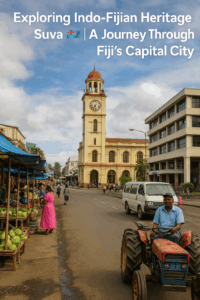 Today’s ride was around 50 km, and I managed to spot this hostel. We reached Suva, the capital city of Fiji, from Nadi – about 180 km. The last three days of heavy rain made travelling really tough. Rain kept troubling us along the way, but finally, we reached Suva. It’s a beautiful capital city, small yet charming, located right on the harbour. That’s the Harbour Centre in front. Nearby, I can also see a Chinese market.
Today, we will explore the city a bit before heading back to Nadi. The rain here is relentless – almost 8–10 hours of rain every day. It gets a little warm during the day, but by evening heavy rain starts again. R.B. Patel stores are everywhere – seems like a big brand here. The taxis also run on meters, which is good.
Now, we are in Suva City, the capital. It’s clean, neat, and very pretty. I saw a lot of money exchange counters here, along with countless supermarkets. Everyone keeps calling out “Bula, bula, bula” (a local greeting). I even found a vegetarian restaurant run by the Hare Krishna group. That will be our meal – breakfast or maybe lunch. We parked the car and decided to have some food.
This is the Reserve Bank of Fiji, just like the Reserve Bank of India. That’s the cathedral here in an area called Totogo. You can get simple dishes here – even kadhi and thali. Honestly, it doesn’t feel like I am outside India. I ordered a simple thali for FJ\$11 (about ₹350), which had chapati, salad, and two vegetables. I also asked them for masala tea, but instead, they gave me milk with masala – no tea leaves at all. For the first time in my life, I had spiced milk instead of proper masala tea.
Look at the foreign-style sunlit buildings on the hill. The car struggles a bit on the slopes. Now we’ve reached the Arya Samaj Headquarters, called Arya Pratinidhi Sabha Fiji. A little further ahead is a Gurdwara Sahib. I’ll visit it as well. There’s also a radio station called Radio Light 104 FM.
Here’s the Nishan Sahib (Sikh flag) of the Gurdwara. Inside, I saw photos from 1947, the year India got independence. These pictures are 76 years old. Sat Sri Akal, Baba Ji.
Everything is good.
“How many years has it been?”
“It’s been five years.”
“Yes, five years.”
“And how many years since the Gurdwara was built?”
“It’s been 102 years.”
“Yes.”
“The first sangat (congregation) came here. This was the first Gurdwara in the Pacific region.”
“Yes, the first Gurdwara in the South Pacific. They even opened some schools.”
“Yes, people had come from India and started Khalsa schools.”
“Oh really?”
“Yes, Indians started education in Fiji. Before that, there was no education system.”
“Okay. So, Indians have made a remarkable contribution to this country’s economy and especially in education.”
The first Gurdwara in the South Pacific was established here. They were talking about whether it should be called a Punjabi *pilkan* or in Hindi—someone wasn’t sure and asked viewers to comment if they knew.
“How old is it, Baba Ji?”
“It’s 55 years old.”
Earlier, the entry to the Gurdwara was from the other side, but due to the highway being built there, that gate was closed and now the main entrance is from here. All this surrounding area is maintained by the Gurdwara Sahib. The view from here is stunning. Look at the structure—how people carried cement and stones on their shoulders and built this with hard work.
Currently, around 100 Sikh families live in this area, but most of them don’t even know Punjabi. The Guru Granth Sahib is taken care of by granthis and pathis (priests) who have come from India.
Our vehicle is ready now, so we are moving ahead. We’ll visit the Indian Embassy and then roam around a bit. I may not stay too long in Suva and might head back to Nadi, and from Nadi, move on to the next country.
So, we left the Gurdwara Sahib. On this side as well, they have a large area of land. The rain has started again and I feel stuck. This constant rain has been really frustrating—rain, rain, and more rain.
Here is a Shiv temple, and right next to it is “30 Motor Works”. Temples are common here—you find one in every second or third lane. The houses here are so beautiful, I really enjoyed looking at them.
There’s also a signboard saying *HIV on the Rise*. HIV is quite prevalent in this country, so one must be careful. That building over there is their hospital. On the back of a taxi, I saw a picture of Lord Hanuman along with a trident.
This is the *Fiji Times* and *National Herald*, which were established here in 1869.
Everything is good.
How many years has it been for you?
It has been five years.
Yes.
How many years since the Gurudwara was built?
It has been 102 years.
Oh, two years?
Yes.
This was the first Gurudwara in the South Pacific region. Along with it, schools were also opened. People from India came and started Khalsa Schools. Before that, there was no proper education system here. Indians actually started education in Fiji. Their contribution to the country’s economy, and especially in education, is remarkable.
The first Gurudwara in the South Pacific was established here. Do you know what “Pillkan” in Punjabi is called in Hindi? I don’t know, but if anyone knows, please comment.
This Gurudwara is about 55 years old. Earlier, the entry used to be from that side, but when the highway was built, that way was closed, and now the main gate is on the other side. The whole surrounding area belongs to the Gurudwara Sahib, and it is maintained by the Gurudwara itself. The view from there looks amazing.
Just imagine how people lifted cement and stones on their shoulders and carried them up here to build it. At present, around 100 Sikh families live in this area, but most of them do not know Punjabi. The Guru Granth Sahib is taken care of by priests who have come from India.
Now, our vehicle is ready, and we are heading towards the Indian Embassy. After that, we will explore the area a bit. Maybe I won’t stay here long and will go back to Nadi, and from Nadi, I might travel to the next country.
So, we have now left the Gurudwara Sahib. On this side as well, they own quite a big area. And again, the rain has started—it’s becoming frustrating now. Rain, rain, and more rain!
Here you can see the Shiva Temple, and next to it is a motor works shop. There is a temple in almost every second or third street here. The houses are really beautiful—wonderful to see.
HIV is also on the rise in this country, so one needs to be careful. That building ahead is the local hospital. Behind the taxi, you can see Hanuman Ji and a trident symbol.
Here is the Fiji Times and the National Herald newspaper building, which was established in 1869.