

Exploring MINI INDIA 🇮🇳 in South America 😱 | Chile me Indians ka Kamaal 🇨🇱 Ep.39
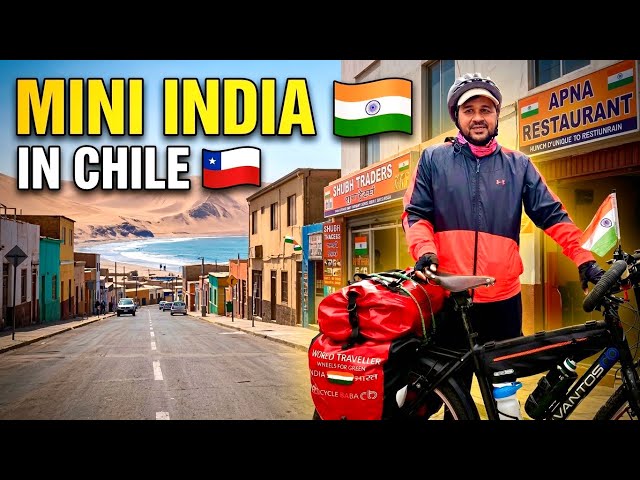
It’s 4:30 in the morning. The bus has just arrived. Earlier, Indians used to carefully pack and send goods in the beginning. Alright. [Music] Fighter jets are flying overhead early in the morning.
Good morning, salaam, namaste, sat sri akal, ram-ram to everyone. Once again, welcome. Right now, I am in Iquique. Iquique is a financial capital of Chile. In the last video, you saw that we had reached here. I had booked a room in an Ibis Budget hotel, and I stayed there. Now let’s go downstairs. Let me show you the view from here—it looks amazing.
Alright, we are heading down now. Let’s check out from the room. And off we go exploring Chile. So this is Dilbagh bhai. Where is he? Let me see. Where are you, brother? Shine the light… yes, there you are! How are you, sir? Looking great!
So this is Dilbagh bhai. I came here mainly to meet him. Actually, I came to get my laptop repaired, and Dilbagh bhai works with computers here. We spoke yesterday, and he said, “Come over,” so I came at night.
“How was your night?”
“Very good, everything is going great. How about you?”
“Pretty good!”
These fighter jets are flying around because there’s some exercise going on—they are celebrating 100 years.
Now Dilbagh bhai gives a short introduction: he is from village Rada, in Assandh tehsil, Karnal district. I’ve met many people from Karnal and Kaithal here. It feels great meeting fellow Indians abroad—there’s nothing bigger than this brotherhood and love.
Now where are we going? First, we’ll give your laptop for repair. I’ve called a technician. He’ll replace the MacBook screen. If needed, he can also provide another MacBook, but as per your situation, this one is fine. We’ll just replace the screen with an original one. Then we’ll go home and have breakfast—aloo parathas!
It’s been so many days since I had proper homemade parathas. I did eat parathas once in Chile, but those were roadside ones—not homemade. Today we’ll have proper homemade Haryanvi parathas.
Now we’ve reached his office. We parked the vehicle. First job—hand over the laptop. There’s a dental hospital nearby (I thought it was a mental hospital at first!). We greeted everyone and handed over the laptop. They’ll reset it to factory settings—there’s no important data anyway.
Now we’ve reached his home. Look at this view—wow! The entire city is nestled in the lap of mountains, and it’s surrounded by desert. I feel like flying a drone from here to show you everything.
Such a beautiful house and view. We had tea and parathas with desi ghee—after so many days, it was an amazing feeling. Thank you, Preeti!
After that, we came downstairs. This place reminds me of Namibia—another place where the desert meets the ocean. This is one of those rare locations in the world where the desert touches the sea.
The roads are very well maintained here. The city lies at sea level, but if you go just 5 km outside, you’ll reach areas that are 700–800 metres above sea level.
There seems to be a fire somewhere—smoke is rising, and emergency vehicles have arrived. Many old houses here are made of wood, so fires can spread quickly.
Look there—that person is paragliding! Iquique is known as a paradise for paragliding and surfing.
There are around 1,000–2,000 Indians living here. Many families are settled, and there are also many Nepali workers.
You’ll notice many buildings here are made of wood—it’s hard to tell at first glance. This is an English college—interesting way they’ve written “English.” The city is quite big—around 101 km long—and it is considered the fourth-largest city in Chile.
Now we have entered Zofri (Zona Franca), the Iquique Free Zone, where there is no tax. This is the main hub for Indian businesses here. Many Indians have been living here since the 1960s and 70s. In the beginning, they used to carefully send goods, and now they own entire malls.
I’m amazed by the graffiti here—it looks so beautiful.
This is the entry for wholesale markets, and further ahead there are malls as well. Look, it all started with “Satguru,” and below that is “Rupa.” There are also many Lebanese businesses here—they are excellent businessmen and are present across the world, including West Africa.
Here is your translation in simple, clear English (UK):
Along with Sindhis, there are many Indians here as well. Look at this—so many trucks are unloading and loading goods. All of this cargo will go out from here. Goods come here and are then distributed elsewhere.
Ahead, this area belongs to Chinese traders. See, all these shops are run by Chinese people. That one is from Taiwan. Oh wow, there are so many of them.
Now, most of these shops you see are owned by Indians. Yes, a large number of them belong to Indians. When I was in Punta Arenas, the free zone there also had around 80% Indian ownership—even big showrooms.
You can even find Apple products here. Everything is sold in bulk in this area. This entire zone is for wholesale trade. If someone wants to buy retail, they can go to the mall right in front.
This area is very large—spread across around 30–40 kilometres. It’s called Zofri (Zona Franca). Entry is not open like a normal place. If you leave and want to come back, you need a permit slip. I can enter easily because my thumbprint is registered. But if you go, you’ll need to take a pass.
This is “Guru Express,” an Indian restaurant. Now we’ve entered the mall. This first shop is Indian-owned. That one too… and that one as well. Many shops here belong to Indians. This one (JPT) is where Mukesh works. Almost the entire mall is filled with Indian shops. Even the LG and Donfin stores here are owned by Indians.
You can also find Indian food items here—some groceries and snacks. These containers arrive here and, once cleared, are brought inside. The port is just a little ahead on the other side.
This is the main road. On both sides, you’ll find wholesale markets—cars, clothes, and other goods. Most of these shops are owned by Indians.
“Hello brother, how are you?”
“All good, brother! Happy Holi!”
Looks like colours have already been thrown everywhere—this is how Holi is celebrated here too!
I had come here to get my laptop repaired, but after checking, they found that the screen was completely damaged. It couldn’t be fixed, so I had to buy a new one—another unexpected expense.
Honestly, Chile has turned out to be my most expensive country so far. In the last few months, a lot of money has already been spent, especially on the Antarctica trip. South America has really drained my budget!
“Thank you so much, brother,” I said to Dilbagh bhai.
He replied, “No worries about money—you just keep making more videos!”
Now we’ll explore the city a bit and later take a bus back at 8:30 pm. I travelled 6 hours just to spend money here, but that’s life—necessity is the mother of invention.
We also exchanged some currency. I bought Bolivian currency in advance because at the border, it takes a lot of time, and there is no currency exchange facility there. Also, Bolivia has a black-market system for currency, and in Calama, it wasn’t available. So I arranged it here for emergencies.
Now we’re standing in the city centre. Look at this church in front—it may look simple, but it is actually around 200 years old. All these buildings you see are also around 200 years old. They may look normal, but they are made entirely of wood.
The historic centre of Iquique is about 150–200 years old. It was developed by wealthy Spanish settlers. Let me tell you a short story of how this city was built.
Around the 1800s, copper was discovered here, and mining began. Later, nitrate was found, which is used to make fertilisers. That brought even more mining activity. Since both were valuable resources, a port was built here, and goods were exported to Europe.
People became very rich. So where did they spend their money? The wealthy came up with a clever idea. Ships going to Europe carried copper and other materials. But on the return journey, instead of coming back empty, they brought wood from different parts of the world.
That wood was used to build the entire city—large houses, villas, and structures. That’s why you see so many wooden buildings here.
The beauty of this city is unique—on one side, there is a desert, and on the other side, the sea, with a narrow flat area in between where the city is built.
There are many more stories about this place.
That building in front is completely made of wood. New buildings, of course, are made of concrete. Another reason for using wood was safety—this area experiences frequent earthquakes.
That building there is a marriage registration office. The red one next to it is like an RTO office where vehicle registrations and number plates are handled. Government-related documentation work also happens here.
This is Dilbagh bhai’s car—a Dodge.
That building in front has “Dharma” written on it. It shows how strong the Indian presence is here. Indians have been here for a long time.
The first Indians arrived here around 1930. Most of the Indian community here belongs to Sindhi families. Some of them originally came from regions that are now part of Pakistan.
Some of them came here directly from what is now Pakistan. They still call themselves Indian because, at that time, India and Pakistan were one country.
This side is the city centre. The area where we came from—that’s where it starts, and it continues until the end of the city. Let’s go for a short drive.
We stepped out a bit from their shop, and now we’re heading towards the port area. Is this a museum? Yes, it’s a museum. They’ve kept a ship here. Their original ship had sunk, so they recreated it. It was used during the war with Peru.
This port is very famous. Large ships arrive here, and goods are supplied from here to multiple countries—mainly Bolivia, Peru, Argentina, and also within Chile. Even Uruguay receives goods from here. So, in total, around five to six countries are supplied from this port.
Because of this major port, the city developed a lot.
When you travel from Antofagasta, there is a checkpoint. From that point until the Peru border, the entire area is a free zone—no tax is applied. But if you cross that barrier and go towards Antofagasta, then any goods you carry will be taxed.
This area was once disputed. Earlier, it belonged to Peru. In the 1800s, there was a war, after which Chile took control. Bolivia also claims this area, though it’s unclear how valid that claim is. There have been several conflicts over this region.
Look at that truck—when it uses engine brakes, it makes a very loud sound.
Later, when the Spanish arrived, they finalised the region (around the late 1800s or early 1900s) as part of Chile. Since then, it has remained under Chile.
There is a special day when the ship’s anniversary is celebrated. On that day, entry to this museum is free; otherwise, you need to buy a ticket.
In earlier times, ships were operated purely based on wind direction—there were no engines. Right now, entry inside is closed. You can see cannons on it—it was actually a warship called Esmeralda. There is also a street named after this ship.
A huge amount of goods comes here—almost everything is available. Perfumes and alcohol are especially famous here. Indians have a strong hold in the perfume business, and local people are very fond of perfumes. In every city, you’ll find around 100 shops just selling perfumes.
Earlier, European perfumes were popular, but now Arabian-style perfumes are trending. Interestingly, most of these “Arab” perfumes are actually made in India.
Indians also dominate the pharmacy sector here—around 70–80% of medicines available are made in India.
Now we’re heading towards the city centre. You’ll see many buses here, and you can even get buses to Santiago from here, which is more than 2,000 km away.
This is an old house with a story behind it. The lower part has been flooded with water now. The ground floor is made of stone to keep it cool (since it gets hot here), and the upper part is made of wood to protect it. Even 200 years ago, the architecture was so advanced—every room has a balcony.
Now we are entering the city centre. Look at this house—it is completely made of wood. From here, the city centre begins.
There is a dedicated street here where vehicles are not allowed. We will park the car and walk.
Here, the fire brigade system is interesting. Firefighters are not salaried employees. Instead, people contribute money voluntarily, and that’s how they operate. Since fires happen often (due to wooden structures), this system works.
Now we have reached the city centre—it’s said to be very beautiful. Wow, it really looks amazing!
This is the opera building. Earlier, the ship-related signals were managed from here. These are air force officers here with their families. Today seems to be a special day—fighter jets have been flying all day.
There’s even a jet on display, and people are allowed to go inside. You can see the ejector seat used in emergencies—it ejects the pilot out of the aircraft.
As we move further, this street is very famous. You’ll find all kinds of restaurants here.
This water system is from old times. All the houses in the centre are wooden. These used to belong to wealthy people. There were railway tracks here earlier, but now they are closed.
This street is called Baquedano. It’s very beautiful. All these buildings are wooden, and the street ends at the beach, meeting the sea.
All these houses are old, and they cannot be demolished or modified from the outside. This is a common rule in heritage areas worldwide. These were once homes of millionaires and billionaires, and now many of them have been turned into museums.
This house was built in 1925—about 100 years old. That one is from 1922. Look how wealthy people were—they even had train tracks running near their homes!
Here’s a house from 1892. Around 200 years ago, this was the symbol of Iquique. It represents mining and industry, which were the backbone of this city.
There was also a railway system with track-switching mechanisms, which allowed trains to change direction.
Now we’re heading back. There is even underground parking built beneath the park here.
It’s now 8:30 pm. I asked my friend to quickly drop me at the bus stand—my bus leaves in 15 minutes.
We’ve reached the bus terminal. Now we’ll board the bus. This one is going to Calama. At this checkpoint, all luggage is checked.
The Iquique region is duty-free, but beyond this point, it becomes part of mainland Chile where taxes apply.
Look at this—this is a customs truck with an X-ray scanner. It scans entire trucks. I’m seeing this kind of scanner for the first time. The truck goes behind it, and the scanner checks everything.
Now our bus has arrived, and we can board it.
I couldn’t find a taxi, so I had to walk. It’s 4:30 in the morning now. By 5:00, I’ll reach the apartment.
I’m a bit out of breath because the altitude has increased again. Also, there’s a slight fear because this area has some crime. It would have been better if I had found a taxi, but there was none—so what can you do?