

Indian 🇮🇳 Cyclist galti se Mars pahunch gaya || Atacama, Chile | Cycle Baba Ep.40
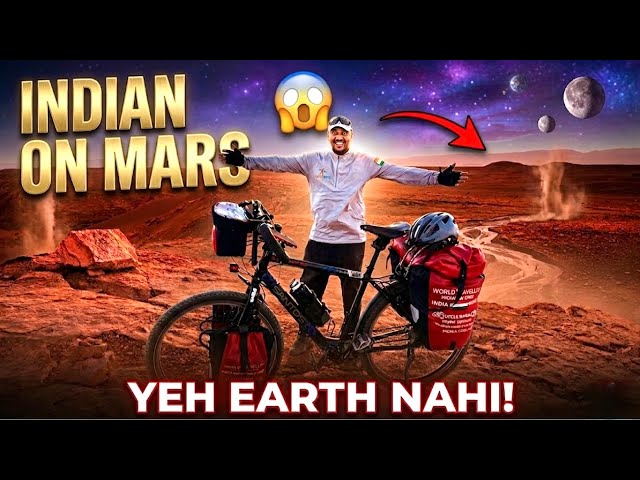
Today, I’m going to take you to a place that feels like Mars itself.
Hello, greetings, Namaste, Sat Sri Akal, Ram Ram to everyone. Once again, welcome to my YouTube channel, my world cycling journey, my pole-to-pole expedition. Right now, I am in Calama, which is the second-last city of Chile for me. I won’t be showing much more of Chile now. I know you might be getting bored, and honestly, even I feel the same. So now, we are preparing to move towards a new country.
From here, we will go to San Pedro de Atacama, and from there, after a tough climb, we will head towards the beautiful country Bolivia.
My bicycle is ready. In the last video, you saw that my laptop had broken, and I had to urgently travel to Iquique to get it fixed. The past week has been quite difficult—first I fell ill, then the laptop broke, and things just kept happening one after another.
Now I’m preparing to leave. I got a bit late in the morning. I planned to leave at 7:00 am, but I’m starting at 9:00 am. Today’s ride is about 90–95 km to San Pedro, so I should reach comfortably.
Right now, I am at around 2,500 metres above sea level. First, I need to climb up to about 3,200–3,300 metres, and then descend back to around 2,400 metres. So there’s one big climb. The first 2–3 hours will go into climbing, and then it will be downhill.
Saying goodbye to everyone here. Mukesh bhai has already gone to work. I got a bit late because I forgot to charge my phone at night.
I will stop somewhere ahead and fly my drone to show you the city from above.
Right now, I’m struggling a bit—feeling breathless. I’m only at 2,500 metres and already feeling it. Later I have to go up to even higher altitude. But no worries, I will go slowly.
I found an open spot and flew the drone. Since the airport is nearby, I couldn’t fly it high—only up to 30 metres.
The graffiti here is amazing. They colour everything beautifully, although some random writings don’t look good.

Now I am turning off towards smaller streets. Look at this tree—it must be very old. Growing a tree in the desert itself is a big thing, and these are old trees.
Now I am almost out of the city and will get onto the highway. There’s a statue ahead. Come on, let’s climb slowly without stopping.
There’s even a river here—that’s why Calama exists. Most towns develop near water sources.
Here is the sign: San Pedro de Atacama via State Highway 23.
Now I am completely out of the city. One road goes towards Antofagasta, and another goes towards the Bolivia border. But I will take the road towards San Pedro.
This is the airport. Trucks are not allowed inside the city, so there is a bypass.
You can see the entire city of Calama settled in a green valley. It’s actually a decent-sized and well-developed city. It is called the mining capital of Chile. There’s no shortage of money here because the entire region is full of mines, especially copper mines.
Most of the red vehicles you see belong to mining workers or officials. I have never seen so many red vehicles anywhere else in the world.
It shows 94 km to go. The Bolivia border is about 140 km away, but I need to go 94 km to San Pedro first.
I stopped to rest my cycle. I’ve covered about 25 km. The wind is in my favour, so it’s helping me. I’m climbing steadily.
I ran out of water, so a truck driver helped me. I thought 2–3 litres would be enough, but I already drank 3 litres because breathing is heavy during the climb.
I met another traveller who has been travelling solo for 10 years and has visited 130 countries. We talked briefly. He is also heading towards Peru and has no fixed plan—just like me. We might meet again somewhere on the way.
He said the climb from San Pedro to the border is very tough—more than 2,000 metres gain in just 40 km. But that’s the kind of challenge we both are looking forward to.
I continued riding alone.
Now I have reached around 60 km. I am at about 3,400 metres above sea level. Calama was at 2,400 metres, so I’ve climbed 1,000 metres. There’s still a little climb left, then it’s all downhill.
The time is 3:12 pm. The wind was pushing me from behind, so I didn’t even need to stop. I maintained a steady speed of around 15 km/h.
You can see snow-covered mountains around. These are volcanic mountains.
There are also many research centres here because the sky is extremely clear at night. Even organisations like NASA conduct research here. The weather here is said to be similar to Mars, which is why this region is important for research. Even ISRO sometimes works here.
Now I have reached a small town called Rio Grande. “Rio” means river and “Grande” means big—so it means a big river town.
I am now at about 3,450 metres altitude. It feels like being at Rohtang Pass—breathing becomes difficult at such heights.
I think I should stop and eat something now.
I can also see local desert animals here. There’s a sign asking to reduce speed.
I will stop at this shelter ahead. I have already cycled 60 km today.
I think I will need to take 1–2 days of rest because I still feel breathless, and I only have two days left before the next phase.
Rio Grande is about 24 km on this side, but I found a good spot here to park my cycle. Let me show you those animals on my phone. I have taken off my luggage and kept it here. Now I’ll make some coffee and relax.
On the way, if you keep finding petrol pumps or such stops, it feels nice—you can enjoy coffee anywhere. But here, there is nothing at all. This whole region is like that. And the next 600–700 km are going to be even more challenging.
Don’t worry, I’ll manage. I am having a bit of trouble breathing. Right now, I am at 3400 metres, and I need to go up to 5000 metres. With your blessings and love, I will reach there. After the climb, I will stay on a plateau for around 500 km—like the high-altitude areas in Ladakh.
I am heating water now to make coffee. The cup is a bit small, though—it would have been better if it was bigger. This time I tried cappuccino from a German brand. Usually, I drink Nescafé.
My lighter has stopped working, so I will need to arrange matches or buy a new lighter. Matches can be quite troublesome sometimes.
I can see a board showing Atacama 35 km ahead. My cycle is standing there, and the coffee is ready. I have packed my things again, and now I’ll sit peacefully and enjoy the coffee.
The best part here is that there is no network. Because of that, you don’t keep checking your phone again and again. You just sit calmly. Otherwise, whenever you stop, you end up scrolling your phone and waste more time.
After resting for about 45 minutes and finishing my coffee, I started again. The wind has become strong. In the Atacama region, winds usually pick up in the afternoon. For the next 10–11 km, I might face some difficulty, but after that it should be fine.
Look, there’s a llama walking around. There are road signs warning about donkeys and llamas crossing. Poor thing is roaming alone.
There are also emergency escape lanes here. These are made for vehicles whose brakes fail—so they can safely stop on loose gravel.
This entire area is full of lava because of volcanic activity. These are not normal mountains; many places are formed from lava. You can see volcanic mountains all around, and some are still active.
The view is absolutely stunning. Strong winds are blowing, and that mountain ahead has a bit of snow on top. Winter is approaching, so you can see some snow, otherwise it remains fully covered.
Now there is a 16 km downhill stretch, which will remove all the fatigue. San Pedro is somewhere ahead, and I can already see it from here, about 27 km away. The air is so clear—you can see that far easily. This shows how clean the environment is here compared to polluted places.
There are many accident memorials on the roadside. Vehicles often lose control on these steep roads.
The wind is very strong, shaking my whole body. I tried flying the drone again to show you the view.
Ahead is a place called Baltinache Lagoon—saltwater lagoons. But reaching there is difficult, and the wind is too strong.
I reached another place that looks natural, though I am not sure if it is man-made. I flew my drone a bit higher—it looks quite strange from above.
This is Moon Valley—it looks like the Moon or even Mars.
There is some writing here in an ancient language. It says this geological structure was created by the Atacama people. It is a very old place. Someone told me earlier that in ancient times, houses here didn’t even have roofs because it hardly ever rains.
From above, the formation looks like a two-headed llama.
The wind is so strong that even my cycle is shaking. It really feels like I am travelling on Mars.
Look at the road—completely black, covered with volcanic material. What an amazing place!
This is Valle de Marte, also called Death Valley. It is one of the driest places in this region because of the surrounding dunes. I don’t know why they call it Death Valley, but it is truly beautiful.
We are about 5–7 km away, but I will stop somewhere before entering the city to watch the sunset, because it won’t be visible from inside the city.
The wind is very strong—you have to fight against it. If you want to avoid wind, you should start riding at 5:00 am.
There was an entry ticket required for some places, but one kind man told me about a free spot with a similar view, so I came here instead.
I told someone I started my journey from India 10 years ago.
Many people say, “Go visit Mars someday.” So today, I am taking you to Mars. Just look at this view—it truly feels like another planet.
This is Mars Valley, and the other one is Moon Valley. If I had gone inside, the view would have been even more amazing, but since I didn’t have a ticket, I am enjoying it from here.
I will try to take a good photo of my cycle here. It hasn’t rained here for years—the soil and stones are completely dry.
I have seen many sunsets, but this one is truly special. Look at the colours in the sky—no colour correction, this is pure nature. Sunlight hitting the volcanic mountains creates an unbelievable effect.
After enjoying this beautiful sunset, I started moving again. It got dark quickly. I am just 2 km away from the city and still haven’t booked a hotel.
Wow… San Pedro is just 1 km away now. It’s completely dark. Let’s see what happens next.